What's the definition of homework?
Homework consists in tasks assigned by teachers for pupils to do outside school hours, according to the definition coined by American researcher Harris Cooper in 1989. This definition is the most widely used in this research field, explains Susana Rodríguez Martínez, a member of the Educational Psychology Research Group (GIPED) at the University of A Coruña, in an interview with the SMC Spain.
From 2015 onwards, the student questionnaire of the OECD's Programme for International Student Assessment (PISA) combines, in one question, the hours of homework assigned by teachers with personal study and additional classes. Therefore, the figures are higher than in the previous edition of the survey, which separated the time spent on these activities.
In general, the studies cited in this article do not provide disaggregated data for students with specific educational support needs (known as ACNEAE, in Spanish). During the 2023-2024 academic year, this group represented 14% of all students in Spain (more than 1.1 million children); this figure ncludes, for example, children with autism spectrum disorders, intellectual disabilities, or communication and language disorders.
How much time do primary school children in Spain spend doing homework?
The answer varies depending on the study:
-
About an hour a day, according to data published by the Government of the Principality of Asturias, analysing responses from a sample of 4th grade primary school pupils between 2010 and 2014. "These data violate Cooper's well-known “10-minute rule” [which recommends 10 minutes of homework in 1st grade, 20 minutes in 2nd grade, 30 minutes in Year 3, etc.] and, in general, the recommendations of educational authorities," the report states. For example, in the French-speaking community of Belgium, a decree limits homework time to about 20 minutes per day in the 3rd and 4th years of primary school, and 30 minutes per day in the 5th and 6th years).
-
The figure is lower in another survey by the Navarre School Council in 2009: 48% of children in a sample of 3rd and 5th year primary school pupils said they did their homework in less than 30 minutes a day, and another 40% said they spent between 30 and 60 minutes a day on it.
-
The following graph shows data from GIPED and the Research Group on Learning, Difficulties and Academic Performance (ADIR) at the University of Oviedo, cited in a report by the Regional Government of Galicia published in 2017:
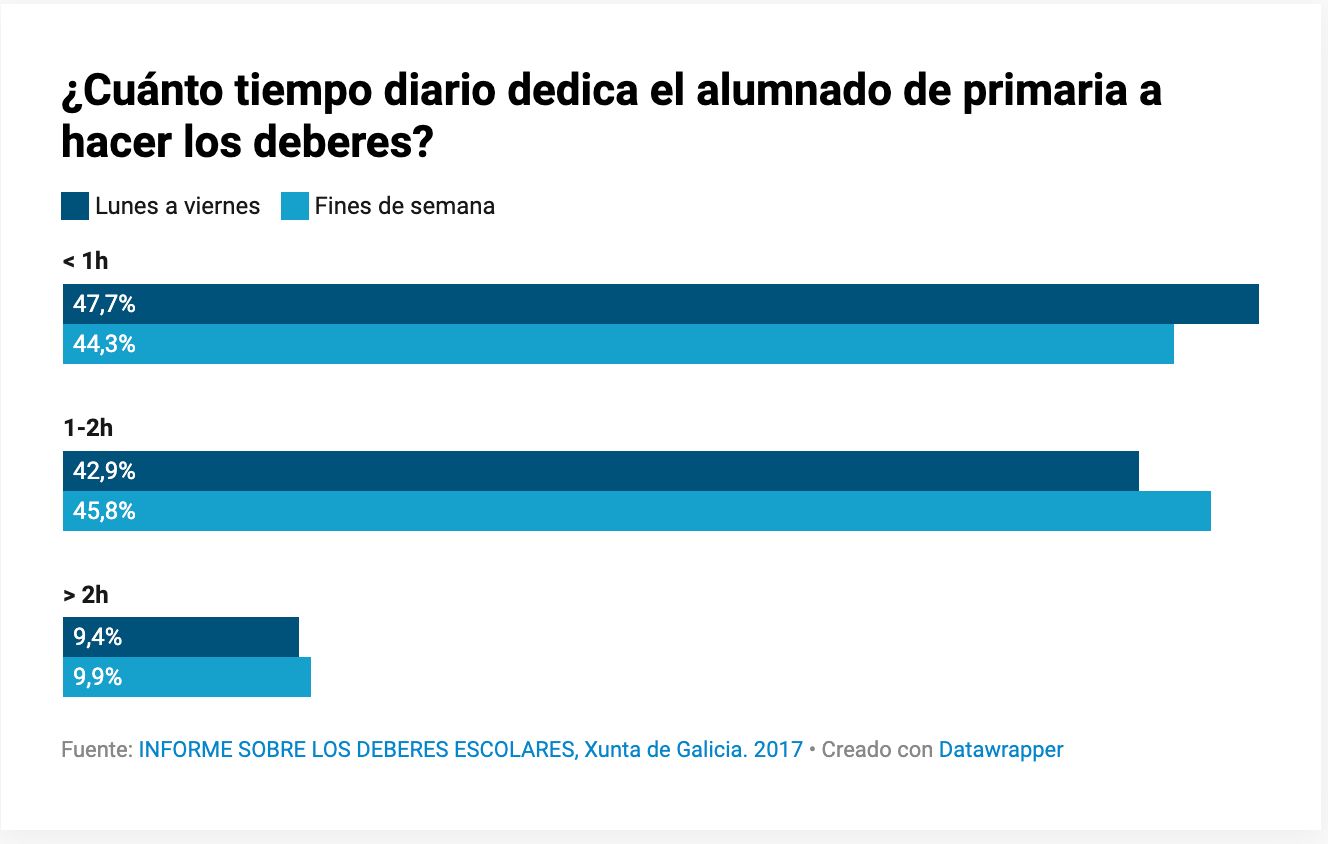
According to this report, 94% of primary school pupils surveyed say they do "all or almost all" of the homework set by their teachers. The figure drops to 80% in secondary school.
Internationally, Spain ranks slightly above the OECD average, explains Rodríguez. The average time spent on homework in Spain fell from 7.4 hours per week in 2003 to 6.5 hours in 2012 (compared to 5.9 and 4.9 hours on average in OECD countries, respectively), according to PISA data, which only has figures for 15-year-olds. Although assigning homework is an almost universal practice, there is a lot of variation between countries, with higher figures in Italy (8.7) and Russia (9.7) and lower figures in Finland and Korea (less than 3 hours per week), according to Europa Press.
Do children who spend more time on homework achieve better academic results?
The answer is not entirely clear, although this relationship has been studied extensively. "Depending on our preferences, it is possible to find data to support the argument that homework benefits all students, or that it does not matter and should be abolished," as researcher Rubén Fernández Alonso, from the University of Oviedo, sums up in an article published in 2017.
There is ample evidence that many factors—commitment, effort, emotions, autonomy—have a greater influence on academic performance than the mere amount of time spent on homework, write Fernández and his co-author José Muñiz in a the book chapter “Homework: Facts and Fiction” of the International Handbook of Comparative Large-Scale Studies in Education (2021).
We must distinguish two variables, Fernández tells the SMC Spain. On the one hand, the time a person spends doing homework reflects their commitment and has "no correlation" with their individual academic results, he says. On the other hand, school average variables (amount of homework and frequency), which reflect the homework policy of the classroom or school, do have a positive correlation with school performance—especially frequency.
Even so, there are important nuances: an analysis of data from 40 countries in the 2003 PISA report, published by a German team in 2009, notes "a positive association between school-average homework time and mathematics achievement in almost all countries, but the size of the association decreased considerably once socioeconomic background and school track were controlled."
In general, the best results are associated with moderate amounts of daily homework, writes Fernández in the aforementioned book. The relationship between homework time and academic results is not linear, but parabolic, notes the Asturian report: "There is a point of maximum effectiveness beyond which results deteriorate."
In any case, "there is abundant evidence indicating that the 'how' is much more important than the 'how much'," write Fernández and Muñiz. A study from 2015—of which Rodríguez is a co-author—concludes that "the amount of time spent on homework was not relevant" to the mathematics and English results of children in the last three years of primary school, but rather the amount of homework completed and the optimisation of the time spent on it.
If there is evidence that homework does not improve individual performance, what can its purpose be?
"Homework should be assigned with the fundamental purpose of promoting self-regulation and autonomy in children," says Rodríguez. "Good homework can help students get to know themselves, take charge of their learning and learn to manage their time," says the educational psychologist, adding that this type of learning does not always happen during school hours.
What role should families play?
"Adults can show interest and ask: 'What homework do you have?', 'When are you going to do it?', or 'How did you do it?’," suggests Rodríguez. If a child is unable to complete a task, the adult can suggest that they write down their question to be clarified in the classroom, rather than give them the answer directly.
As far as possible, it is important for families to let children do their homework without help, say both Rodríguez and Fernández. "What longitudinal studies show is that the more parents get involved in homework, the worse the children's results are," says the researcher. It is important to note that these are observational studies that cannot determine causality: it could be that certain children receive more help from their families precisely because they have more difficulties at school, and not the other way around.
As for students with specific educational support needs and depending on their degree of difficulty, "these children often need support to do their homework," says Juan Antonio Gil Noguera, an educational counsellor who has conducted academic research on this topic at the University of Murcia. The quality of the families' support is more important than the number of hours they devote to it, says the professional: "What aspects do we need to work on? Self-regulation, organisation of work? That's where the family has to have an impact," he states.
What criteria should homework meet to be useful?
According to Fernández, it is essential that schools are clear about why they set homework and reflect on the volume and frequency of tasks they want to set. However, in a study by the University of Zaragoza, more than half of the the sample of teachers "acknowledges not investing much time in preparing the tasks they subsequently assign to their students, a behaviour that is most likely reflected in the students' description of [these] tasks, pointing out that they are repetitive and unmotivating".
Synthesising the available evidence, GIPED developed the Homework Implementation Method (MITCA, in Spanish) and studied its effects on approximately 500 children in 5th and 6th grade classrooms. The studies concluded that the method improved students' time management and increase their emotional and behavioural engagement.
These are the five qualities defined by MITCA for homework to be useful:
-
Diverse: different types of tasks.
-
Specific: tasks are described by the mental work they involve and the content they address. Better to say: "solve the subtraction exercise" than: "finish exercise 3 on page 22".
-
Valuable: the teacher explains what the task is for. Will it be similar to the exam? Will the output be displayed at school? Does it help to apply a concept from one area to another?
-
Weekly: On this point, Rodríguez and Fernández disagree. "Based on our research, it is better to have fewer, more frequent assignments," says Fernández. But Rodríguez points out that "if we want schoolwork to become a tool that contributes to autonomy [... ] giving them the opportunity to plan their schoolwork at home has undeniable potential.
-
Corrected weekly, in the classroom or individually, highlighting strengths and weaknesses.
It is also important to pay attention to the characteristics of students with specific educational support needs, recommends an article published by GIPED last year, referring to " designing tasks that encourage their motivation [...] towards learning." "However, [these pupils] fail to understand the purpose of the tasks their teachers set them, although they acknowledge a modest effort on their part to adapt the amount of work assigned to them," says the study, based on interviews with seven Year 5 pupils with these special needs.
What are the problems associated with homework?
-
Homework can perpetuate socio-economic inequalities.
Yes, homework can "reinforce socio-economic disparities in student achievement," according to a 2014 OECD report which refers to data on 15-year-olds. Students with socio-economic advantages and those who attend schools with socio-economic advantages tend to spend more time doing homework, according to the report.
"The widespread idea that parents from the working-class are less involved is contradicted by recent data," notes a French study published in 2024. The study cites factors that do contribute to inequalities directly — such as the home environment — and indirectly — such as the family's cultural and digital capital. "To reduce inequalities, rather than eliminating homework, it seems more promising to train and raise teachers’ awareness about the existence of material and cultural conditions that vary according to the social background of the children," the authors recommend.
-
Homework can accentuate educational inequalities.
Schools that assign more homework tend to show greater differences in their students' results, according to the study by Fernández and his colleagues cited above. "If I assign a lot of homework, but there are students who don't do it, the loss of learning opportunities compared to their peers who know or are able to do it will be greater the heavier the homework load," explains Fernández. To combine quality and equity, it is therefore important to assign the right amount of homework that the vast majority of students—and not just the most competent ones—can do in a reasonable amount of time, adds the researcher.
-
Doing homework takes away time for rest, play or family life.
Some researchers have raised this issue for years. For example, this study from 2024 warns that spending a lot of time on homework, extra lessons and other "enrichment activities" does not improve children's cognitive skills and can take away from their time to sleep, play and socialise. Another study from Hong Kong in 2022 concludes that incorporating homework-free periods improved attitudes towards homework and enhanced academic competence, autonomy and planning skills.
-
Homework causes stress and conflict at home.
This is true, especially in families whose children have poorer academic results. As summarised in a study by the University of Murcia, "it has been observed that homework causes emotional strain on the family in relation to study factors (discomfort, exhaustion, academic inability, conflict and time) and that these are significantly linked to academic performance."
These problems are exacerbated in the case of ACNEAE, explains Gil Noguera, one of the authors of the latter article. "Specific educational support needs are associated with higher levels of stress caused by the mismatch between homework and their abilities," he says in another study, focused on the lockdown period. The article adds that families with children with these needs "find schoolwork more difficult and lengthy, perceive fewer benefits, perceive their children as less capable of performing it, and consider it more of an obstacle to the parent-child relationship."
Are there specific homework regulations?
There are no national regulations on this matter; homework policies are usually the responsibility of each school. The few attempts to establish rules by the authorities "are not always based on evidence," says Rodríguez.
At the regional level, the Law 26/2018, of 21 December, of the Generalitat Valenciana, whose Article 69 aims to protect children's leisure time. "Efforts shall be made to ensure that most of the scheduled learning activities can be carried out during the school day, so that those that have to be carried out outside of it do not undermine the students' right to leisure, sport and participation in social and family life," the law says.
There is also this circular from Asturias. Among other criteria, it requires that tasks be designed "so that students can complete them independently," be accessible to all students "regardless of their personal and social circumstances," and warns that "an excessive amount of homework can lead to increased educational inequality."
Some countries have more stringent rules. In France, for example, a 2013 law mentions the "formal prohibition of written homework for primary school pupils", reaffirming a 1956 circular. A current government web page clarifies that "homework can be oral tasks (e.g., reading or research) or lessons to be learned," but this rule is not always applied in practice.