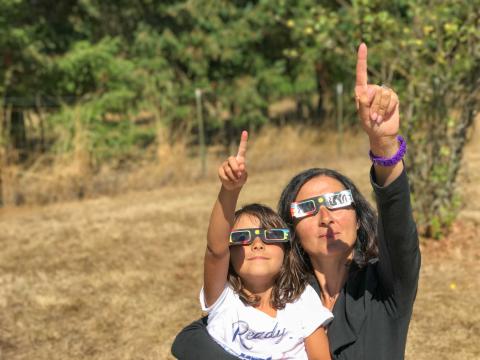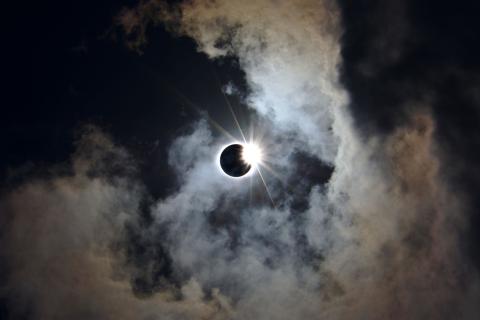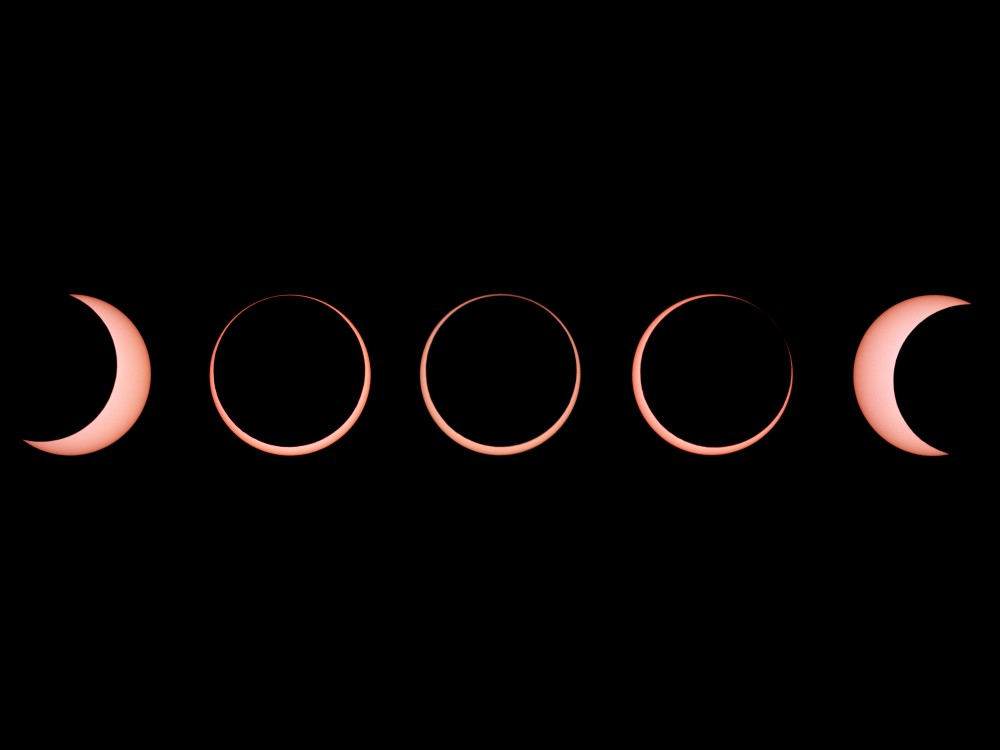
If someone were to ask us why an eclipse occurs, how would we respond? Educational research has been asking this question for decades, and the findings are surprising. Misconceptions about eclipses form part of our collective intuition about the sky, a shared understanding among people of all ages and educational backgrounds.
The most widespread and persistent misconception about the Sun-Earth-Moon system is confusing the mechanism of eclipses with that of the lunar phases. A large proportion of the population believes that the phases of the Moon are due to the Earth’s shadow partially covering it throughout the month, when that mechanism actually describes a lunar eclipse, not a phase.
The belief that it is the Earth’s shadow that produces the lunar phases is a spontaneous explanation that arises naturally when we try to make sense of our everyday observations without the support of a three-dimensional reference model. The curious thing is that very young children — before anyone has formally explained anything to them — do not think this way: this idea seems to develop over time, through culture, conversations and the materials we all learn from.
Added to the confusion about the shadow are other equally well-documented misconceptions: we believe that a solar eclipse requires a full moon (when in fact it occurs during a new moon) or we get it wrong as to which body is obscuring the other.
Now, we have an unprecedented educational opportunity before us. The upcoming trio of solar eclipses in Spain (2026, 2027 and 2028) will turn our sky into the best possible laboratory for debunking misconceptions both inside and outside the classroom, explaining fundamental problems in the history of science, and sparking curiosity about what lies beyond our planet.
The pedagogical paradox: why do we struggle to explain what we have always seen?
For millennia, observing the Moon was a matter of survival. Before the advent of satellites and atomic clocks, humanity lived to the rhythm of a silvery metronome. Recording its appearance enabled the creation of the first lunar calendars, essential tools for predicting the changing seasons. For a human group 30,000 years ago, anticipating the arrival of winter was no trivial matter; it was the critical signal for finding shelter and securing food supplies.
But the Moon did not merely govern the calendar; it also shaped the map of the environment’s resources. Our ancestors learnt that the full moon provided the visibility needed for night-time hunts with the highest success rates, whilst tracking the cycle helped identify the optimal times for gathering. Even personal safety depended on this celestial ‘lantern’: predicting periods of the new moon — total darkness — was vital for protecting oneself from nocturnal predators and avoiding travel across dangerous terrain where the slightest misstep could be fatal.
This curiosity about the sky seems to have left physical traces, such as the famous Blanchard Bone (dating back some 38,000 years), whose notches change shape with astonishing precision and have been interpreted as the phases of the Moon. These are not mere decorations; they are evidence that humans were already attempting to model the cosmos in order to organise time and make predictions.
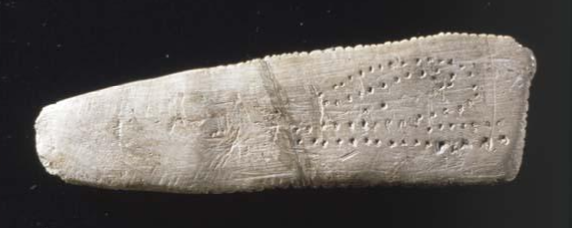
If we have been gazing at the Moon for so long, why is it that today, in the midst of the technological age, we are still so confused about it?
The reason is that the Sun-Earth-Moon system is three-dimensional, dynamic and impossible to grasp on a real-world scale from our limited vantage point on the Earth’s surface. When attempting to translate this cosmic dance into our world, we face three conceptual obstacles that often go unnoticed.
1. The trap of two-dimensionality
Most educational resources depict the Sun-Earth-Moon system using two-dimensional diagrams in which sizes and distances are completely out of scale.
This visual simplification is not harmless: by showing the Earth and the Moon very close together and sharing the same plane on the page, the brain mistakenly assumes that the Earth’s shadow is a massive obstacle that the Moon repeatedly passes through. It is this flat representation that fuels the persistent idea that the phases are nothing more than constant partial eclipses.
Without a model that respects the actual proportions, it is impossible to visualise that the Earth’s shadow is, in reality, an extremely subtle and elongated cone in the vastness of space, which rarely intersects the Moon’s body.
2. The shift in perspective, from the outside and from the inside
There is a profound disconnect between the geocentric perspective (empirical observation from the Earth’s surface of a waxing and waning Moon) and the spatial perspective (the interaction of three spheres within a dynamic system).
Traditionally, teaching jumps from one to the other without clear bridges. We are required to understand the phases through a framework ‘from outside’ the system, whilst our actual experience is ‘from within’. Reconciling both points of view requires a high degree of abstraction. Without activities that force a change in the point of observation — moving from what the eye records on Earth to what an external observer in space would see — knowledge remains purely rote, failing to become a functional understanding.
3. The 5 forgotten degrees that complete the puzzle
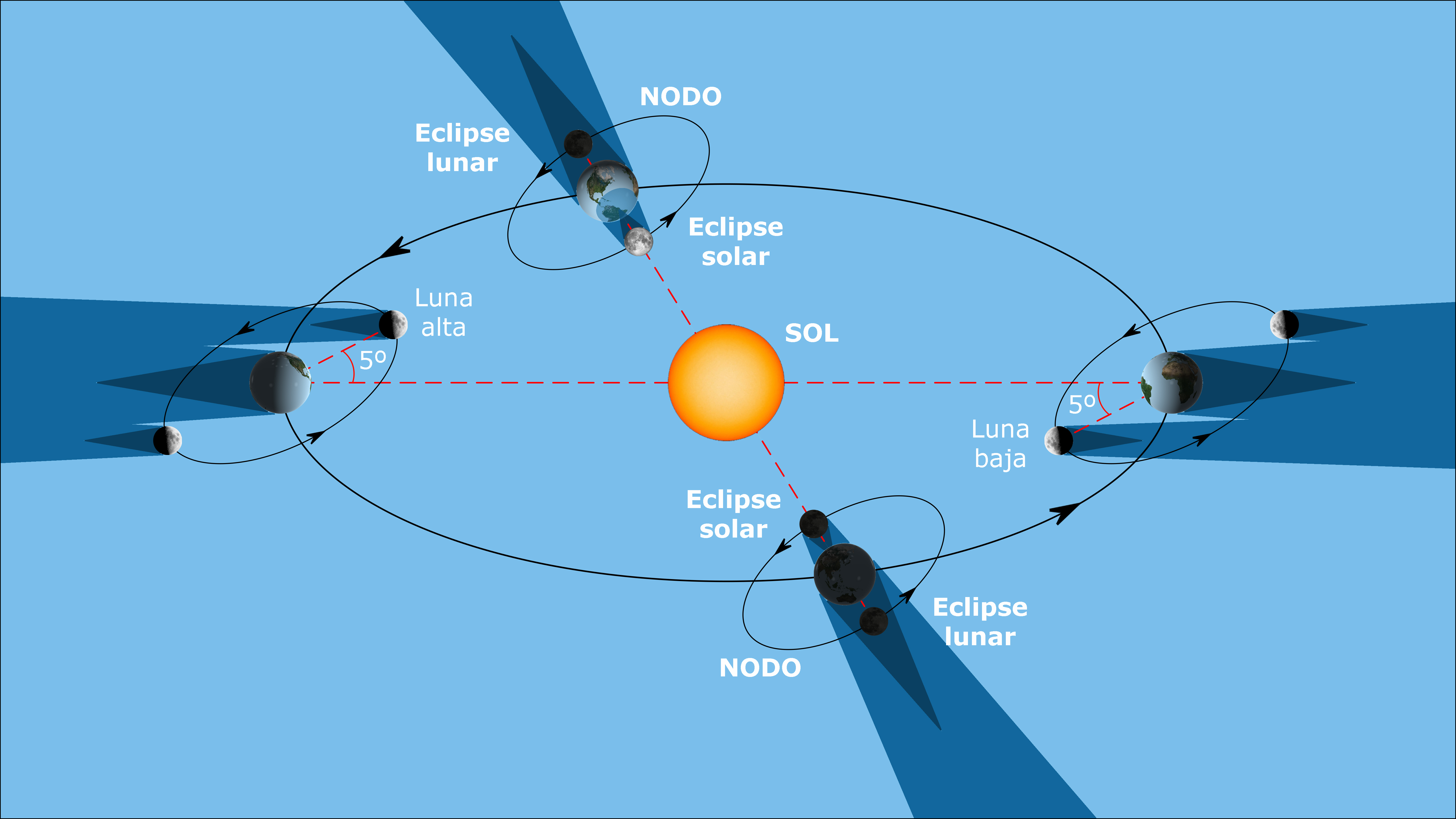
This is the key obstacle to understanding the frequency of eclipses. In most mental models, it is assumed that the Moon orbits in the same plane in which the Earth revolves around the Sun (the ecliptic). Under that premise, perfect alignment would be inevitable: a solar eclipse at every new moon and a lunar eclipse at every full moon.
By systematically overlooking the fact that the Moon’s orbit is inclined by about 5° relative to the Earth’s, we are depriving ourselves of the key piece that resolves the conflict. Understanding that most of the time the Moon passes above or below the shadow cone is what allows us to move from interpreting the event as something fortuitous to the logic of celestial mechanics.
To overcome these obstacles, we have designed two interconnected proposals, based on the problem-based or guided inquiry teaching methodology. These proposals invite students to immerse themselves in the scientific method to understand the geometry of the sky through two major fundamental problems.
First question: why doesn’t the Moon always look the same?
The challenge lies in constructing an explanatory model of the lunar phases to answer a fundamental question in celestial mechanics: what must be the arrangement and relative motion of the Sun-Earth-Moon system for the appearance of the lunar disc to vary before our eyes in the way that it does?
The first step is to record the Moon’s various appearances and check whether they repeat cyclically; we will then look for a model that explains the observed phases and their periodicity.
- How can we determine whether there are regularities in the Moon’s appearance? To do this, we must record its appearance over an extended period and analyse the data using graphs that reveal whether a cyclical pattern exists. In this phase, we will use the free virtual simulator Stellarium, which makes it easier to obtain accurate data, saving the time that direct observation over several months would entail.
- How can we explain the different phases in which we see the Moon? The first step is to analyse how the Earth and the Moon appear illuminated from space; to dispel the misconception about the Earth’s shadow. Upon noting that the Sun always illuminates exactly half of the lunar sphere, regardless of its position, a fundamental fact emerges: if the illuminated half remains constant but our perception changes, it is because the Moon is moving relative to us.
We can design a spatial model of the Sun-Earth-Moon system that not only explains the current phases but also allows us to make predictions about how we will see the Moon from any point in its orbit. We will thus realise that the change in shape is, in reality, a change in perspective: what we see depends on our Earthly vantage point relative to the illuminated part of the Moon.
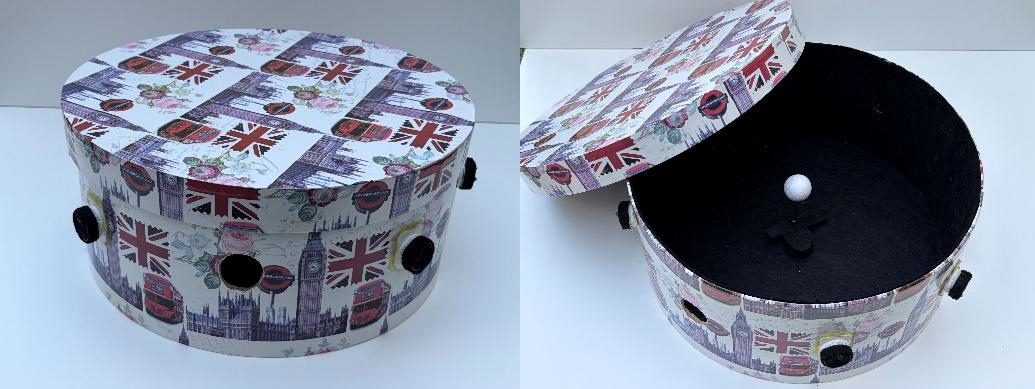
This can be done using physical models, such as this Moon box, to observe the lunar phases depending on the orbital position. You can make your own with this tutorial.
Second question: how do solar and lunar eclipses occur?
According to the Sun-Earth-Moon model we have constructed, the three celestial bodies appear to line up every month during the new moon and the full moon. This raises a new cognitive dilemma: if this is the case, why do we not see two eclipses in every lunar cycle?
We will divide the study into two parts: on the one hand, we will investigate the geometric conditions necessary for a solar eclipse to occur (in this video, we simulate it) and, on the other, we will analyse the spatial arrangement that gives rise to a lunar eclipse (here is another video to recreate it).
The challenge now is to position these three bodies in space in such a way that the model not only explains the alignment, but also its exceptional nature.
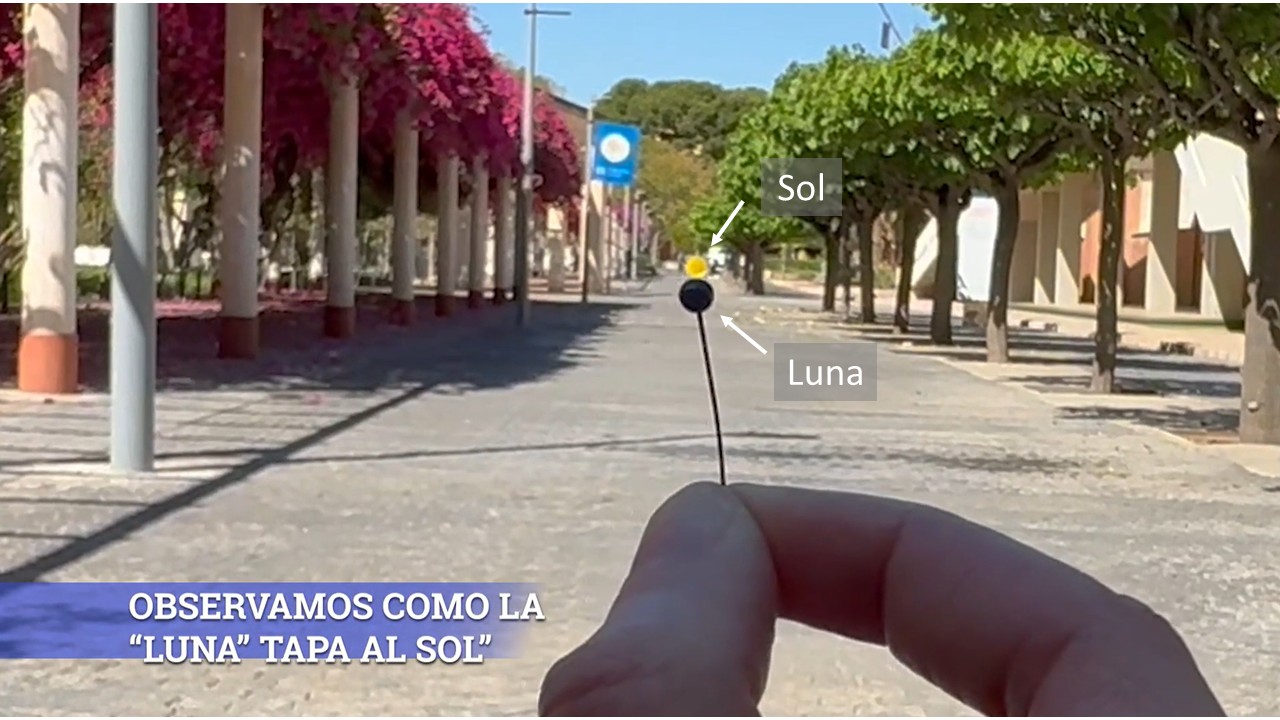
In the case of a solar eclipse, a new physical dilemma arises: how is it possible that the Moon, being minuscule in comparison to the Sun, is capable of completely obscuring it? We need to consider the actual dimensions of the system, its apparent size and the distances between them. By using scale-model analogue simulators, we can visualise why these two bodies, so different in size, can fit together perfectly before our eyes.
Once the scale has been understood, the next step is to give the model its geometry. We will investigate the different types of eclipses to find a physical explanation that accounts for their differences. Using spatial scenarios, we will recreate the positions the Moon must occupy for each phenomenon to occur, moving from a two-dimensional understanding to a spatial interaction of bodies and shadows.
However, the definitive breakthrough in the model comes when we test the frequency conflict: why aren’t there eclipses every month?
In NASA’s real-data tables (those for lunar eclipses, those for solar eclipses) we can discover the exceptional nature of these events, which highlights that the two-dimensional model is insufficient. We must integrate a new variable that sheds light on the Moon’s actual movement: its culmination.
By analysing data from the US Naval Observatory (USNO), we plot the angular height of the Moon (culmination) during new and full moon phases over the course of a year relative to the plane of the ecliptic. At this point, the model becomes three-dimensional and complete: we discover that the Moon’s orbit is inclined by about 5 degrees.
This piece of the puzzle solves the problem: an eclipse only occurs when the Moon crosses the ecliptic (at the nodes) whilst coinciding with a full or new moon. The rest of the time, the Moon simply passes above or below the perfect alignment.
As we have seen, the key to genuine scientific literacy does not lie in providing definitive answers, but in the art of asking the right questions. Science is not about accumulating data, but about constructing models that allow us to understand and predict nature. Through this approach to problem-based learning, we cease to be passive spectators of diagrams in textbooks and become researchers who rediscover the three-dimensionality of the cosmos. By confronting our own intuitions with physical evidence and astronomical data, learning becomes deep, critical and, above all, lasting.
We invite the entire educational community to download this teaching proposal along with the rest of the resources and audiovisual materials. These include videos and tutorials designed to facilitate the construction of models and prototypes that enable that fundamental leap from two-dimensional to three-dimensional vision. These proposals are living tools: they are constantly evolving and adapting, drawing on the results and advances of current educational research.