When will the eclipses take place?
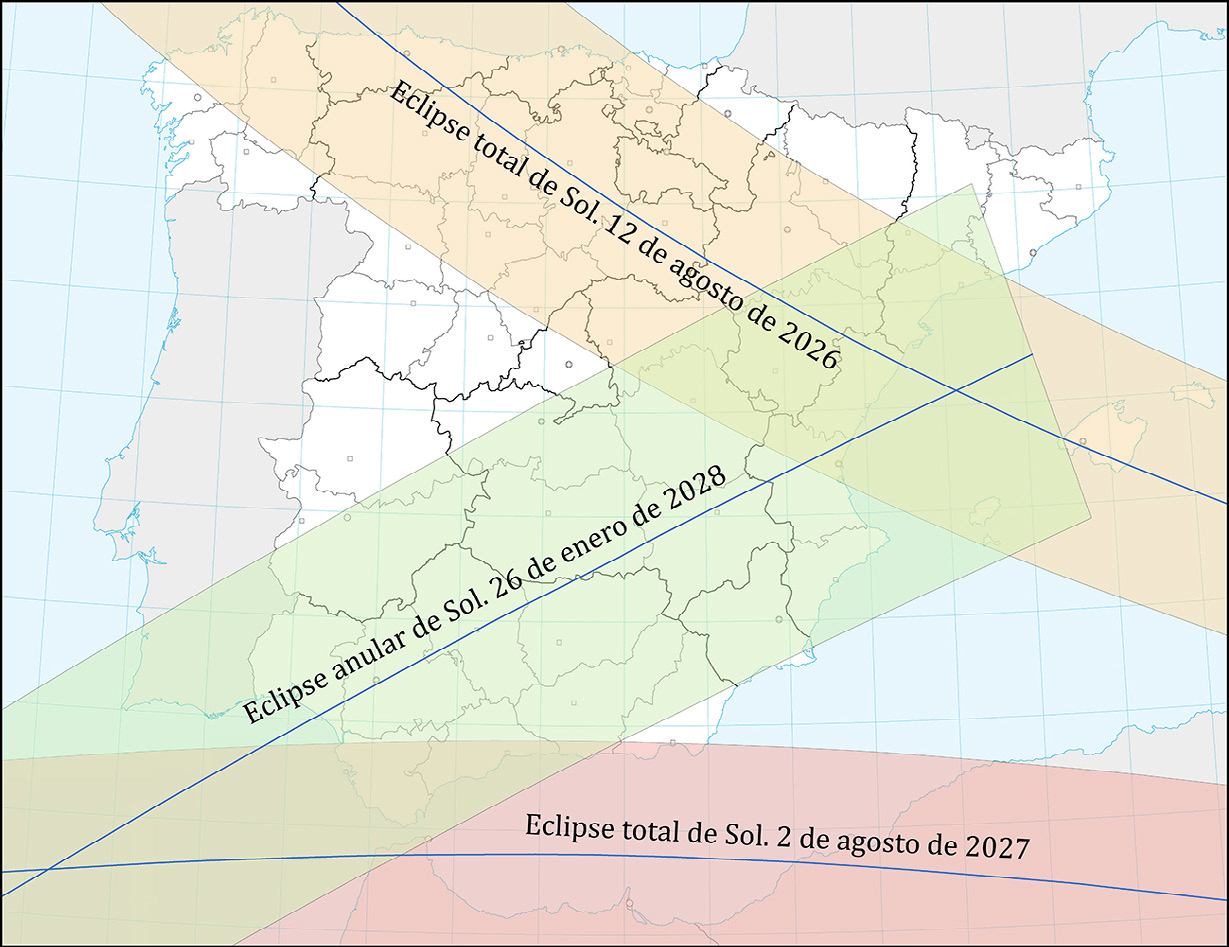
The first total solar eclipse visible in Spain in over a century will occur on August 12, 2026. The so-called “path of totality” will cross Spain from west to east and pass through numerous provincial capitals from A Coruña to Palma de Mallorca, including León, Bilbao, Zaragoza, and Valencia. As explained in a special feature on the website of the National Geographic Institute (IGN), our country is located at the end of the path of totality, so the eclipse will occur when the Sun is setting very close to the horizon, making it advisable to observe the eclipse from a location with good visibility to the west.
The first place where it will be visible will be Galicia. In A Coruña, the eclipse will begin at 7:31 p.m., reach its maximum at 8:28 p.m., and end at 9:22 p.m., a few minutes before sunset, with a total duration of 76 seconds. With the three eclipses, the IGN has developed a search engine by provincial capitals, by municipalities, and a viewer to find out when and how they will be seen.
On August 2, 2027, another total eclipse will cross Spain. The path of totality will cross the Strait of Gibraltar from west to east and cover the southern tip of the peninsula and North África, including cities such as Cádiz, Málaga, Ceuta, and Melilla. The maximum duration of totality in our country will occur in Ceuta, where it will take place between 10:45 a.m. and 10:50 a.m., with a total duration of 4 minutes and 48 seconds.
Finally, on January 26, 2028, there will be an annular eclipse whose path of annularity will cross the peninsula from southwest to northeast just before sunset, including cities such as Seville, Málaga, Murcia, and Valencia, where the annular phase will be seen in its entirety. In Palma de Mallorca and Barcelona, only the beginning of the annular phase will be visible, as the Sun will set before it ends. Due to the low elevation of the Sun above the horizon, observation of this eclipse will require excellent visibility in the direction of the sunset. In Seville, it will begin at 5:34 p.m. and will have a total duration of 153 minutes.
What types of eclipses are there?
First of all, it is important to understand what an eclipse is: a phenomenon whereby the Sun's light is totally or partially obscured when a celestial body comes between the Sun and the observer. In solar eclipses seen from Earth, the celestial body obscuring the Sun is the Moon.
From the observer's point of view, solar eclipses are classified as total, annular, or partial. A person will say they have seen a total eclipse when they observe the Moon completely covering the Sun's disk. However, another person located hundreds of kilometers further north or south will see the Moon covering only part of the Sun, so for them the eclipse will be partial. There are times when the Moon does not completely cover the Sun from any point on Earth, so for all observers the eclipse is partial.
Another type of eclipse is an annular eclipse. These occur when a person sees that the Moon's disk does not completely cover the Sun's disk, even though their centers are well aligned. This is because the Moon is farther from Earth on that day than in the case of a total eclipse, so its disk appears smaller than the Sun's. In this case, a bright ring surrounding the lunar disk can be seen.
Why are they so special for Spain?
Although it is common to observe a partial solar eclipse every few years from the same location, witnessing a total or annular eclipse is not the same. In Spain, the last visible annular eclipse occurred in 2005, and the last total eclipse was seen in 1959, and only from the Canary Islands. A total solar eclipse has not been seen from the Iberian Peninsula since 1912.
Where can I find expert sources to report on this phenomenon?
On the map below, you can locate the museums, planetariums, research centers, and astronomy groups that have informed us that they have experts on eclipses.
Journalists registered with SMC Spain have access to the contact details provided to us by the centers. If you are a journalist and are not registered, you can do so here, and we will provide you with the details once we have validated your registration.
If you are an eclipse expert and would like us to add your center, please write to us at info@sciencemedia.es.
Official website of the Spanish Government's trio of eclipses
Scientific and Advisory Committee of the Trio of Eclipses (CCATE)
Centers with eclipse experts without a physical location:
- Magallanes Astronomy Group of Jerez
- Rías Baixas Astronomy Association (Vigo)
- Association for the Teaching of Astronomy
- Astrodemanda (Sierra de la Demanda Astronomy Association)
- Creative Cosmos
- Ávila Astronomy Observers Group