Institute of Astrophysics of Andalusia (IAA-CSIC)
If you are the contact person for this centre and you wish to make any changes, please contact us.
EMERGIA post-doctoral research in the Sky Quality Office
Research Professor at the IAA-CSIC (Granada) and co-principal investigator of the SO/PHI instrument on board Solar Orbiter
Astrophysicist at the Instituto de Astrofísica de Andalucía (IAA-CSIC)
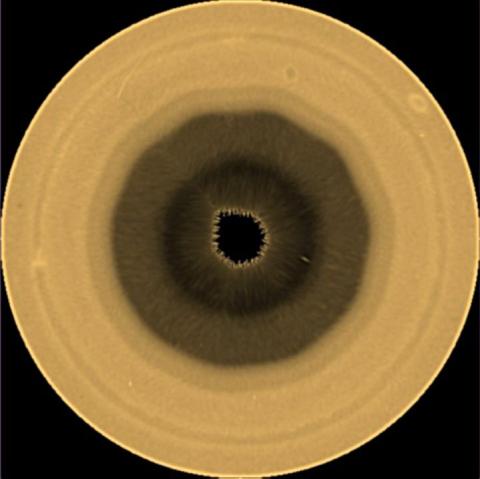
Thanks to the Voyager probe, we know that Saturn has a long-lasting hexagonal wave at its north pole, which is linked to a powerful jet of matter and energy. Now, a team led by the University of the Basque Country has discovered, for the first time, the presence of a decagonal wave at the south pole. The observations, carried out from the ground and using the Hubble Space Telescope, show that the decagon appears to have formed between 2023 and 2025 and may continue to evolve, in contrast to the more than 40 years of stability exhibited by the hexagon. The research is published in Science Advances and suggests that the ten-sided shape could be a meandering wave trapped by the curvature of a dominant atmospheric current.
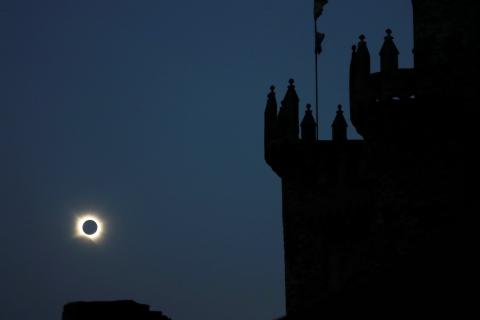
We hadn’t seen a total solar eclipse on the Iberian Peninsula since 1912, and this Wednesday, just before sunset, the celestial bodies aligned once more. That perfect cosmic dance between the Sun, the Moon and the Earth could be seen from numerous regions across Spain. Among the millions of people who observed the phenomenon in Spain, eclipse experts share their impressions with SMC Spain.
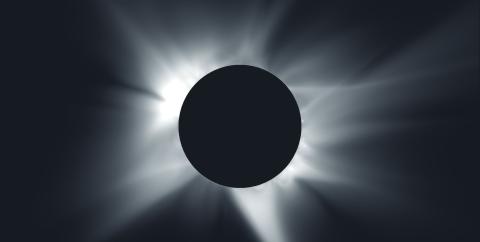
There are just a few days to go until 12 August, when we’ll be able to enjoy the first of the three eclipses we’ll see in Spain. This is a total solar eclipse — the Moon will completely cover the Sun’s disc — something not seen on the Iberian Peninsula since 1912. Experts from different regions of Spain with extensive experience in observing eclipses offer their recommendations. Choosing the right viewing spot, using approved eclipse glasses, coping with the heat and respecting the natural environment are key to observing the eclipse safely and enjoying the experience.
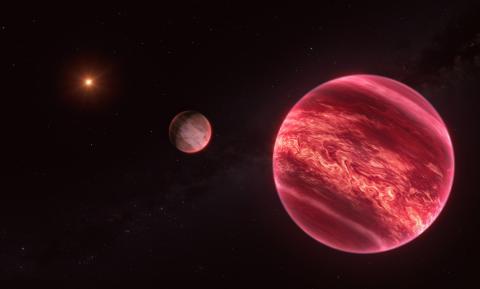
To date, more than 6,000 exoplanets — planets orbiting a star other than the Sun — have been discovered, but no moon outside the Solar System — known as an exomoon — has ever been definitively identified. Now, a study published in Nature presents evidence of what could be an exomoon orbiting a brown dwarf — an object halfway between a star and a planet. By analysing radial velocity data from observations made by the European Southern Observatory’s (ESO) Very Large Telescope, a team has identified a signal indicating the presence of a satellite with a minimum mass of 0.9 times that of Jupiter and an orbital period of around 170 days. “Although it is unclear whether this exosatellite will meet the criteria—yet to be defined—for being considered an exomoon, it represents an important step towards that first indisputable detection,” the authors state.
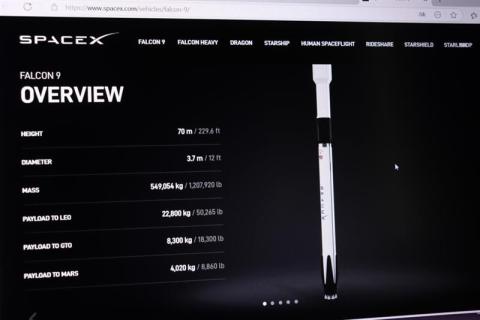
In February 2025, lithium concentrations suddenly increased around 96 km above sea level some 20 hours after a SpaceX Falcon 9 launch vehicle re-entered the atmosphere. This is the first direct detection of pollution in the upper atmosphere due to the re-entry of a spacecraft, according to a study published in Communications Earth & Environment. Lithium is used in spacecraft components, but it is only found naturally at these altitudes in trace amounts, and its accumulation could have consequences on the climate.

The rapid growth of satellite constellations threatens the operation of space telescopes, according to a study published in Nature. If the planned launches are completed, the Hubble Space Telescope could see more than a third of its images affected by light pollution from these satellites, as they share the same orbital space, while other telescopes would have more than 96% of their images damaged, the authors estimate.
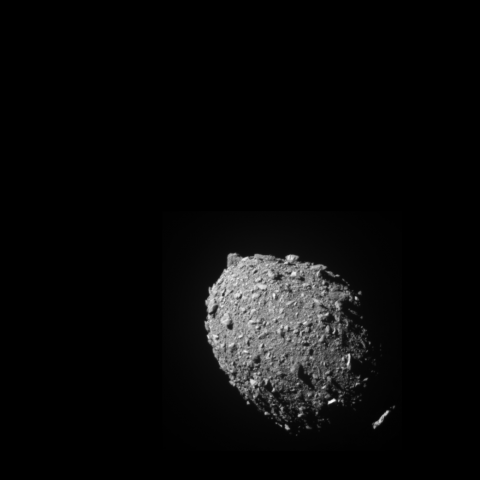
As planned, the DART (Double Asteroid Redirect Test) mission has hit the asteroid Dimorphos, which orbits a larger asteroid, Didymos. Neither is a threat to Earth. This is the first planetary defence test mission designed to change the orbit of an asteroid, launched by NASA and the Johns Hopkins APL laboratory, with Spanish participation. Scientific teams will study with ground-based telescopes how much the orbit of Dimorphos will change around Didymos after the collision.
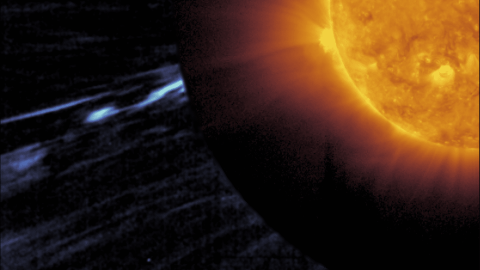
The ESA/NASA Solar Orbiter mission may have made the first direct observation of what are known as magnetic switchbacks on the Sun. The phenomenon, which consists of S-shaped disturbances that cause sudden reversals of its magnetic field, had been identified by different space probes since the 1970s, but its explanation had only been described theoretically. The finding is published in The Astrophysical Journal Letters.