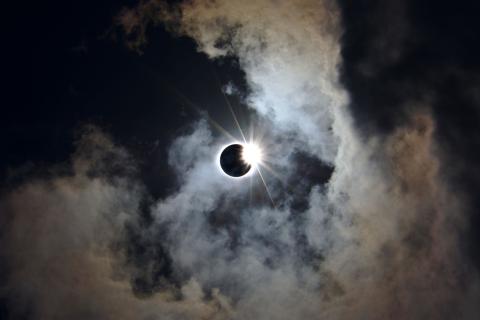
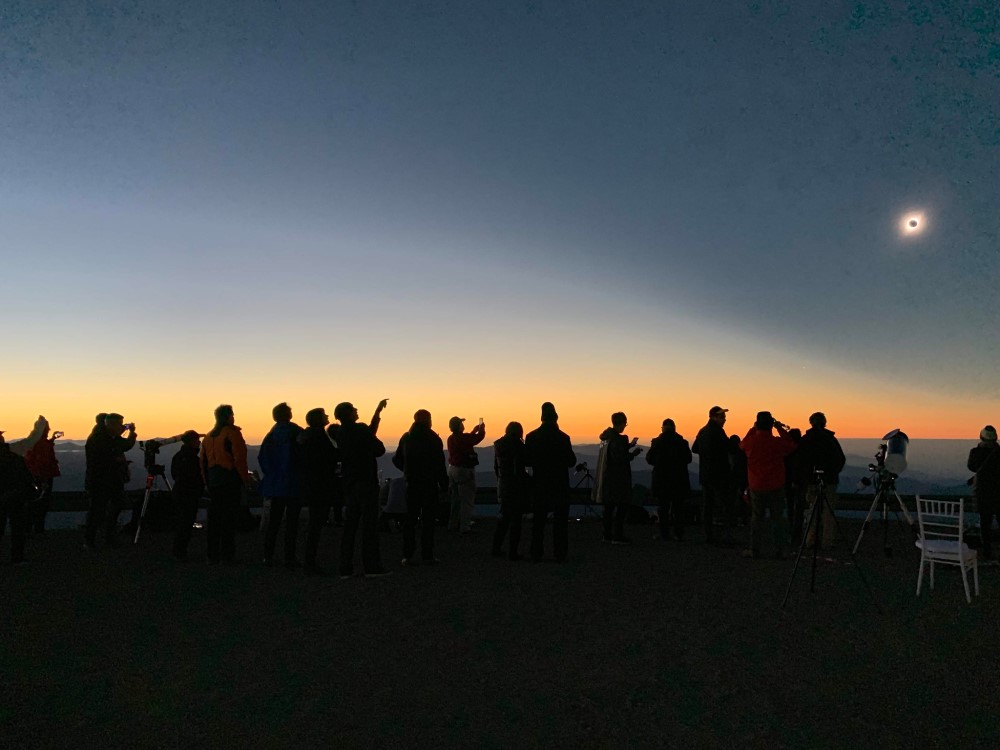
 A total solar eclipse was visible from Cerro Pachón on July 2, 2019. B Blum/NSF/AURA
The total solar eclipse on 12 August will be visible almost exclusively from Spain, with the path of totality crossing the northern part of the peninsula from west to east. Millions of visitors are expected to converge along this corridor to witness the event. The anticipated influx of people has prompted the authorities to take special measures, most notably the Ministry of the Interior’s Special Security Plan, which includes guidance and recommendations for the public.
Get ready for the crowds
Large gatherings of people, and the challenges that come with them, are among the main risks being considered for this eclipse. In some cases, overcrowding will be unavoidable. Added to this is the excitement surrounding an event that will last only a few minutes and the high temperatures expected in many regions, both of which could heighten tensions within the crowds.
Staying calm is key to avoiding panic. Enter and leave the observation area in an orderly manner and without rushing. It is also a good idea to familiarise yourself with the evacuation plans.
Communication networks are likely to become overloaded, making it more difficult to stay in touch and meet up with others. Agreeing on designated meeting points in advance will make it much easier to locate companions if mobile phones stop working. Particular attention should be paid to older people, children and those with disabilities, who may become disoriented more easily. It is also advisable to bring an FM radio so that you can stay informed if other communication channels are unavailable.
The large number of visitors is also expected to put pressure on local supplies, a concern highlighted by Spain’s Civil Protection agency. The advice is to obtain essential items in advance, from food and water to eclipse glasses, while avoiding excessive stockpiling that could lead to shortages for others.
Enjoy the eclipse locally
Heavy traffic is expected before and after the eclipse, with hours of delays on major and minor roads.
“The key message is that, if possible, people should avoid travelling to see the eclipse. If travel is necessary, they should plan their journey carefully and follow the recommendations outlined on the website [of the Interministerial Commission for the Eclipse Trilogy],” Civil Protection told SMC Spain.
Such commission, coordinated by the Ministry of Science, Innovation and Universities (MICIU), also encourages residents living within the path of totality to watch the eclipse from their local area or from home. Doing so, it notes, not only helps strengthen their connection to the region, but also allows them to enjoy the event in a safe and relaxed way, while reducing many of the risks outlined above.
Otra opción para evitar desplazamientos es seguir la retransmisión del fenómeno. La Agencia Espacial Europea (ESA, por sus siglas en inglés) lo hará desde el Observatorio Astrofísico de Javalambre, en Teruel, a través de sus canales de YouTube y de Televisión.
Another way to avoid travelling is to follow a live broadcast of the eclipse. The European Space Agency (ESA) will be streaming the event from the Javalambre Astrophysical Observatory in Teruel via its YouTube and television channels.
Plan your journey
If travelling is unavoidable, and according to Civil Protection, it is advisable planning your route and schedule well in advance. Ideally, you should already be at your chosen viewing location on the day of the eclipse and avoid unnecessary journeys. However, if you do find yourself stuck in a traffic jam, make sure your fuel tank is full and that you have water and food with you.
The MICIU, in collaboration with the Spanish Foundation for Science and Technology (FECYT), has made an online viewing tool available to the public. The application allows users to determine the Sun’s exact position and identify suitable viewing locations ahead of time.
Planificar la movilidad ayudará a disfrutar el evento. La observación del eclipse desde lugares improvisados provocó incidentes y riesgos viales en eventos pasados, según informa la Comisión Interministerial para el Trío de Eclipses. Se recomienda estacionar solo en áreas habilitadas para no comprometer la seguridad propia ni la de otros conductores. Es importante extremar la precaución durante la conducción y seguir las indicaciones de los agentes de movilidad.
Careful travel planning will help ensure a more enjoyable experience. According to the Interministerial Commission for the Trio of Eclipses, viewing the eclipse from improvised roadside locations has led to incidents and road-safety risks during past events. Visitors are advised to park only in designated areas and to avoid compromising their own safety or that of other road users. Extra care should be taken while driving, and all instructions from traffic and emergency personnel should be followed.
Many journeys will be made on rural roads or between poorly connected locations, which should be avoided wherever possible. There are official points set up to manage high volumes of traffic and changing weather conditions.
“The recommend locations are easily accessible and have basic facilities such as toilets, water, parking areas and mobile phone coverage,” says Begoña Nicolás, assistant professor in the Astronomy and Astrophysics Section of the Department of Applied Mathematics at the University of Santiago de Compostela. A list of locations recommended by the authorities is available on the Trio of Eclipses website.
Booking accommodation and activities
With high hotel occupancy rates in key regions, coupled with limited accommodation capacity in some of them, anyone who has not yet booked accommodation may find themselves in a difficult situation. The situation is particularly challenging in rural areas. According to the report “The Iberian Trio: an opportunity for tourism development in inland Spain”, produced by Analistas Financieros Internacionales (AFI) for Airbnb, 47 % of rural municipalities in the central path of the eclipse do not offer short-term rentals.
The same applies to activities organised around the eclipse, both those specifically related to astronomical observation, such as guided tours, talks or viewing sessions, and other tourist attractions in the area. Many of these have limited places and may reach full capacity well in advance.
Respect the natural and human environment
Large crowds can have a significant environmental impact if appropriate precautions are not taken.
“Highly sensitive natural areas that could be adversely affected by large numbers of visitors should be avoided out of respect for the environment itself,” says Nicolás.
Access restrictions may be imposed in protected areas across Spain, so visitors should check in advance for any locations where access is restricted or discouraged by the authorities.
For other areas, the main recommendations to minimise such impact include not leaving any rubbish behind — not even organic waste —, respecting the flora and fauna, and not trespassing on private property or farmland. Leave the countryside as clean as you would like to find it.
The same principle applies to cultural and historical heritage. You may be observing the eclipse near homes, chapels or even archaeological sites, all of which should be treated with care and respect.
Preventing wildfires
The high temperatures typical of summer significantly increase the risk of wildfires. Spanish regulations prohibit lighting fires in forested areas during this period. When wildfire risk reaches very high or extreme levels, additional restrictions may be introduced, including limits on the use of machinery or equipment capable of generating sparks and bans on activities such as barbecues or the outdoor burning of vegetation.
Furthermore, at any time of year, it is prohibited to set off fireworks, light fires outside authorised areas, throw away cigarette ends, or leave glass or other objects that could act as a magnifying glass and help ignite vegetation. It is also essential not to park vehicles in places that obstruct access for emergency and fire-fighting services.
Before travelling, visitors are advised to consult the wildfire risk maps published by Spain’s State Meteorological Agency (Aemet), which provide forecasts of fire danger levels across the country.
Festivals, parties and raves
“This eclipse marks a once-in-a-generation event for Europe, drawing people from across all borders to gather under the same sky for a shared moment of wonder,” states a festival’s website.
“Unlike most festival experiences, a total solar eclipse is not a spectacle you can revisit. It crosses the planet just once, along a narrow path, and then disappears,” reads another.
Numerous festivals, parties and raves are set to be organised around the eclipse. This is hardly surprising, given that eclipses are collective experiences meant to be enjoyed.
For this type of event, in addition to the guidelines set out in this article and in our previous piece on personal safety, it is worth adding some specific advice: on the Energy Control website you can find resources on hearing protection, as well as information on alcohol and other substance use, to protect both yourself and others.
It’s a good idea to take a break. Sitting down every now and then, eating and staying hydrated won’t take away from your enjoyment; on the contrary, it will allow you to return with your batteries recharged. Finally, check in on the people around you, look after others and ask for help if necessary. With or without an eclipse.