Einstein’s gravity observed in the quantum world
A team of researchers, including Nobel Laureate in Physics Roger Penrose, has observed for the first time an effect of gravity on a falling quantum object that had long been predicted. The result demonstrates that a fundamental principle underpinning Einstein’s theory of gravity remains consistent with the behaviour of matter in the quantum world. The study, published in the journal Science Advances, does not unify quantum mechanics and gravity, nor does it prove that gravity itself is quantum.
Emilio Elizalde - Einstein sept 2026
Emilio Elizalde
The press release summarises the study with exquisite precision. However, there are a couple of points that might have warranted greater clarity, given the importance of both the article and the journal in which it appears. In the press release, when it refers to: the pulse splitting into two, with one of the parts being pushed upwards by means of a controlled magnetic pulse, and then converted into a state “almost unaffected by the magnetic field”, so that it can fall freely under the influence of gravity. What is the residual effect here, expressed as a numerical value or a percentage? Does this affect the purported free fall?
Nor have I fully understood the sentence towards the end of the press release (towards the end of the fifth paragraph), which states that ‘this complex experiment provides new clues as to how to achieve the unification [of Einsteinian gravity and quantum physics].’ To the best of my understanding, the work carried out is strictly limited to experimentally confirming that the theoretical calculations made over the last hundred years regarding quantum modifications to the equivalence principle are correct. Perhaps it refers (although this could be explained more clearly in the press release) to the fact that further experiments, to be carried out with larger particles, might be able to explore regimes closer to the classical-quantum transition, which are much more difficult to tackle theoretically. Here, experimentation could get ahead of theory, which would be very positive.
The other point concerns the conclusions of the paper (p. 5, 2nd column, at the beginning), where it is stated that “we have confirmed the predicted phase with a high level of confidence…” One immediately wonders: how high? I believe this question probably slipped past the article’s referees.
The study is of high quality and the writing is excellent, starting with the abstract and the introduction, and ending with the conclusions. In this respect, I believe that drafting the press release must have been a fairly straightforward task. As has it been to write this response to the article. It has been extremely difficult to find any flaws.
The conclusions are supported in the paper by solid data, well established and corroborated for years, as is perfectly reflected in the publication’s bibliography. The paper fits very well with the existing theoretical evidence. This is a positive point. In any case, so as not to leave anything out, it might be worth recalling the well-known saying that, when an experiment is carried out knowing in advance what the outcome should be, it is easier to adjust the result. Let me be clear: this is a purely general observation; it in no way seeks to call into question the rigour of the experimental setup, which I consider, based on the description provided, to be very well controlled.
But it does occur to me to add the following “gedanken” scenario. Let us imagine for a moment that, with the same experimental rigour employed here, the result had diverged from the theoretical one, after having reviewed the experimental setup time and time again. What would have happened in such a case?
Finally, at first glance, it may be difficult to determine the precise real-world implications of the significant result obtained. Although, in fact, it does have implications, if only indirectly: it confirms once again, and brilliantly, that the fundamental theories of physics are firmly established. And we can immediately extend this certainty to the vast number of practical real-world applications these theories have, across a wide range of scales and levels.
The result of this work confirms that we are on solid ground, even if we stand (provided our weight does not exceed certain limits) on the slender bridge that is beginning to connect classical gravity with quantum physics.
Carlos Sabín - Einstein 2026
Carlos Sabín
Senior Lecturer Department of Theoretical Physics UAM Madrid
The principle of equivalence, as formulated by Einstein, states that the only reference frames that are truly free of forces are those in free fall. This runs counter to our intuition that, if we are at rest on the Earth’s surface, no force is acting upon us. In reality, gravity is pulling us downwards, which is counterbalanced by an opposing reaction force from the ground. That effect is cancelled out when we let ourselves fall. Therefore, the true privileged reference frames, in which the principle of relativity holds strictly (that is, the laws of physics take the same form), are those in free fall. By contrast, those at rest on Earth are accelerated systems and are therefore not equivalent. If we throw a basketball, the free-fall reference frame will measure a straight-line trajectory, as befits a trajectory at constant velocity—that is, one free of forces—whilst an accelerated reference frame will measure the curved trajectory with which we are familiar. These differences can be calculated using coordinate transformations within the framework of the theory of relativity.
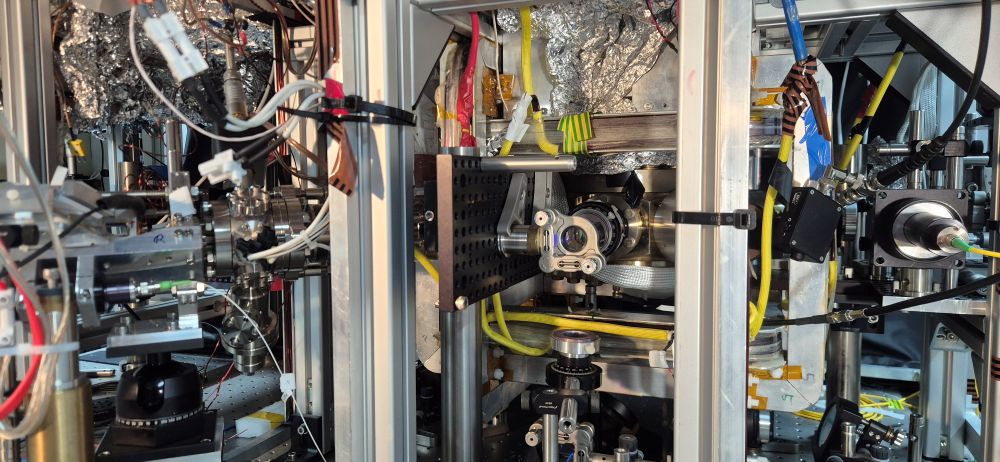
The experiment published today in Science Advances is the quantum equivalent of this idea, as it measures the differences between a reference frame in free fall and one at rest on the Earth’s surface, but carried out using physical systems governed by quantum physics—in this case, rubidium atoms cooled to ultra-low temperatures. What is significant, then, is the effect on the quantum wave function. To measure the differences between an atomic wave function in free fall and one at rest, the experiment uses an interferometer: a device that guides wave functions along different paths depending on their quantum state. Gravity in quantum systems has been observed many times in various experiments over recent decades, and on some occasions even using similar atomic interferometers. That is not what is new, however; rather, in this case, it is specifically the effect on the wave function — in other words, the phase difference — that is measured, rather than, for example, the value of the acceleration due to gravity, as in previous experiments. To achieve this, the interferometer must be modified so that, in one of its arms, gravity is counteracted by magnetic fields – the equivalent of anchoring an object to the Earth’s surface – whilst in the other arm it acts freely. The authors refer to this ingenious device as the Galileo Quantum Interferometer (QGI). The results appear to agree well with relativistic predictions based on the principle of equivalence. It is a beautiful and highly sophisticated experiment, which provides an elegant theoretical complement to the already known results on gravity in quantum systems.
Dobkowski et al.
- Peer reviewed
- Research article