A new fossil suggests that the closest ancestors of modern apes originated in North Africa rather than in the East
A newly discovered ape fossil in northern Egypt suggests that the closest ancestors of modern apes may have originated in North Africa, outside the East African regions that have traditionally been studied. Dating back between 17 and 18 million years, the new species —Masripithecus moghraensis — represents the closest known hominid relative to the lineage that ultimately gave rise to all living apes, including humans. The study is published today in the journal Science.
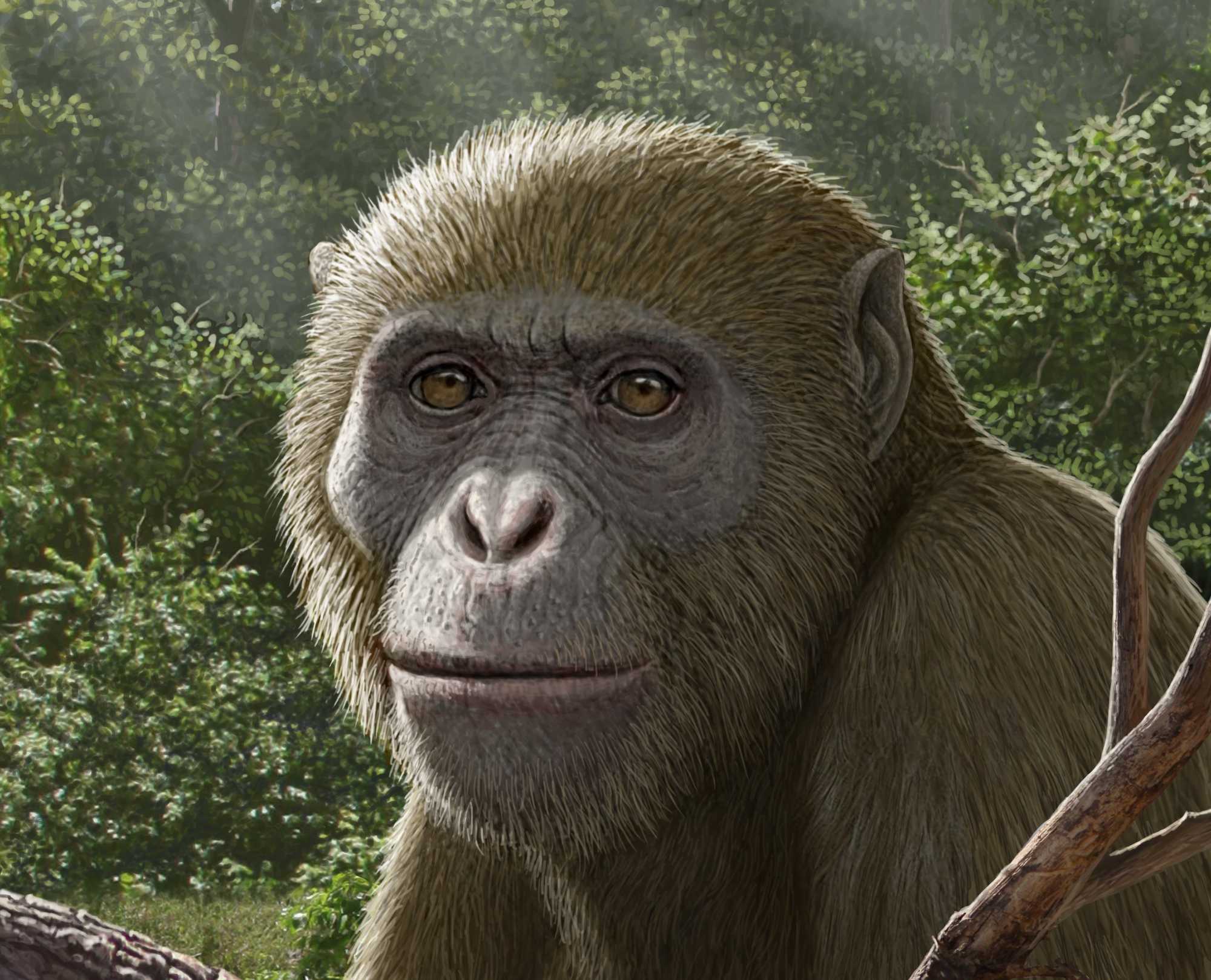
Reconstruction of Masripithecus moghraensis by Mauricio Antón. Copyrights belong to Professor Hesham Sallam.
Marta Pina - monete egipto
Marta Pina
Research Associate in Palaeoprimatology and Human Palaeontology at the Miquel Crusafont Catalan Institute of Palaeontology, Autonomous University of Barcelona
The press release accurately reflects the impact and significance of the discovery of Masripithecus moghraensis in northern Egypt. This find is of fundamental importance as it provides a robust study of the first Miocene ape discovered in North Africa, dating back between 18 and 17 million years. Thanks to the analysis of its dental and mandibular remains, new evidence is provided suggesting that the origin of crown primates may have taken place in north-eastern Afro-Arabia, an area traditionally less explored than East Africa or Eurasia.
It is true that, as the authors point out, the study has limitations because the material recovered (a jaw fragment and several teeth) does not allow for easy comparison with all the taxa of the period. However, this information is extremely valuable because it forces us to look towards new geographical regions to complete the map of our evolution. Ultimately, this study allows us to place a key piece in the evolutionary jigsaw of hominoids, serving as an essential link between the fossils of Africa and those of Eurasia.
Al-Ashqar et al.
- Research article
- Peer reviewed