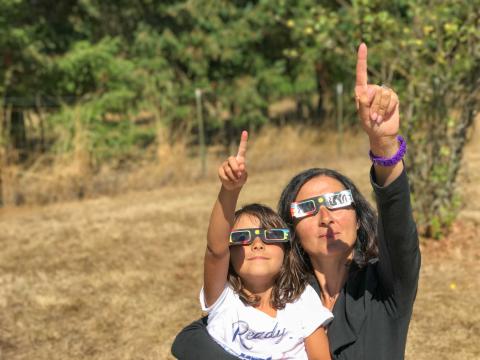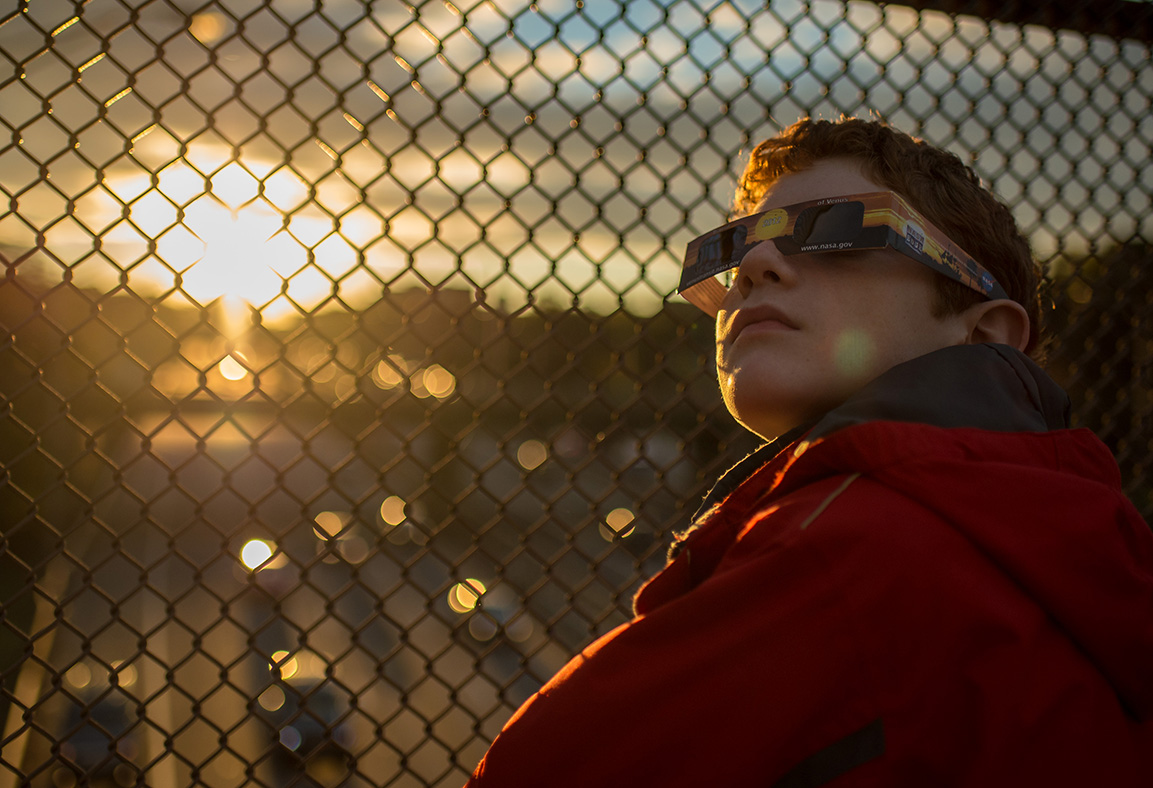
The best image of the total solar eclipse on 12 August 2026 will not be that of the solar corona silhouetted against the dark sky, nor even a sequence of how the Moon passes in front of our star, performing the magic of turning the afternoon into a unique night. The photograph that will truly capture the essence of the phenomenon will be a close-up of people with wide eyes, shouting with joy, perhaps a silent tear, and that expression of seeing something that should not be happening, but is. We will see thousands of videos with a boisterous roar that, curiously, we do not remember producing ourselves. But it is this gesture that indicates, in some way, that we had the opportunity to live an unusual and beautiful experience, which marks the human landscape of wonder.
In 2023, Dacher Keltner, a psychologist at the University of California, Berkeley, where he directs the Berkeley Social Interaction Lab, published the book AWE: The New Science of Everyday Wonder and how it Can Transform Your Life, in which he compiled nearly two decades of research on the psychology of wonder, which he describes as a powerful mechanism that moves and transforms human beings and makes them more cooperative, perhaps even better. Eclipses are a good example of this mechanism in action.
During the eclipse that crossed the United States in 2017, Twitter detected a significant increase in terms related to surprise, as well as positive attitudes and expressions related to gratitude and affection
On the occasion of the eclipse that crossed the United States in 2017, Johns Hopkins University psychologist Sean Goldy analysed posts on Twitter around 21 August, the date of the total eclipse. His study detected a significant increase in terms related to surprise, as well as positive attitudes and expressions related to gratitude and affection. The use of pronouns also changed: ‘we’ was used more than ‘I’. And people in the totality zone did so more systematically, although the effect lasted only 24 hours: the next day, everything returned to normal. Subsequent research, also gathering reactions to other eclipses, has led to the understanding that they are transformative experiences for those who witness them, as was confirmed on 8 April 2024 with another total eclipse that crossed North America.
What causes this feeling? Ramón Núñez, in his recent book Eclipses. Historia y ciencia de la ocultación extemporánea del Sol (Eclipses: History and Science of the Untimely Occultation of the Sun), reproduces various testimonies from astronomers and scientists who, over the centuries, have experienced a total eclipse, explaining how ‘it is a unique, strange, impressive and overwhelming event’. All the accounts are similar in their description of the amazement experienced as a very personal experience. Perhaps this is partly due to the fact that they are rare phenomena: the probability of seeing an eclipse from a given location on the planet during a human lifetime is less than 25%.
Eclipses for science
For years, professionals in astronomy and science communication have thought that eclipses are the perfect Trojan horse for sneaking science into classrooms and conversations. The striking nature of the phenomenon and the perfect explanation offered by astronomy to predict them accurately seems like a flawless strategy on paper: excitement attracts, rigour explains and, in the end, the public comes out ahead with a dose of scientific literacy. The massive crowds and the impact on the media and social networks of space mission launches or milestones such as a space walk correlate with greater interest in science and reinforce scientific identity and the intention to get involved in activities of this type. However, there is a gap between this intention and actual action.
An eclipse is a phenomenon that transcends the astronomical and the scientific. The laboratory that a total eclipse offers us is attractive from that point of view, but above all it excites us. Even from a naturalistic perspective, it seems that eclipses, rather than celestial mechanics, point to something higher. We must concede that the psychological experience generated when the two celestial bodies most present in human life play hide and seek for a few minutes disarms us before the majesty of the cosmos, reminding us how small we are and, paradoxically, how much we need each other, always in a social context that is not at all astronomical. And where social circumstances can completely change the experience.
Two solar eclipses in Belgrade were experienced under very different socio-political circumstances: curiosity in 1961, which was well publicised by the Yugoslav communist authorities, turned to fear in 1999, now as the capital of post-communist Serbia
This is the opinion of anthropologists Ivan Kovačević and Danijel Sinani from the University of Belgrade, who analysed two solar eclipses in Belgrade under very different socio-political circumstances: the first in 1961 and the second in 1999. Curiosity in the first case, which was well reported by the Yugoslav communist authorities, turned to fear in the second, now as the capital of post-communist Serbia; there was even panic in the streets. Socially, the eclipse is an empty signifier ready to be inscribed by the dominant narrative. And in many countries, it is still claimed, for example, that eclipses are dangerous for pregnant women. During some eclipses, the idea has even been spread that all women should stay at home, just in case.
Journalism to the rescue
That is where journalism's responsibility lies. It is not a question of inventing an artificial epic, but of organising emotion and constructing a narrative that does not betray the facts, but also does not ignore the fact that what is happening in the viewers' minds is much more than the sum of orbits and analytical mechanics. The temptation, however, is to fall into excess. It is often pointed out that the eclipse of 17 April 1912, which was quite a spectacle with millions of people watching it in Paris, was accompanied by enormous interest from the media of the time, so much so that it overshadowed the news of the sinking of the Titanic on the 15th. The truth is that almost no one remembers that eclipse now, certainly much less than the story of the British ocean liner.
The public does not need exaggerated headlines, because it is enough to convey how wonderful the eclipse will undoubtedly be to observe, and to follow a series of logical recommendations
We now live in the age of clickbait and exaggerated headlines, of urgency promoted by the media and, above all, by certain social networks, so we can expect an avalanche of sensationalist headlines. In analyses of the last major mass eclipse, which crossed Mexico, the US and Canada on 8 April 2024, with more than 40 million people living in the zone of totality, the increase in the circulation of theories related to the end of the world or conspiracies has been highlighted. Even sectors such as flat-earthers, precisely the group that would least want to see eclipses that contradict their worldview, were promoted by algorithms, so that fake images and videos ended up being more popular than official broadcasts. I dare not predict what will happen now, with eclipses that will be fully embraced by the trend of generative artificial intelligence.
Despite everything, I want to believe that journalism can be the solution. The public does not need exaggerated headlines, because it is enough to adequately convey how wonderful the observation of the eclipse will undoubtedly be. To enjoy it, you don't need to be an expert in astronomy, but simply follow a series of logical recommendations. This is what needs to be said, introducing the importance of planning what we will do on 12 August 2026, 2 August 2027 and 26 January 2028.
We will explain how to look properly, which means understanding that this phenomenon has very real consequences: traffic jams, overloaded services, eye risks and traffic accidents
We will explain how to view it properly. And viewing it properly, in the case of an eclipse, also means being aware that the phenomenon has very earthly consequences: traffic jams, overloaded services, eye risks and, as a study by the University of Toronto shows, a significant increase in fatal traffic accidents, especially in areas close to the path of totality.
In addition, and this is an open request to those who work in scientific communication, we can take advantage of this opportunity to convey how interesting the phenomenon is. There will be people who are not moved to observe it and even less moved by the idea of a total eclipse. But we know that there are people who will remember one of these eclipses for the rest of their lives. We will read juicy headlines and newspaper articles, but above all, we will have those memories and, perhaps, someone will record a video of how we stood mesmerised, staring at the sky during those minutes.