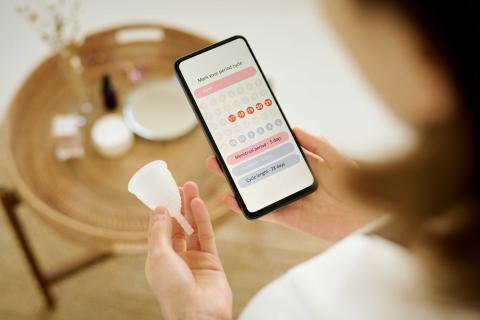
Researchers have developed an algorithm to analyze health data that may be hidden within the menstrual cycle
A team in the United States has developed an open-source tool that enables the analysis of health data related to the menstrual cycle. So far, after analyzing 5,674 non-reproductive cycles recorded by 753 participants, they have found correlations between cycle variability, basal body temperature, and aging. According to the authors, who published the results in Science Advances, the algorithm could help advance the discovery of digital biomarkers, and they note that “most attention in menstrual health focuses exclusively on the reproductive aspect and fails to leverage these non-reproductive menstrual cycles (99%) as health indicators.”

Carrasco - Algoritmo regla
Cristina Carrasco Romero
Substitute lecturer and researcher at the Department of Physiology, Faculty of Medicine and Health Sciences of the University of Extremadura
Efforts in the field of women's health continue to bear fruit after decades of relative underrepresentation in biomedical research. The prestigious journal Science Advances has published a methodologically sound study that reinforces the importance of recognizing the menstrual cycle as a vital sign, beyond its purely reproductive aspects. The study presents a new, freely available tool with potential applications for analyzing the wide variety of non-reproductive physiological data that remain insufficiently characterized in menstrual cycles.
It is well known that body temperature fluctuates throughout the menstrual cycle as a consequence of hormonal variations, indicating the presence of ovulatory cycles. Based on this indicator, the study's authors developed an algorithm to analyze an extensive database of daily basal body temperature, collected in the 1990s from more than 750 participants aged 18 to 42 from seven European countries. This analysis identified correlations between aging, body temperature, and cycle variability. Specifically, an increase in basal body temperature was observed throughout the menstrual cycle with age, along with a reduction in the duration of the follicular phase, among other changes. Furthermore, the results showed individual-specific patterns in multiple characteristics of the menstrual cycle, like a unique fingerprint.
This opens the door to future research that should confirm and expand upon these findings, addressing some limitations of the study, such as the lack of information on sociodemographic, anthropometric, and biological variables, as well as the lack of data on relevant neuroendocrine and immunological contexts—including the use of hormonal contraceptives, stages such as postpartum or lactation, and common gynecological conditions—which limits the complete interpretation of the results.
In summary, applying this type of open-source algorithm to large records of menstrual cycles could serve to extract relevant information about general health status and, consequently, identify rhythmic patterns with potential diagnostic value. As the researchers point out, the evidence obtained highlights the importance of taking into account interindividual differences when addressing the menstrual cycle in research and healthcare, as well as moving towards a more personalized approach in the identification of biomarkers that have been little explored so far in women's health.
Gombert-Labedens et al.
- Research article
- Peer reviewed
- People