All our cells, as well as those of other animals, plants and fungi, are known as eukaryotic cells, which means they are complex, with multiple internal compartments and a nucleus where genetic information is stored. They first appeared around 2 billion years ago, but exactly how this happened remains one of the great unresolved questions in biology. The process has been described as “the greatest evolutionary discontinuity to be found in the modern world” and is considered one of the most significant leaps since the origin of life.
For decades, the most widely accepted explanation has been the one proposed and defended by biologist Lynn Margulis, who identified the incorporation of the mitochondrion—the organelle that functions as the cell’s powerhouse—as a major turning point: at some point, an archaeon established a symbiotic relationship with a bacterium which, over time, would itself become a mitochondrion.
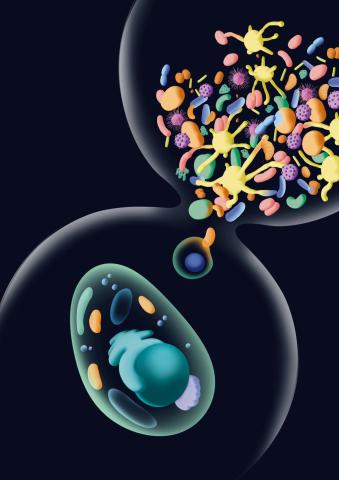
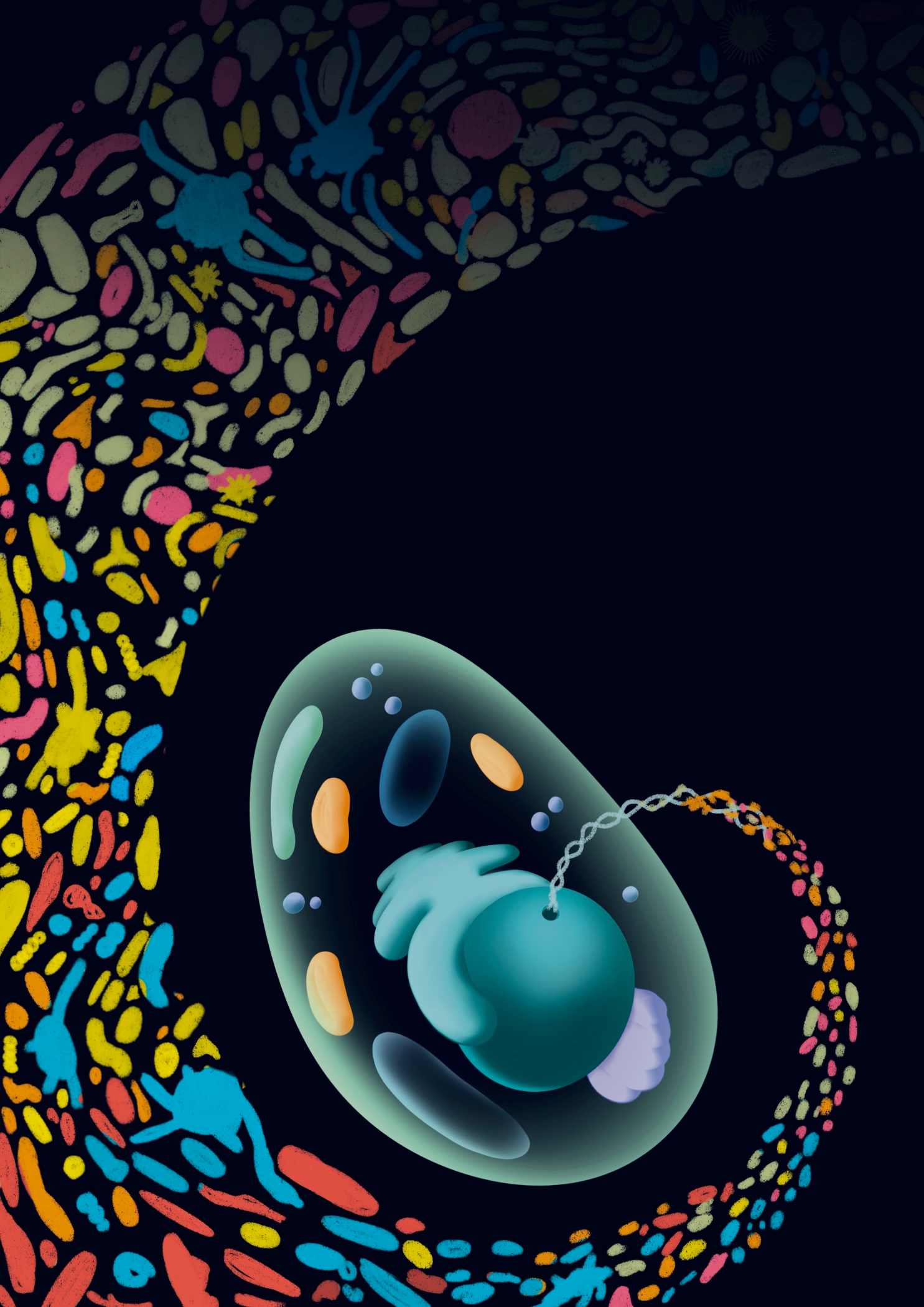
Now, research carried out by the team led by Toni Gabaldón, an ICREA researcher and head of the Comparative Genomics group at IRB Barcelona and the Barcelona Supercomputing Center (BSC-CNS), and published in the journal Nature, challenges this view: without denying the role of mitochondria, it suggests that the process was longer and more complex than previously thought, stretching over hundreds of thousands of years. At least two other different bacteria contributed to the development of eukaryotic cells, and giant viruses appear to have acted as vehicles for genetic transfer, facilitating exchanges between microorganisms that coexisted in the same ecosystem. To present their findings and address any questions, the Science Media Centre Spain organised a briefing with Toni Gabaldón, the lead researcher.
Lynn Margulis revolutionised thinking on the origin of eukaryotic cells (...). Our work partly supports her ideas, but I believe it completes her hypothesis
“Lynn Margulis revolutionised thinking on the origin of eukaryotic cells by raising the possibility that their complexity arose from the association of different cells,” explained Gabaldón. “Her theory was initially rejected, but over time the part concerning the incorporation of mitochondria came to be accepted. Our work partly supports her ideas, but I believe it completes her hypothesis.”
The origin of the eukaryotic cell left no fossils, but the team has carried out a form of molecular archaeology using the BSC-CNS’s MareNostrum supercomputer, which has enabled them to compare and analyse databases containing tens of thousands of genomes from different microorganisms. “We have discovered two strong and consistent signals originating from two different bacteria,” noted the researcher. Furthermore, “we found sequences from a specific group of giant viruses, which was a pleasant surprise because it provided us with a possible mechanism. Through them, the bacteria were able to donate genes to the initial host, making it increasingly complex.”
Could it be said, then, that without the contribution of these viruses and bacteria, our cells would not be as they are now? That we ourselves would be different? “I think so,” replied Gabaldón. “The fact that these genes have survived for 2 billion years and are still present in all eukaryotic cells means that they are essential contributions in terms of their architecture and functioning. We are direct descendants of interactions between microbes,” he noted.
A paradigm shift
The researcher also does not rule out the possibility that similar processes are occurring today. Although gene transfer between organisms can occur even between plants and animals, it is much more likely to occur between single-celled organisms. And it is precisely among the latter that most eukaryotic diversity is found. “I think it may be happening somewhere, because eukaryotes have colonised the entire planet Earth. It is possible that something like this is beginning to happen,” explained the expert.
The story we told ourselves is incomplete and more complex than it might seem
When asked whether these findings might lead to changes in textbooks, Gabaldón said, “It does shift the paradigm slightly.” “Textbooks still talk about an interaction between mitochondria and archaea, but I believe this places mitochondria at the end of the story and reopens the debate about what happened before and how these interactions took place. It makes us realise that the story we were telling ourselves is incomplete and more complex than it might have seemed.”
Regarding the potential utility of this research, Gabaldón argued: “Biology must always first try to understand life, how things work. From there, potential applications can emerge. If we didn’t know how genes work, genetic engineering wouldn’t exist.” In this specific case, “if we understand how organisms can integrate with one another through symbiosis, it could open the door to creating consortia of organisms by integrating them into a single cell.”
Could one of its applications be the design of organisms that help alleviate the environmental crisis? “I don’t want to give the impression of an overly scientistic view that everything will be solved by bringing cells together. The best solution lies in controlling our activities. There may be possibilities we cannot even imagine today, but I think the problems we currently face are too significant to try to solve them with the means we have at present,” he concluded.
Independent reactions to the study
The experts consulted by SMC Spain regarding this study are unanimous in their assessment of its importance and quality. Jordi Bascompte, Professor of Ecology in the Department of Evolutionary Biology and Environmental Studies at the University of Zurich (Switzerland), states: “The origin of the complex cell is undoubtedly one of the most significant transitions in the history of life on our planet. Without it, the subsequent evolution of multicellular animals such as plants, insects, amphibians, reptiles and mammals, including humans, would not have been possible. It is also one of the most abrupt and enigmatic transitions. This study contributes to our understanding of this transition by providing very solid evidence that there were multiple events of incorporation of genetic components from various prokaryotes even before the famous endosymbiotic event between the host cell, an archaeon, and the prokaryote that gave rise to mitochondria.”
For his part, Enrique M. Muro, senior principal researcher at the Institute of Organismic and Molecular Evolution at Johannes Gutenberg University in Mainz (Germany), states: “Studies such as this are a testament to humanity’s biotechnological capabilities. Just 25 years ago, it would have seemed implausible that evidence of this kind could be produced (bear in mind that the origin of the eukaryotic cell occurred billions of years ago—nine zeros in the number of years). Sequencing and bioinformatics are making it happen, and paleogenomics is achieving something similar, managing to reconstruct the history of populations and even extinct species. It happened so long ago that sifting through those sequences seems like reading tea leaves. But the authors show us that our biotechnological capabilities are sufficient to find answers in this way.”