Benjamín Montesinos
This is not the first time that a similar configuration has been observed. For example, this article from 2021, whose lead author is Jorge Lillo and of which I am a co-author (see the figure included), shows a hierarchical triple system in which a subgiant star (B) orbits a giant star (A) and star B is, in turn, orbited by a brown dwarf (C). Brown dwarfs are objects that fall within the ‘category’ of substellar objects and differ from stars in that they do not have sufficient mass to sustain nuclear reactions, as is the case, for example, with the Sun.
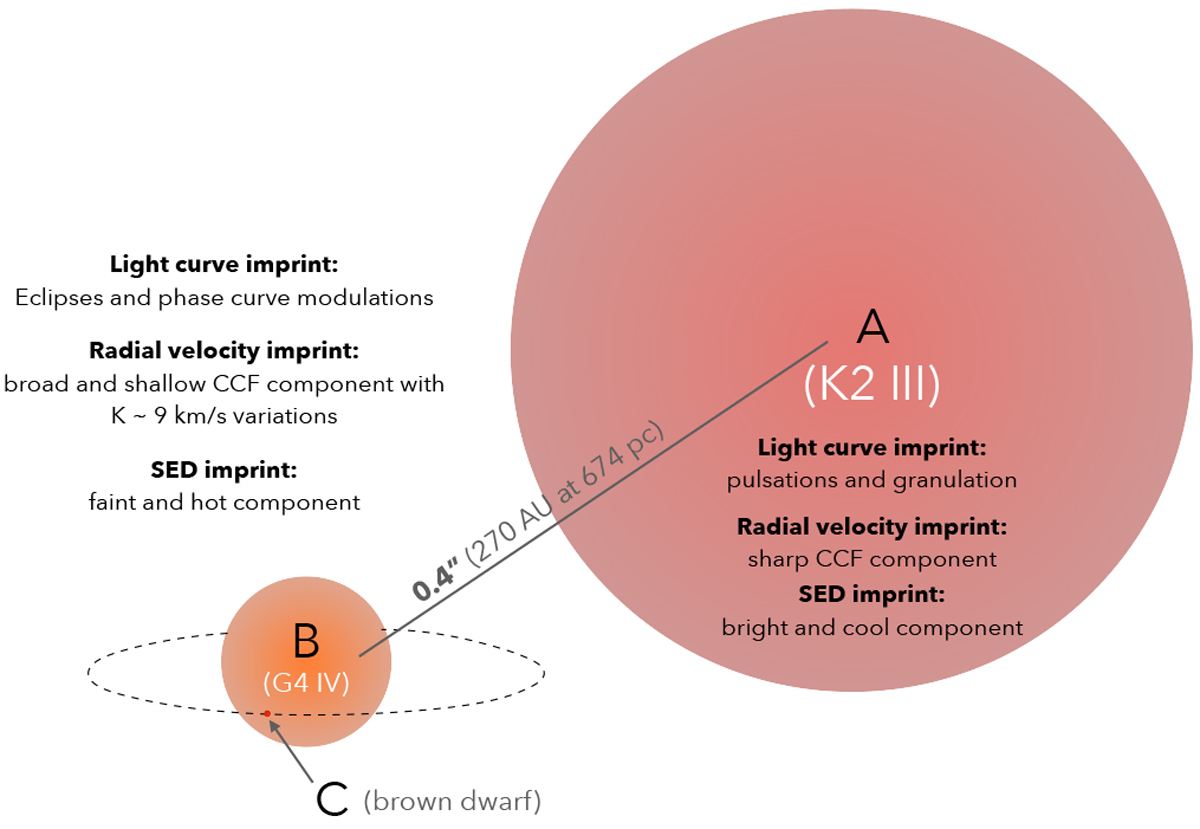
This configuration, shown as an example, is qualitatively similar to the one presented in the Nature article. In that case, star A is a cool, small star compared to our Sun (it has ~0.4 times the Sun’s mass), whilst object B – referred to as CD 35 B in the article – is a brown dwarf with a mass of about 37 times that of Jupiter, which is orbited by object C, which has a mass of about 0.9 times that of Jupiter.
As can be seen, in both cases B orbits A and C orbits B. The distinctive feature of the Nature paper is that what the authors call an ‘exosatellite’ is an object of planetary mass, and they raise the possibility that it could be classified as an ‘exomoon’ (exomoons).
This is where we enter the realm of nomenclature: as far as I am aware, the International Astronomical Union, which is responsible for the nomenclature of astronomical objects, does not yet have a definition for that term, but it does have one for ‘moon’ (moon, lowercase), defined as ‘a natural satellite of other planets can be referred to as a moon’. For example, the satellites of Jupiter or Saturn are often referred to as ‘the moons of…’.
Following the same line of reasoning, one could say that an ‘exomoon’ is a natural satellite orbiting a planet which, in turn, orbits a star (an exoplanet); however, this would not apply to this object, as it orbits a brown dwarf, not a planet.