What could be the first exomoon orbiting a brown dwarf has been discovered
To date, more than 6,000 exoplanets — planets orbiting a star other than the Sun — have been discovered, but no moon outside the Solar System — known as an exomoon — has ever been definitively identified. Now, a study published in Nature presents evidence of what could be an exomoon orbiting a brown dwarf — an object halfway between a star and a planet. By analysing radial velocity data from observations made by the European Southern Observatory’s (ESO) Very Large Telescope, a team has identified a signal indicating the presence of a satellite with a minimum mass of 0.9 times that of Jupiter and an orbital period of around 170 days. “Although it is unclear whether this exosatellite will meet the criteria—yet to be defined—for being considered an exomoon, it represents an important step towards that first indisputable detection,” the authors state.
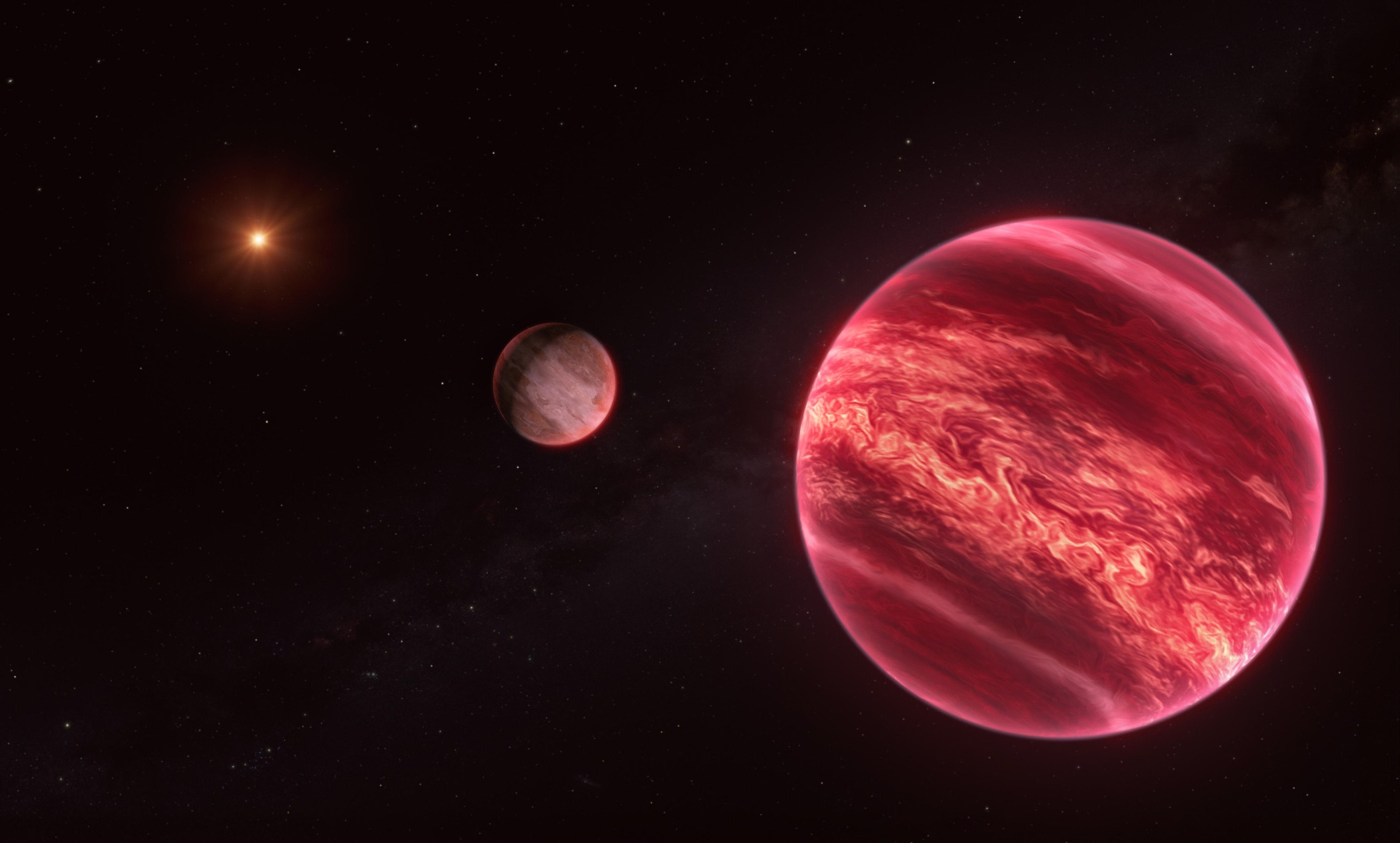
Artist’s impression of CD-35 2722, a system containing a Moon-like object. Credit: ESO/M. Kornmesser.
Pedro J. Amado - exoluna
Pedro J. Amado
For me, the most interesting thing about this finding is that it provides another example of just how different other planetary systems can be from our own. For many years, the Solar System was the only point of reference we had, and we used to think that it represented, more or less, the typical way in which stars form planets and moons. We now know that this is not the case. In this instance, we may be looking at a star orbited by a brown dwarf, and this brown dwarf, in turn, is orbited by an object with a mass similar to that of Jupiter. We have nothing comparable in the Solar System. Whether we ultimately call this object an ‘exomoon’, an ‘exosatellite’ or even a ‘planet’ is perhaps less important than the fact that nature forms complex objects and systems that do not easily fit into the categories we have created based on our own Solar System.
Of course, we must still proceed with some caution. The periodic signal is convincing and consistent with the presence of an orbiting object, but further observations will be needed to confirm its nature. The work is also very interesting from an observational point of view, as it demonstrates that radial velocities can be measured directly in an imaged brown dwarf and used to search for objects orbiting it. This opens up a new avenue for discovering more exomoons in the future, including objects with smaller masses, and for finding out whether systems like this are actually rare or whether we simply hadn’t been able to detect them until now.
Javier Peralta - exoluna
Javier Peralta
Detecting an exomoon for the first time (that is, observing that planets in other stellar systems have their own moons) is a milestone of enormous significance in astronomy. On the one hand, because it would tell us that we do not have to wait for future technology or undertake interstellar travel, but that we can observe them now. And on the other, because it would help us understand how planetary systems form. The significance is comparable to that of the wave of discoveries that followed the start of the exoplanet discovery race, which has helped us understand not only that planet formation is far more common than we thought, but also that the architecture of our solar system—with small planets orbiting closer to the star and giant planets orbiting further out—is not exactly ‘normal’ in other stellar systems.
However, the authors admit that they are not sure whether they can categorically state that this body can be called an ‘exomoon’, as it is almost as large as Jupiter and orbits a brown dwarf (which is something halfway between a planet and a star). Nevertheless, I believe that it is precisely this uncertainty that highlights the significance of the discovery made by Kevin Hoy and his team: the observation of a body that challenges our understanding of what we can call a ‘moon’. Something similar happened when it was discovered that the dwarf planet Pluto had a moon, Charon, which was far too large and massive for what moons are usually like in comparison to the planets they orbit. Sometimes, discovering something unexpected is even more exciting than finding what you were looking for in the first place. Above all, because it forces us to rethink everything we know.
Jorge Lillo-Box - exoluna
Jorge Lillo-Box
This paper presents an interesting finding concerning the detection of a planetary-mass object orbiting a brown dwarf, which in turn orbits an M-type star. In my view, the significance of the study lies not so much in the classification of what has been detected, but rather in the technical capability provided by ESO’s CRIRES+ instrument to obtain precise radial velocities of very faint objects (such as this brown dwarf) and, furthermore, at a small angular separation from another star (in this case, the other component of the system, the M-type star). This capability is precisely what will enable us to obtain high-resolution spectra of increasingly faint exoplanets that are close to their stars, something that will be essential for directly studying planetary atmospheres using future instruments on the VLT (RISTRETTO) or the ELT (ANDES). In this regard, this discovery demonstrates the technological potential of current instrumentation and serves as a test case for these new instruments.
As far as nomenclature is concerned, in my view, the discovery does not represent the detection of the first exomoon or exosatellite, as I understand the concept. However, the absence of a definition by the International Astronomical Union (IAU) regarding what constitutes an exomoon or exosatellite opens the door for individual researchers to interpret these terms with varying degrees of flexibility. In fact, in a similar vein, there is not even a proper definition of an exoplanet, but only a working definition by the IAU set out in Lecavalier des Etanges & Lissauer (2022). But this working definition by the IAU is important in this case because it states that exoplanets are objects with an absolute mass of less than approximately 13 Jupiter masses. Consequently, the brown dwarf hosting the object discovered by Hoy’s team and colleagues (with a mass of 30 Jupiter masses) cannot be considered an exoplanet; therefore, the object found orbiting it would be nothing more than an exoplanet orbiting a brown dwarf which, in turn, orbits another star. Such configurations are commonly referred to as S-type planetary systems (from satellite), as opposed to circumbinary planetary systems (or P-type systems) where the planet orbits both stellar or substellar components.
For all these reasons, as I understand it, this is not the detection of the first exomoon, which would have to be a planetary-mass object orbiting another planetary-mass object, both of which are orbiting a stellar object or brown dwarf. Rather, we are witnessing the discovery of an interesting S-type planetary system that demonstrates the technological capabilities at our disposal and the potential of the next generation of instruments for exoplanetary research using direct light from the planet itself.
Benjamín Montesinos - exoluna
Benjamín Montesinos
This is not the first time that a similar configuration has been observed. For example, this article from 2021, whose lead author is Jorge Lillo and of which I am a co-author (see the figure included), shows a hierarchical triple system in which a subgiant star (B) orbits a giant star (A) and star B is, in turn, orbited by a brown dwarf (C). Brown dwarfs are objects that fall within the ‘category’ of substellar objects and differ from stars in that they do not have sufficient mass to sustain nuclear reactions, as is the case, for example, with the Sun.
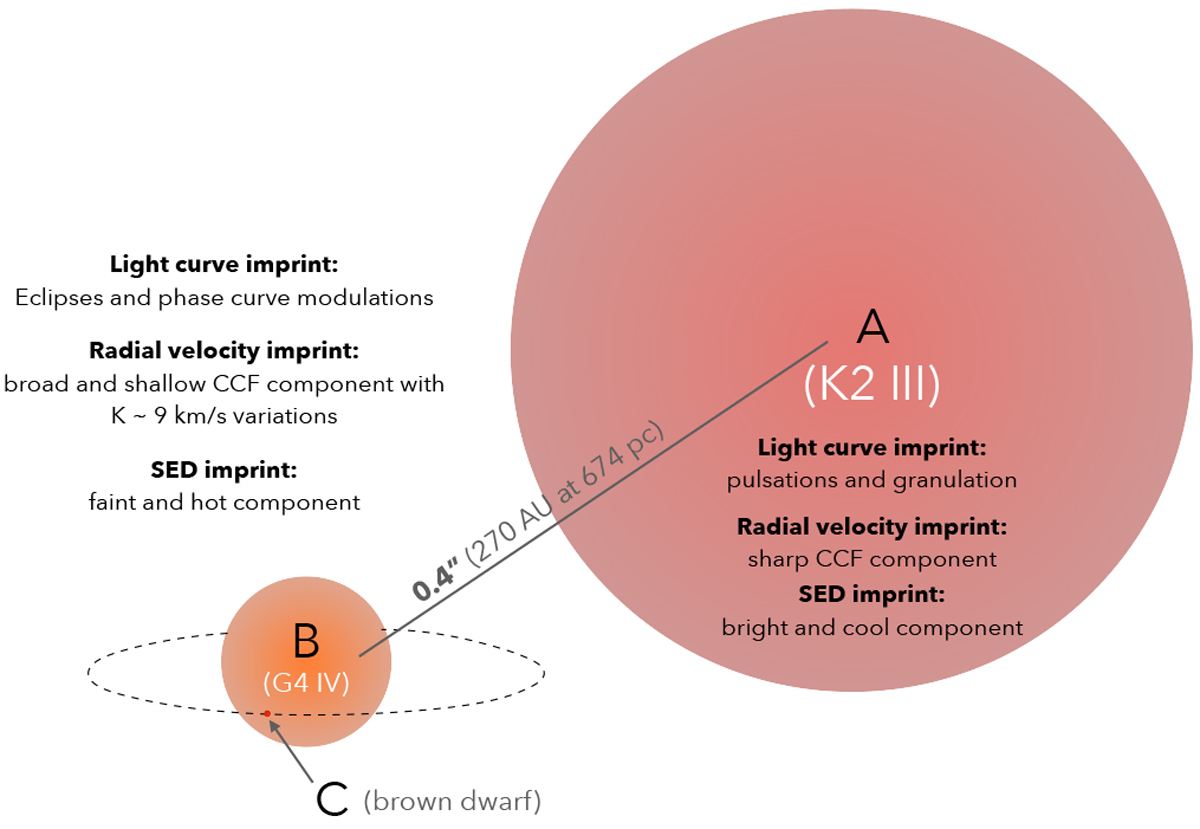
This configuration, shown as an example, is qualitatively similar to the one presented in the Nature article. In that case, star A is a cool, small star compared to our Sun (it has ~0.4 times the Sun’s mass), whilst object B – referred to as CD 35 B in the article – is a brown dwarf with a mass of about 37 times that of Jupiter, which is orbited by object C, which has a mass of about 0.9 times that of Jupiter.
As can be seen, in both cases B orbits A and C orbits B. The distinctive feature of the Nature paper is that what the authors call an ‘exosatellite’ is an object of planetary mass, and they raise the possibility that it could be classified as an ‘exomoon’ (exomoons).
This is where we enter the realm of nomenclature: as far as I am aware, the International Astronomical Union, which is responsible for the nomenclature of astronomical objects, does not yet have a definition for that term, but it does have one for ‘moon’ (moon, lowercase), defined as ‘a natural satellite of other planets can be referred to as a moon’. For example, the satellites of Jupiter or Saturn are often referred to as ‘the moons of…’.
Following the same line of reasoning, one could say that an ‘exomoon’ is a natural satellite orbiting a planet which, in turn, orbits a star (an exoplanet); however, this would not apply to this object, as it orbits a brown dwarf, not a planet.
Enric Pallé - exoluna
Enric Pallé
In my view, this discovery is a brilliant find. The paper is very sound and certainly deserves a press release, but I’m not sure that the term ‘moon’ applies here. The authors acknowledge this, but they continue to use it (sic).
By definition, given the mass they’ve determined (almost as much as Jupiter’s) and the likely formation mechanism, what they’ve found is a run-of-the-mill planet orbiting the lowest-mass star discovered to date, but not a moon.
Hoy et al.
- Peer reviewed
- Research article