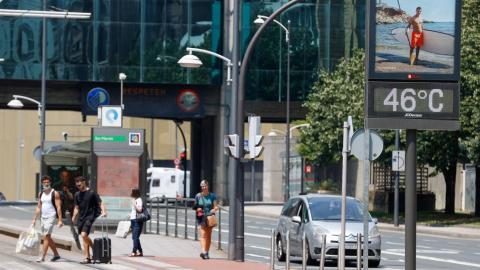
Spain is one of the world’s leading tourist destinations, and much of its success has historically been based on a resource that is difficult to replicate: favourable climatic conditions for sun and beach tourism. However, climate change is gradually altering this scenario, which has underpinned the development of tourism along much of the Spanish coastline. The increase in the frequency, intensity and duration of heatwaves poses a growing challenge to one of the most important sectors of the Spanish economy. In a country where tourism accounts for around 15.6 per cent of GDP, understanding how tourist demand responds to extreme heat is of ever-increasing economic importance.
The question is no longer whether climate change will affect tourism, but how it is doing so and what consequences this could have for Spanish tourist destinations in the coming decades. Although there is as yet no evidence of a decline in Spain’s appeal as a tourist destination, changes in the behaviour of international demand are beginning to be observed. Scientific evidence from recent years shows that climatic conditions are having an increasingly direct influence on travel decisions. Factors such as choice of destination, the time of year for travelling or the length of stay are beginning to be influenced by perceptions of thermal comfort and exposure to extreme temperatures. Various studies warn that the Mediterranean region is one of the areas most vulnerable to global warming, with a rate of temperature rise exceeding the global average.
Our study, published recently, analysed the impact of heatwaves on international tourist flows to Spain’s main sun and beach destinations. To this end, we compared the behaviour of more than 6,500 tourists from the main source markets (the United Kingdom, France, Germany and the Netherlands) across two different climate scenarios. One of these scenarios was July 2022, characterised by one of the most intense heatwaves ever recorded in Spain; the other was July 2023, without any extreme weather events. The analysis was carried out using data from the FRONTUR survey conducted by the National Statistics Institute and climate records from the AEMET.
Spain is one of the world’s leading tourist destinations, and much of its success has historically been based on a resource that is difficult to replicate: favourable climatic conditions for sun and beach tourism. However, climate change is gradually altering this scenario, which has underpinned the development of tourism along much of the Spanish coastline. The increase in the frequency, intensity and duration of heatwaves poses a growing challenge to one of the most important sectors of the Spanish economy. In a country where tourism accounts for around 15.6 per cent of GDP, understanding how tourist demand responds to extreme heat is of ever-increasing economic importance.
The question is no longer whether climate change will affect tourism, but how it is doing so and what consequences this could have for Spanish tourist destinations in the coming decades. Although there is as yet no evidence of a decline in Spain’s appeal as a tourist destination, changes in the behaviour of international demand are beginning to be observed. Scientific evidence from recent years shows that climatic conditions are having an increasingly direct influence on travel decisions. Factors such as choice of destination, the time of year for travelling or the length of stay are beginning to be influenced by perceptions of thermal comfort and exposure to extreme temperatures. Various studies warn that the Mediterranean region is one of the areas most vulnerable to global warming, with a rate of temperature rise exceeding the global average.
Our study, published recently, analysed the impact of heatwaves on international tourist flows to Spain’s main sun and beach destinations. To this end, we compared the behaviour of more than 6,500 tourists from the main source markets (the United Kingdom, France, Germany and the Netherlands) across two different climate scenarios. One of these scenarios was July 2022, characterised by one of the most intense heatwaves ever recorded in Spain; the other was July 2023, without any extreme weather events. The analysis was carried out using data from the FRONTUR survey conducted by the National Statistics Institute and climate records from the AEMET.
Differences can be observed across different source markets, such as the United Kingdom, where there has been a decline in travel during periods of extreme heat
The results show that heatwaves are already influencing the distribution of international tourist demand. Extreme temperatures affect the choice of holiday destination and reduce the length of stays in certain contexts. Differences are also observed depending on the source markets, such as the United Kingdom, where a decline in travel is evident during periods of extreme heat.
Furthermore, some destinations are more sensitive to these extreme weather events, as is the case with the Balearic Islands. In island regions, the combination of high temperatures and high humidity levels can significantly increase the heat index and reduce visitors’ comfort, which appears to be influencing the choice of certain destinations during periods of extreme heat.
However, the results do not suggest that tourists are turning their backs on Spain, nor that the Mediterranean tourism model is in crisis. Spanish destinations continue to maintain a high level of international competitiveness, and the climate remains one of their main attractions. What is evident is a gradual process of tourists adapting to more challenging weather conditions.
Extreme heat is beginning to be factored in as just another element in travel planning. Tourists are choosing to shorten the duration of their holidays during the hottest periods, change their travel dates or seek out destinations with milder temperatures. Against this backdrop, the phenomenon of so-called coolcations has emerged – a trend describing the growing preference among travellers for destinations with more temperate climates during the summer months. Various European studies already suggest that thermal comfort is becoming increasingly important in tourism decision-making.
The available evidence also allows us to anticipate certain trends. If heatwaves continue to intensify, the appeal of spring and early autumn as tourist seasons may increase, helping to reduce seasonal peaks in summer and leading to a more balanced distribution of demand. In this case, tourism promotion strategies will also need to evolve towards marketing campaigns focused on climatic quality during these seasons.
Against this backdrop, climate adaptation becomes a priority for the competitiveness of tourist destinations. It will be necessary to incorporate the climate variable into tourism planning and management, enhancing visitor comfort through shaded or air-conditioned spaces and services designed to reduce heat stress. Hotels can play a key role in this regard.
Diversifying the range of offerings is another key strategy. Destinations specialising in sun and beach holidays can complement this with cultural, gastronomic, nature-based or wellness products. The more diversified the tourist experience, the less reliance there will be on weather conditions to maintain visitor satisfaction.
We are not witnessing the end of Mediterranean tourism, but rather the beginning of a transformation in patterns
High temperatures also make it necessary to rethink the timing of tourist activity by introducing new evening activities that can help to extend the length of stay and increase spending during periods of extreme heat.
However, the study is based on international tourists from the four main European source markets — the United Kingdom, France, Germany and the Netherlands — and therefore its conclusions cannot be generalised to domestic tourism or other markets. Future research should incorporate new source countries, inland destinations and different demand segments to better understand the effects of heatwaves on tourist behaviour.
The main conclusion is clear: heatwaves are already influencing international tourist flows to Spain. We are not witnessing the end of Mediterranean tourism, but rather the beginning of a transformation in travellers’ mobility patterns, length of stay and expectations regarding comfort. Climate adaptation is no longer solely an environmental issue; it has become a central element of the competitiveness, resilience and sustainability of Spanish tourism.