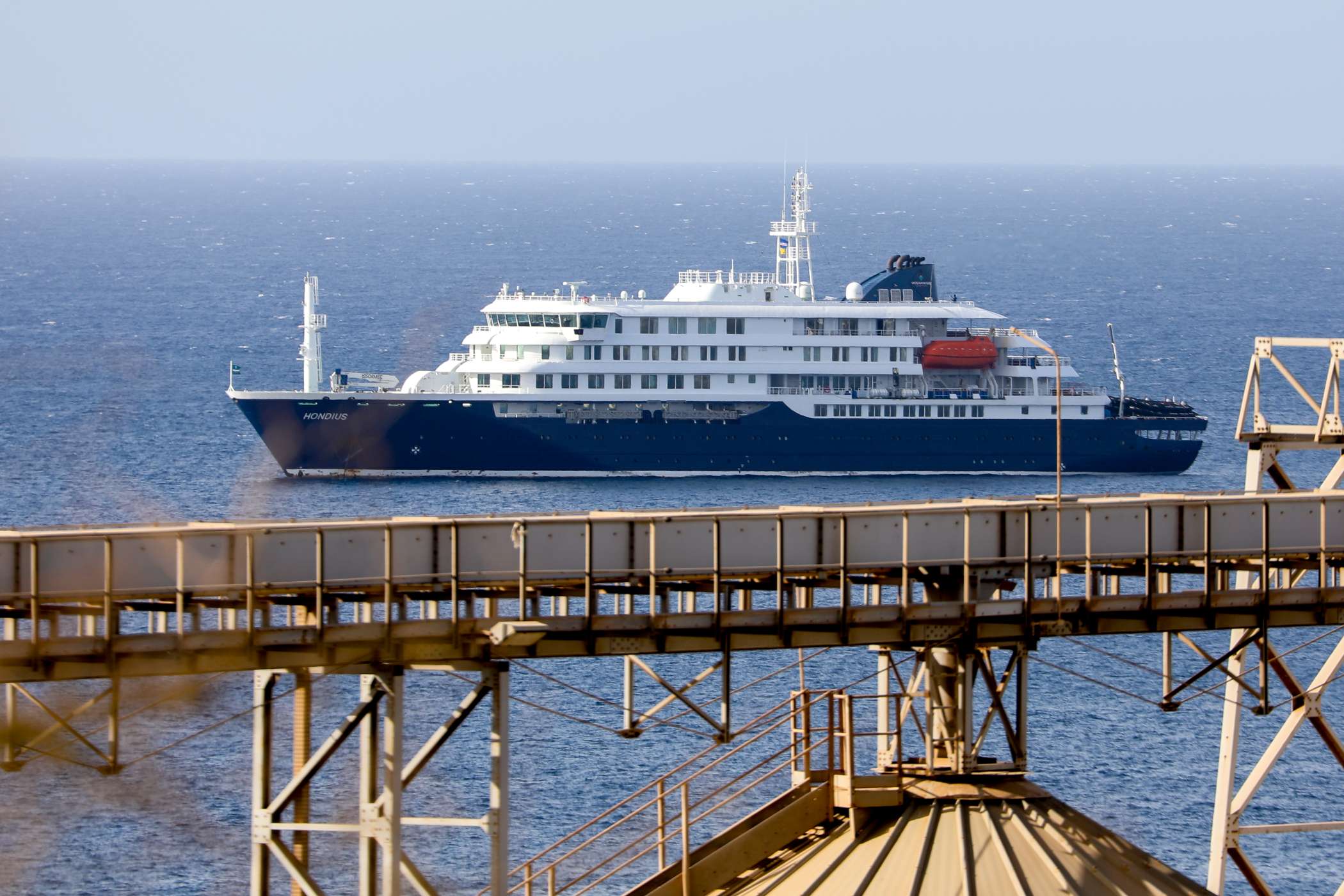
The Ministry of Health is awaiting epidemiological data from the cruise ship carrying possible cases of hantavirus in order to decide where it will call
The Ministry of Health has announced on social media that, depending on the epidemiological data gathered from the ship regarding a possible hantavirus outbreak during its stopover in Cape Verde, “a decision will be made as to which port of call is most appropriate”. Various reports suggest that the World Health Organisation (WHO) would have preferred the cruise ship to stop in the Canary Islands. “Until then, the Ministry of Health will not take any decision, as we have made clear to the World Health Organisation,” it stated. Furthermore, the Ministry of Health has indicated that, following a meeting with the WHO, a team of epidemiologists will inspect the vessel this afternoon to assess the condition of those on board, determine whether there are any further cases with symptoms, and identify high-risk and low-risk contacts. “This will aid decisions regarding repatriation procedures and the ship’s route.”
Mar Faraco_Sanidad hantavirus
Mar Faraco
Former president and current secretary of the Association of Foreign Medical Doctors (AMSE) and head of the Servicio de Sanidad Exterior in Huelva
Wherever this ship ends up – whether in the Canary Islands or another country – what needs to be done is to implement protocols for monitoring cases and potential contacts, and to do whatever can be done. It is a disease that is very unlikely to spread from person to person; there are very few documented cases. Precisely for that reason, we do not know exactly when or how it is transmitted, but it is very likely that it is only when you are symptomatic, and that is difficult. So, common sense tells me that the ideal approach would be to disembark with caution, with isolation, using specially equipped ambulances and protective equipment for those who are ill or suspected of being ill, because they have symptoms – even if it is just a slight cough or a slight fever – but it could be. As for the rest, who are contacts, we need to check whether they have been in close proximity or not, and assess whether any have had very close contact – such as sharing the same cabin or spending a lot of time together – in which case a period of quarantine might also be considered... And if not, for the rest who have had more casual contact and have no symptoms, what needs to be done is for each person to go home using normal transport and monitor for symptoms. If symptoms appear, such as a slight fever, take their temperature in the morning and at night, and if any symptoms appear, they should go to their local hospital or referral centre, say they are linked to this case, and they will be assessed there.
You cannot diagnose whether you are incubating hantavirus two weeks beforehand, because the incubation period is now relatively long—up to six weeks has been reported—so what are we going to do? Do we keep 200 asymptomatic people on a ship or in a hotel? I believe this is more of a communication management issue than a risk management one, and it will be very difficult to explain this so that people understand the risk is minimal and we must send people back to their homes, to their peace of mind, because there is practically no risk. There is no such thing as zero risk in life. This is also something far beyond my decision; it is a public health decision and involves many factors to consider.
Amós García Rojas - hantavirus Sanidad EN
Amós García Rojas
Former head of the Epidemiology and Prevention Service of the General Directorate of Public Health of the Canary Islands Health Service, former president of the Spanish Vaccination Association (AEV) and until his retirement in 2024 a member of the WHO Standing Group for Europe
I believe that, fundamentally, the option of allowing the ship to dock in the Canary Islands – which is not yet clear – is being considered to safeguard the health of some passengers who may be ill or in case others develop symptoms. Logically, the Canary Islands have a hospital infrastructure capable of handling patients of this kind, and I believe this is the key issue: ensuring care for these people who are currently in a vulnerable state and, above all, being able to gain a comprehensive overview of the outbreak’s status.
In a context such as this, it is vital to convey a message of reassurance to a population that is already sufficiently distressed and for whom the memory of that terrible health crisis—the pandemic—is still all too fresh. And, furthermore, because this situation is being exploited for social media to spread an absolutely terrifying message about the risks we might face if the ship docks in the Canary Islands—a message which, without a doubt, is intended to terrify the population.
This has absolutely nothing to do with Covid. I’ll highlight two key differences: when Covid emerged, we had no information about what this new microorganism was. The hantavirus has been with us for many decades; we know enough about these viruses and their epidemiology. Furthermore, COVID-19 is transmitted through the air, whereas this virus is not. This explains the low risk to the population in an environment such as ours. The hantavirus is transmitted primarily either through direct contact or inhalation of microscopic particles from rodent faeces, urine or saliva; or through the consumption of food contaminated by these rodent residues. Person-to-person transmission is very rare. There is only one American variant, known as Andes, in which some cases of human-to-human transmission have been reported, but these are few and far between and require direct, close and very intense contact in enclosed, poorly ventilated spaces.
Therefore, the likelihood of a public health risk is low, as the WHO has stated, if not non-existent.
It is reasonable to wait for the epidemiological data from the cruise ship to get a rough idea of how the problem arose on board. As we do not yet know, it is reasonable to be cautious. The hantavirus on that ship may have been transmitted in three ways. The first: the ship was coming from Argentina, it visited adventure tourism areas where hantavirus is endemic, and infection may have occurred there in some of those patients; as the American variant of hantavirus has an incubation period of around seven weeks, they may have been infected there and the clinical symptoms may have manifested here. The second: through direct contact with or inhalation of rodent faeces, urine or saliva. The third: because a person who had been infected in Argentina with the Andes variant lives in close contact with another person, for example, a partner, and person-to-person transmission has occurred.
These are the variables on the table. Logically, we need to have a rough idea of how the outbreak occurred in order to make a decision, although the risk to the general population is frankly low.