Pollution from the 2023 Canadian wildfires linked to nearly 70,000 deaths in North America and Europe
More than 350 million people in North America and Europe may have been affected by fine particulate matter (PM2.5) pollution from the 2023 Canadian wildfires, according to estimates from a study published in Nature. The authors estimate that 5,400 acute deaths in North America and 64,300 chronic deaths in North America and Europe were attributable to exposure to these particles originating from Canadian forest fires.
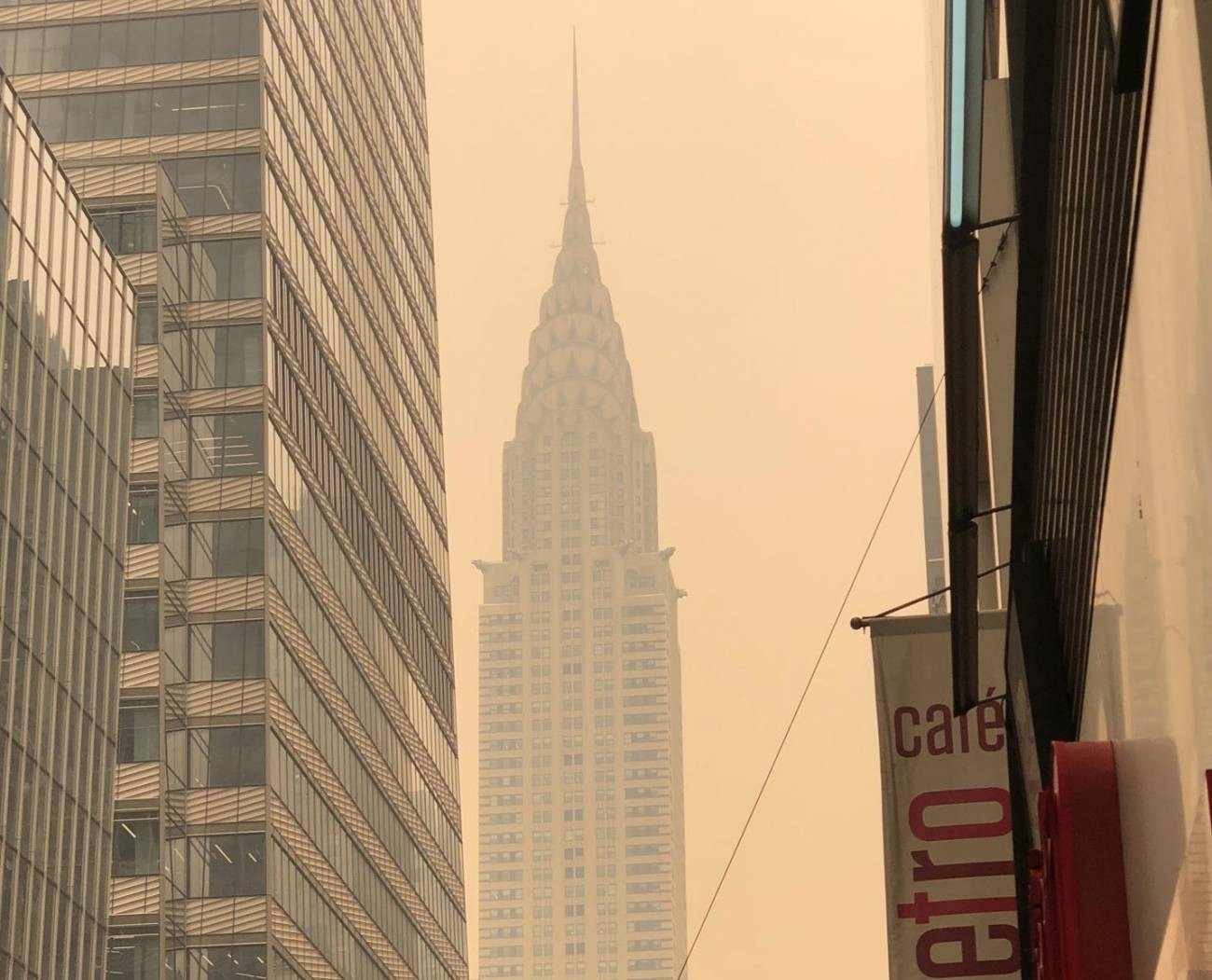
Photograph showing smoke from Canadian forest fires in June 2023 enveloping downtown New York City. / Javier Otazu-EFE.
Julio Díaz - incendios Canadá EN
Julio Díaz
Research professor and member of the Departament on Climate Change, Health and the Urban Environment at the Carlos III Health Institute
In my opinion, this is an interesting study that highlights the importance to health of exposure to smoke from forest fires that have occurred hundreds or even thousands of kilometres away from the place where it is focused. In this case, it refers to the impact of fires in Canada on mortality in Europe and North America.
Although the article appears robust from the point of view of smoke transport models from these fires, from the point of view of health impact, there are two issues that could be improved in the manuscript.
On the one hand, the impact of PM2.5 is estimated using standard functions for PM2.5, without taking into account the composition of PM from forest fires, which tends to be more toxic and therefore has greater health effects.
On the other hand, PM2.5 is often associated with volatile organic compounds that act as precursors to tropospheric ozone, so the health impact of this other secondary pollutant should be added to the impact of PM. This tropospheric ozone has a health impact that is sometimes greater than that of PM itself.
Therefore, the figures given in this study on the health impact of these Canadian fires on North America and Europe are probably underestimated.
Isidro Pérez - incendios Canadá EN
Isidro A. Pérez
Professor in the Department of Applied Physics and coordinator of the Atmospheric Pollution research group at the University of Valladolid
This article analyses the impact on public health of particles smaller than 2.5 μm in diameter produced by uncontrolled forest fires in Canada during 2023. The topic is of general interest due to its social impact, and the publication of the analysis in a leading journal is justified by the global scope of the study. In addition, the volume of data used, together with the various models employed, indicate the handling of a significant amount of information. However, as with any scientific article, the results should be treated with caution and are subject to discussion and review.
In particular, this article uses different spatial resolutions in the models it employs. Specifically, the 2.5° resolution is good for speeding up calculations, but it masks local processes that take place on a smaller spatial scale.
Since the dataset is very large, it is difficult to obtain complete series, and the authors have filled in some gaps with modelled data.
Some linear relationships between measured and predicted values could be questioned due to the dispersion of the data.
In addition, the authors indicate a lack of epidemiological evidence between mortality and particles emitted by fires, so they have taken an exposure-response function for all sources.
A striking assessment is that the number of deaths in Europe from uncontrolled fires in Canada is lower than that caused by dust.
The authors also point out that they consider environmental concentrations, but that exposure may be reduced indoors and that the effects will also be less, so they believe that further research is needed to improve the determination of the impact on the population.
Qiang Zhang et al.
- Research article
- Peer reviewed
- People