It is demonstrated for the first time that a cow can use tools
Two researchers from the University of Veterinary Medicine Vienna (Austria), one of them Spanish, have described for the first time the flexible use of tools in a cow, which, according to the authors, suggests that the cognitive abilities of cattle have been underestimated. The animal, named Veronika, was kept as a pet by an Austrian farmer, who observed that she occasionally picked up branches and used them to scratch herself. After several experiments, the researchers found that she could use different parts of the same tool for different purposes and apply different techniques depending on its function and the body region. Beyond humans, this has only been convincingly documented in chimpanzees, the researchers indicate. “The findings highlight how assumptions about cattle intelligence can reflect gaps in observation rather than true cognitive limitations,” they state. The results are published in Current Biology.
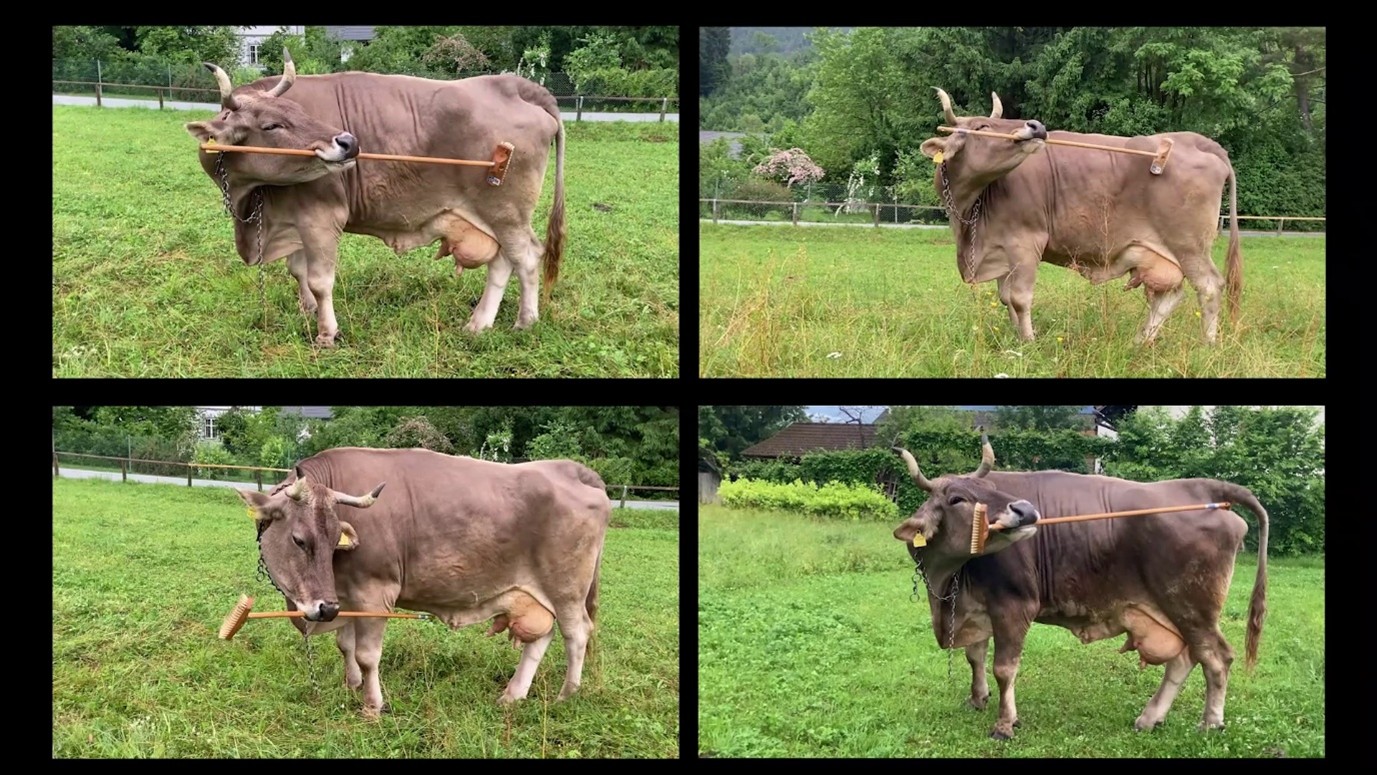
Veronika using different scratching techniques. / Credit: Antonio J Osuna Mascaró.
Nawroth - Vaca
Christian Nawroth
Researcher in the Working Group on Animal Behavior and Welfare at the Research Institute for Farm Animal Biology (Dummerstorf, Germany)
What do you think of the article overall? Is it of good quality?
"The study not only relies on observational data for Veronika's tool use, but it goes beyond that and experimentally manipulates the setting to assess the specific characteristics of Veronika’s tool use".
How does it fit with existing evidence and what new information does it offer? What implications might it have?
An increasing number of cases of tool use in the animal kingdom are being reported, and recent research has also demonstrated that several farm animal species possess a rich cognitive repertoire. That we are still surprised when cows—or other farm animal species—exhibit such abilities says maybe as much about our perceptions of these species as it says about the animals’ behaviour itself.
Are there any important limitations to consider?
It's on a sample size of one subject, so the study can only tell us something about general capacity, rather than prevalence, and I would fairly state that we lack data to make broader claims on this behaviour. Still, it is a fascinating finding! The authors already mention that they want to look at potential developmental factors that might foster this behaviour, and I am looking very much forward to this work.
Vacas herramientas Miquel Llorente EN
Miquel Llorente
Head of the Department of Psychology at the University of Girona, associate professor Serra Húnter and principal investigator of the Comparative Minds research group
This article strikes me as being of outstanding quality and represents a real breath of fresh air in the study of animal cognition. Most notably, the authors have not confined themselves to describing an anecdote, but have tested the animal in a controlled and systematic manner. By presenting the tool in random orientations, they were able to demonstrate that the cow, Veronika, was not acting through mechanical repetition, but with a clear and functional intention.
Until now, tool use has been considered a rather exclusive club, largely restricted to primates (especially great apes, but also macaques and capuchin monkeys), certain birds such as corvids and parrots, and marine mammals like dolphins. Finding it in a cow is a fascinating example of convergent evolution: intelligence emerges as a response to similar problems, regardless of how different the animal’s “design” may be.
The real novelty here is not merely the use of an object, but its flexible and multifunctional use. Veronika discriminates which part of the tool (bristles or handle) is more appropriate depending on the sensitivity of the area of her body she intends to scratch—something that, outside humans, has only been documented with such clarity in chimpanzees. This is all the more remarkable when we consider her anatomical constraints: lacking hands or a trunk, she must make very fine adjustments in grip and anticipation using only her mouth.
As for limitations, caution is warranted: this is a single-individual study, and we cannot generalise that all cows possess this capacity innately. Ontogeny and Veronika’s individual history are crucial here. She is a cow with a long life, raised in an enriched environment and with constant human contact—factors that have likely allowed a cognitive capacity to flourish that would remain entirely latent in intensively housed or industrially farmed cattle.
This work opens up a new frontier in science: the study of cognition in ungulates, a group historically neglected due to our utilitarian bias towards them. It compels us to rethink the ecological and cognitive demands of these animals and has direct implications for their welfare. If they possess this kind of mental potential, environmental enrichment on farms should not be a luxury, but an ethical necessity for their proper care and management.
Antonio J. Osuna-Mascaró, Alice M. I. Auersperg
- Research article
- Peer reviewed
- Animals