Gibraltar macaques might ingest soil to mitigate digestive discomfort caused by food provided by tourists
The deliberate consumption of soil—known as geophagy—is a common practice among animals, either to supplement their diet or as a protective mechanism against intoxication and other digestive issues. For the first time, a research team with Spanish participation has documented this behaviour in Barbary macaques in Gibraltar, particularly during the summer, when tourist numbers peak. This has led the authors of the study, published in the journal Scientific Reports, to hypothesise that the purpose of geophagy is to mitigate the digestive discomfort caused by food provided by visitors.
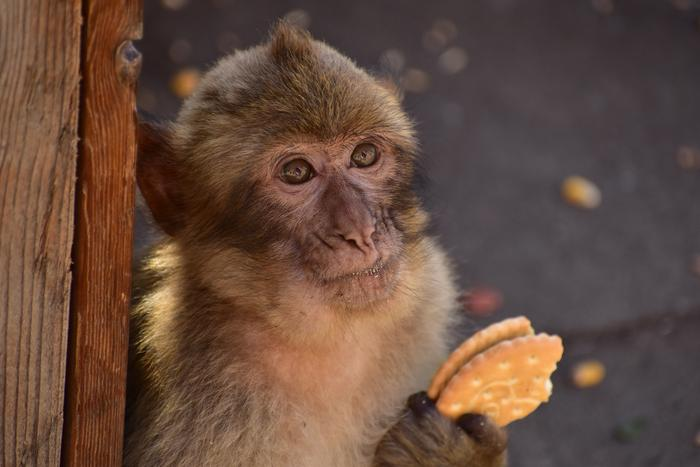
A Gibraltar macaque eating a biscuit. Martin Nicourt/Gibraltar Macaques Project
2026 04 22 monos Gibraltar Mª Carmen Hernández EN
Mª Carmen Hernández
Assistant Professor in Zoology at the Autonomous University of Madrid
Geophagy is a behaviour that, although it may seem unusual to us, is actually quite widespread across the animal kingdom, occurring in mammals, birds, reptiles and invertebrates. One of the most striking examples is that of macaws and parrots in various tropical and subtropical ecosystems, which gather at clay licks to consume mineral-rich soils. In this case, clay ingestion serves to supply essential minerals such as sodium. In other animals, it also fulfils functions related to digestive regulation and the neutralisation of toxic compounds. Clay—particularly minerals such as kaolinite and smectites—can adsorb alkaloids, tannins, phenols and other plant toxins. It may also protect the intestinal mucosa and act as an antidiarrhoeal agent. Among primates, geophagy is a widely distributed behaviour and has been documented in up to 136 species.
This study clearly demonstrates the impact of human activity on the behaviour and welfare of wild animals. The researchers find that human-derived food likely compromises digestive health, leading to an increase in geophagy as a mechanism to alleviate gastrointestinal discomfort caused by processed foods. Moreover, these anthropogenic pressures may be promoting a process of cultural transmission within macaque social groups, as different groups show distinct preferences for particular types of substrate.
Once again, the negative impact of human activities on the welfare of wild animal populations is evident. This should translate into greater efforts in environmental education and the development of effective biodiversity protection policies. We must recognise that, although some species display a remarkable capacity to develop compensatory mechanisms—such as the one described in this study—many others are unable to adapt to heavily disturbed environments and consequently experience population declines or, in the most extreme cases, disappear altogether.
2026 04 22 monos Gibraltar Ana María Fidalgo de las Heras
Ana María Fidalgo de las Heras
President of the Spanish Primatology Association (APE), coordinator of the Primatology Research Group and co-director of the Master’s Degree in Applied Ethology and Animal-Assisted Interventions at the Autonomous University of Madrid
The study by Frater and colleagues provides a novel account of geophagy (soil ingestion) in the Barbary macaques of Gibraltar, a population living in a context of intense human interaction. Based on systematic observations and spatial and dietary analyses, the authors show that this behaviour is relatively common and is associated with the consumption of food provided by tourists. The work stands out for its integrative approach and for illustrating how certain behaviours can emerge and persist in highly anthropogenic environments, offering a clear example of behavioural flexibility in primates.
However, the conclusions should be interpreted with caution. All the evidence comes from a single population that does not inhabit a natural setting for the species, but rather an artificial environment with regular food provisioning and diets far removed from the original ecological conditions. Moreover, although an association is observed between geophagy and the consumption of human-derived food, the actual quantities ingested by the macaques and their physiological impact are not clearly quantified, making it difficult to conclusively test the proposed functional hypotheses. In addition, the different hypotheses are assessed using variable sample sizes and observational methodologies that are not always equivalent, complicating the interpretation of whether the observed patterns consistently support one explanation over another. Finally, comparisons with other populations bring together highly heterogeneous contexts (ranging from wild populations to zoo settings) without truly comparable data. Overall, the study provides valuable information at a local scale, but it also highlights the need for caution when extrapolating these findings to the natural behaviour of the Barbary macaque more broadly.
2026 04 22 monos Gibraltar Andreu Sánchez EN
Andreu Sánchez Megías
PhD candidate in the Department of Social Psychology and Quantitative Psychology at the Faculty of Psychology, University of Barcelona
This is a very interesting study that examines geophagy, or the consumption of soil—a behaviour known in various animal species in the wild as a way to obtain nutrients required for their diet. It is also well established that some species consume soil to alleviate gastrointestinal problems arising from the ingestion of toxins or compounds that may irritate the digestive tract, or even during episodes of gastrointestinal parasitism. In other words, geophagy can function as a form of ‘ethnomedicinal’ relief for digestive discomfort.
What is particularly interesting about this study is that it shows Barbary macaques on the Rock of Gibraltar using geophagy to counteract the harmful effects associated with consuming ultra-processed foods provided by tourists. This is highly significant, as it highlights the detrimental consequences of tourists feeding wildlife with human ultra-processed foods. These are foods designed to exploit our evolutionary mechanisms to generate a sense of reward when consumed, as they are rich in calories, salt, saturated fats and simple sugars, yet they do not provide balanced or adequate nutrition.
Beyond demonstrating that such foods can be harmful to humans when consumed in large quantities, the article underscores that they may also be harmful to other wildlife. It emphasises the importance of educating tourists not to feed wild or semi-wild animals, particularly with foods that may be detrimental to their health. This aspect should be fully integrated into awareness campaigns aimed at tourists in order to ensure safe and sustainable coexistence with wildlife. Moreover, it is well known that animals provisioned by humans often develop dependency, which can lead to further coexistence issues, including increased aggression and territorial behaviour, sometimes even resulting in attacks on people.
Overall, this study highlights the risks associated with ultra-processed foods, underlines the importance of appropriate human behaviour when engaging in wildlife tourism, and illustrates the remarkable behavioural flexibility of primates. The fact that such behaviours may spread through cultural transmission further reinforces this point.
J. Frater et al.
- Research article
- Peer reviewed
- Observational study
- Animals