Are pollinators disappearing?
Pollinators encompass numerous species from all over the world. Various studies have shown strong evidence of a profound and sustained decline, with the exception of the honeybee (Apis mellifera), whose populations have been recovering in various regions.
The decline affects virtually all invertebrates, not just pollinators. A 2019 study estimated that 40% of insect species are at risk of extinction in the coming decades. However, “media and public attention has focused disproportionately on the honeybee because it is domesticated, managed by humans, and crucial for agriculture, making it an attractive and easily communicable symbol, far more so than wild pollinators, which are much more diverse but less visible,” explains Anna Traveset, a research professor at IMEDEA (CSIC-UIB), to SMC Spain. This has led to a diversion of resources, public attention, and policy measures that have overshadowed more vulnerable pollinators—a situation science is now trying to correct.
Assessments by the Red List of the International Union for Conservation of Nature (IUCN) show that up to 40% of bee species could be threatened. Concepción Ornosa, a professor at the Complutense University of Madrid (UCM) and director of the Arthropod Biology and Biodiversity Research Group, tells SMC Spain: “In Europe, 9% of bee species, including bumblebees, are at risk of extinction, and in the U.S., between 2008 and 2013, there was a 23% decline in wild bees in the country’s major farming areas.”
As for butterflies, the report The EU Butterfly Indicator for Grassland Species: 1990–2017 shows that 39% of the biomass of European species was lost between 1990 and 2012. They continue to decline today, though at a less pronounced rate. Furthermore, Ornosa notes that “the best pollinators that exist are bumblebees, and, paradoxically, they are the most vulnerable group, as the IUCN estimates that globally, 46% of their species are threatened.”
What has happened to honeybee populations?
Apis mellifera is a species native to Africa, West Asia, and Europe, which has been introduced by humans to other continents. The IUCN includes these bees on its Red List of Threatened Species, but only counts wild populations: although they show a decline, the organization notes that the data are insufficient.
When it comes to domesticated bees, during the winter and spring of 2006 and 2007 in North America, a significant decline in commercial honeybee colonies resulted in the loss of approximately one-third of them. Following this, the conservation of Apis mellifera became a priority. The Food and Agriculture Organization of the United Nations (FAO) estimates that in 2022 there were 102 million honeybee colonies in domestic hives worldwide, representing a 76.3% increase since 2000. This is due to beekeeping strategies, such as replacing dead colonies by splitting existing ones, to address their decline.
“The scientific perception of the honeybee has changed significantly: far from being a species in decline, its global populations have remained stable or increased thanks to beekeeping, while numerous studies show that in ecosystems where it is not native, it can behave as an invasive species that competes with wild pollinators for food and nesting sites, transmits pathogens, and disrupts pollination networks,” says Traveset.
Research conducted in Australia and California (United States) has shown that honeybee densities account for nearly 98% of the total bee biomass in some areas, displacing native species and reducing their access to pollen. For this reason, ecologists and conservationists are warning that saving the honeybee does not equate to protecting biodiversity and that the priority should be the conservation of native pollinators, many of which are at risk of extinction.
When we talk about bees, we shouldn’t limit the discussion to the honeybee, as is often mistakenly done due to its importance in beekeeping
Concepción Ornosa
“When we talk about bees, we shouldn’t limit the discussion to the honeybee, as is often mistakenly done due to its importance in beekeeping; rather, we should use the term to refer to all bees, both domestic and wild. That is, the thousands of bee species that exist, which are just as important—or even more so—as pollinators than Apis mellifera, which is just one of those 22,000 recorded species,” Ornosa points out.
Which animals pollinate?
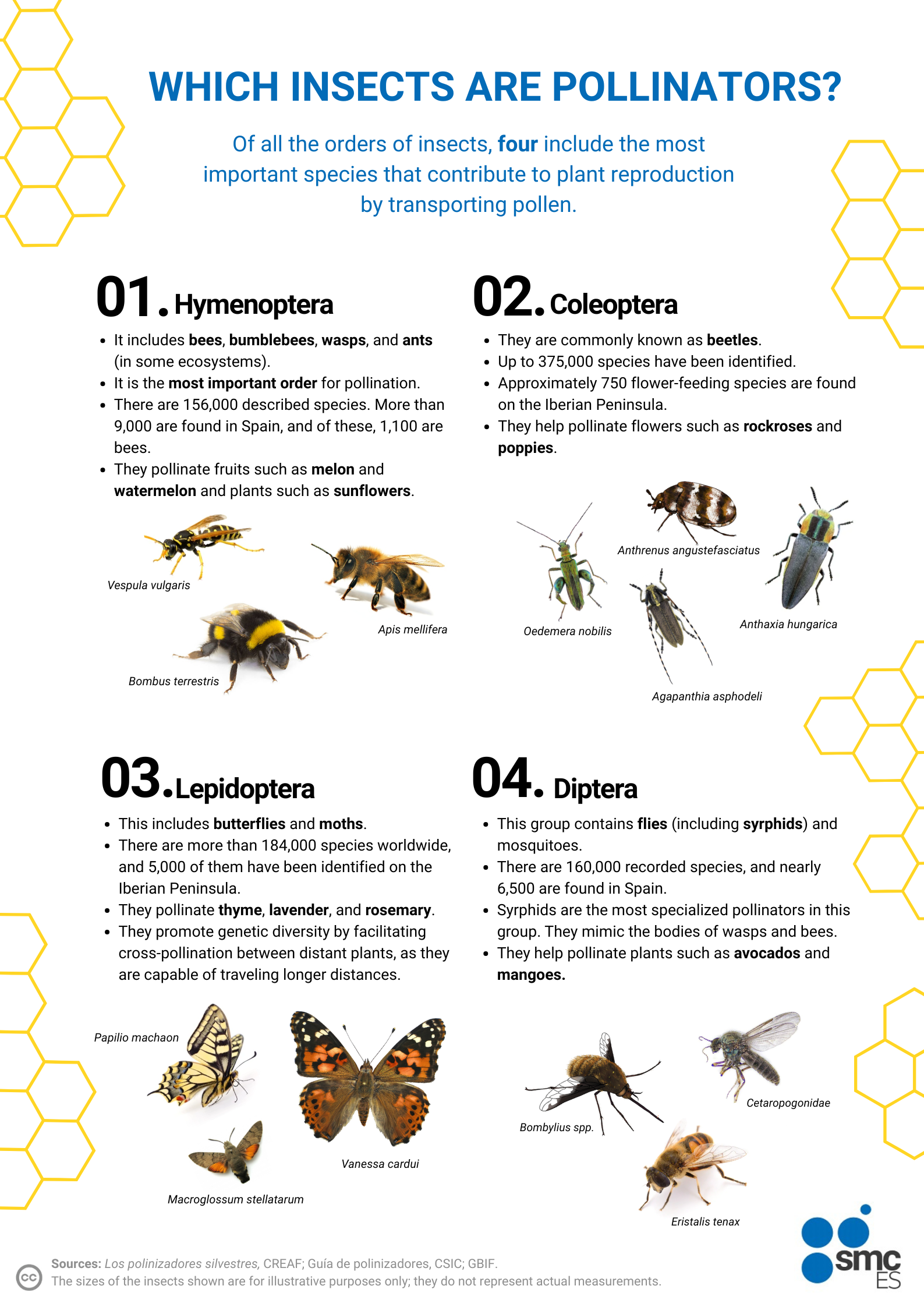
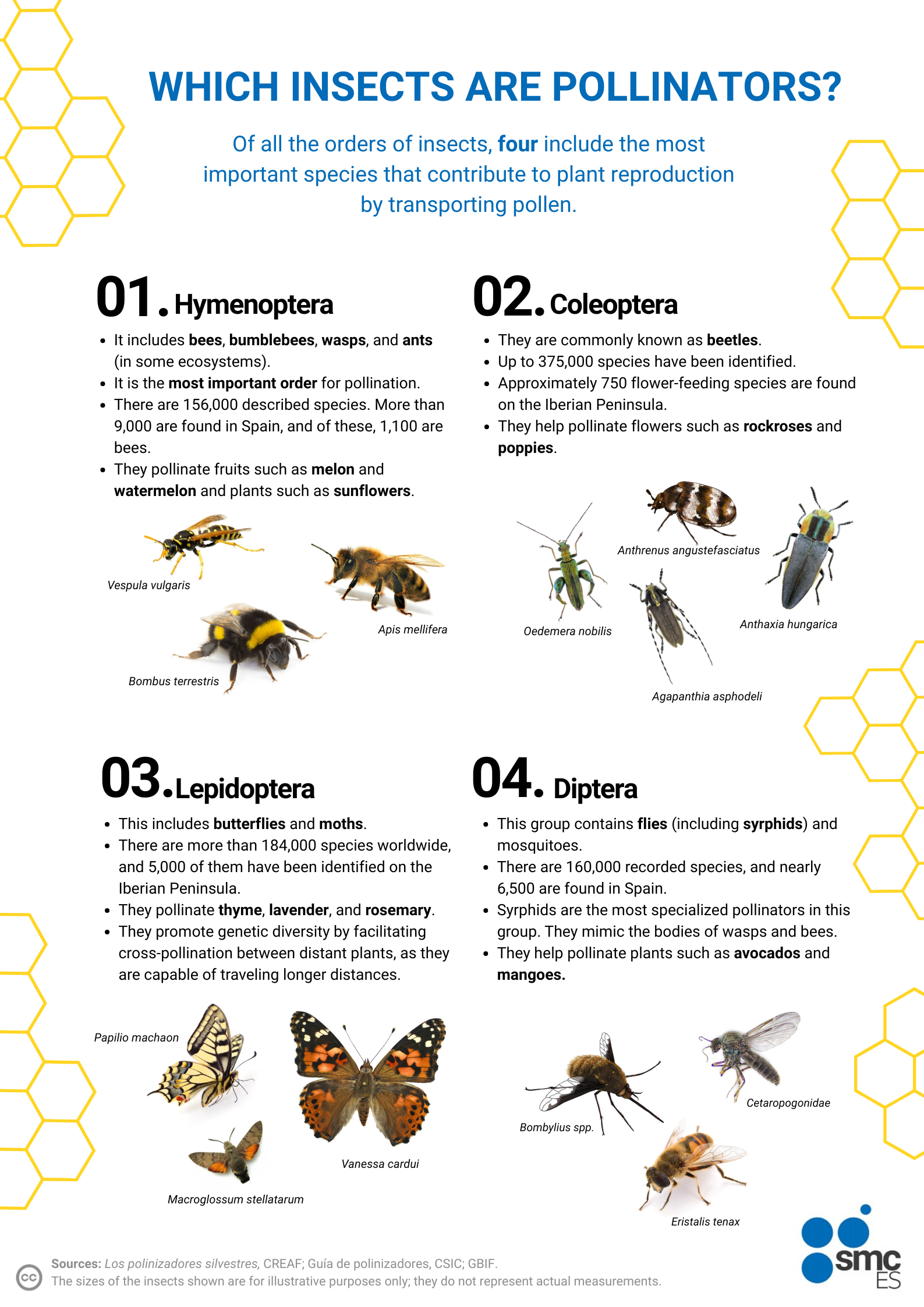
Insects are the primary agents of pollination, and this is carried out mainly by species of Hymenoptera, Coleoptera, Lepidoptera, and Diptera. Other animals also participate in this process. Gema Trigos, a researcher at the Museum and Institute of Zoology in Warsaw (Poland), tells SMC Spain that “hummingbirds carry pollen stuck to their beaks when they consume nectar, and nectar-feeding bats also play a key role in its dispersal.”
How do pollinators influence what we eat?
The economic value of pollination for crops essential to human survival worldwide ranges from $235 billion to $577 billion annually.
Foods derived from animal-pollinated crops are rich in essential micronutrients such as vitamins, antioxidants, and minerals. According to a study published in the journal Ecosistemas, 98% of vitamin C, 71% of vitamin A, 100% of certain carotenoids, and 58% of the calcium in the global human diet come from insect-pollinated crops.
75% of the world’s major plants rely on insects to ensure the quantity, quality, or stability of their crops, and it is estimated that, in the European Union, around 84% of crop species depend on the activity of these organisms. Among the crops for which pollinators are essential are cacao, melon, watermelon, squash, kiwi, and many varieties of almond. Others, such as most fruit trees, cucumbers, mangoes, and avocados, have a high degree of dependence.
Luis Navarro, professor of Botany at the University of Vigo and founder of the platform divulgare.net, explains to SMC Spain that the key lies in diversity. “Simplifying pollinator communities by relying excessively on a single species like Apis mellifera may partially maintain pollination services in some cases, but it reduces their resilience and can lead to crop losses or worsen growing conditions in others,” he argues. A study published in Science analyzed the effect of pollinators on fields across all continents—except Antarctica—and demonstrated that production increased with visits from wild pollinators in all crops, while visits from honeybees only increased production in 14% of them.
The decline of pollinators puts ecosystems and agricultural production at risk. To imagine what a future without these insects would look like, the EU created the Pollinator Park, an interactive digital experience developed in collaboration with several scientific institutions, including the Museum of Natural Sciences in Barcelona. The initiative recreates a dystopian scenario in 2050 in which visitors enter a virtual supermarket and observe how, as time progresses, certain fruits and vegetables—such as mangoes—become unavailable until they disappear entirely.
Who is primarily responsible for their decline?
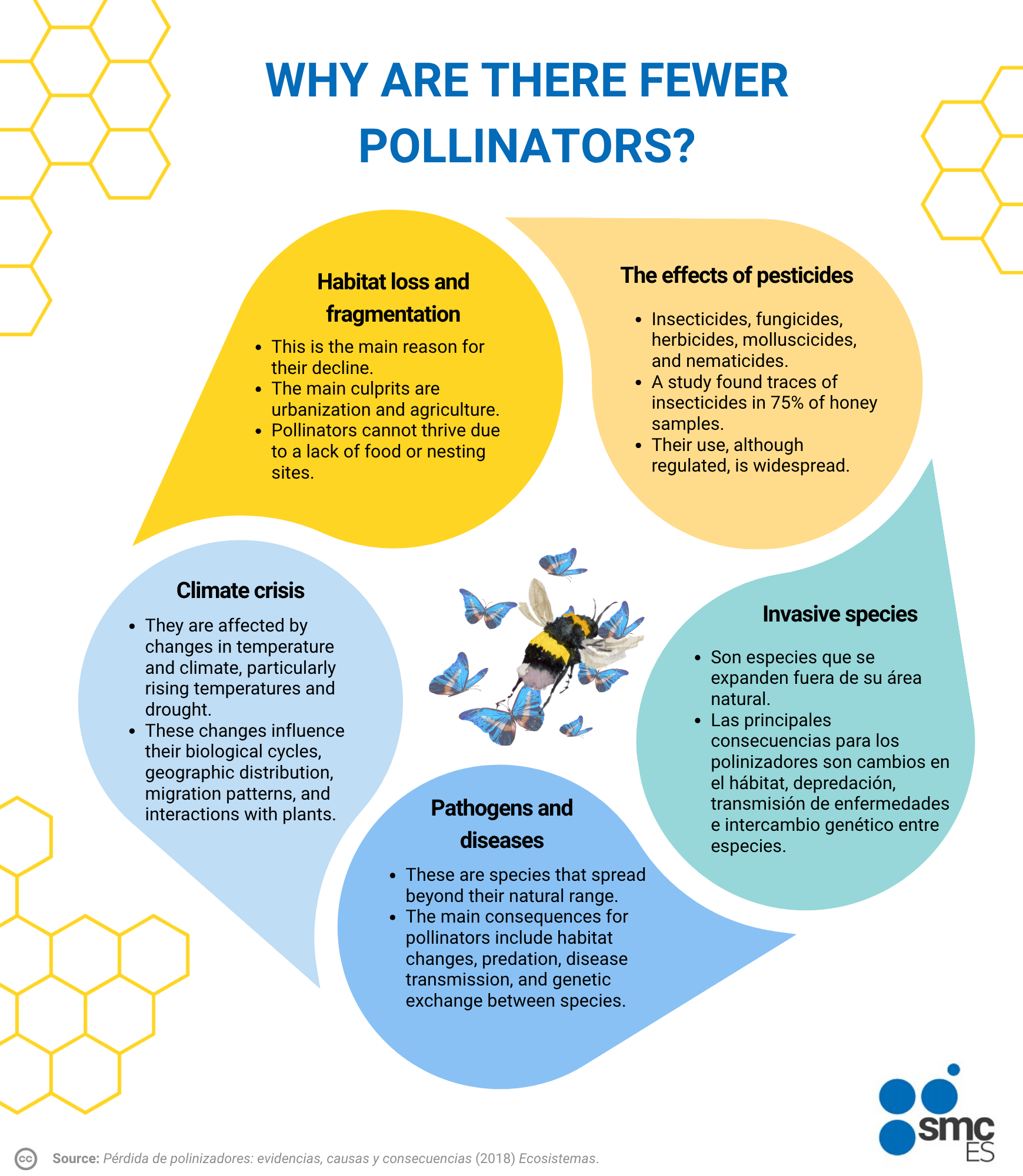
The main factors are habitat loss, degradation, and fragmentation; agricultural intensification; pesticide use; chemical pollution; pathogens; and climate change. “The important thing here is that these pressures rarely act in isolation: their effects accumulate and interact, so that communities already impoverished by habitat loss, for example, can become much more vulnerable to other factors,” notes Navarro.
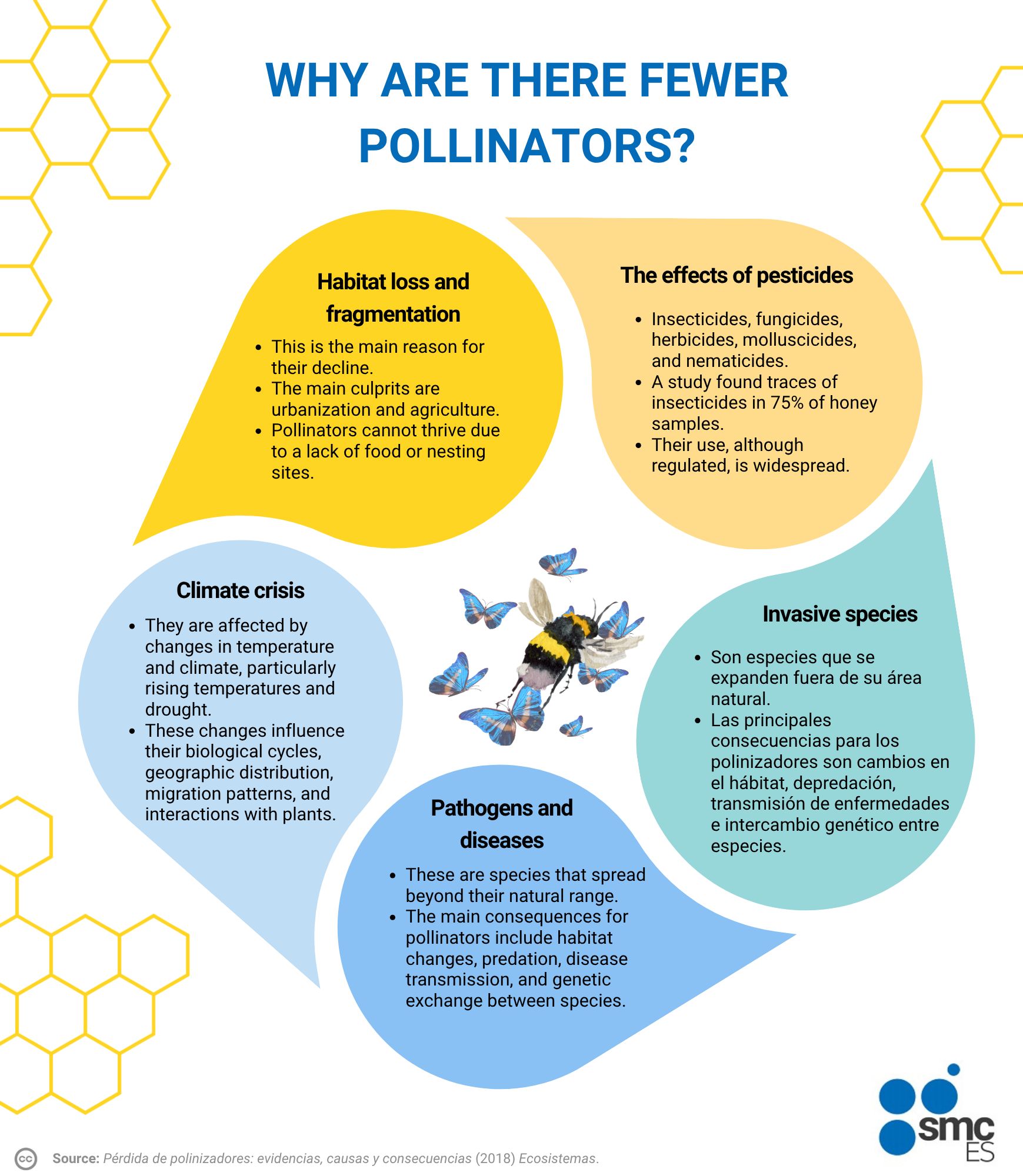
Land-use change is the main threat to these insects and is caused by agriculture, livestock farming, and urbanization, which limit floral diversity as well as the availability of food, nesting sites, and shelter.
Although pollinators do often find the resources they need to survive in agroecosystems, they are exposed to agrochemicals such as pesticides, fungicides, and herbicides. Navarro explains that “the most problematic for pollinators are neonicotinoid and pyrethroid insecticides.” Neonicotinoids have been widely used as seed treatments, which causes the insecticide to be absorbed by the plant and can appear in nectar and pollen, leading to chronic exposure for pollinators. Pyrethroids, on the other hand, are commonly applied against pests.
The use of such insecticides has been identified in multiple scientific studies as a major threat to bees, which is why their use was regulated by the EU in 2013. A study published in 2017 in the journal Science, which analyzed honey samples from around the world, concluded that 75% contained traces of one type of neonicotinoid and 45% contained two or more.
Like other animals, pollinators also face diseases and pathogens. Navarro notes that “in bees, the best-known case is Varroa destructor, a mite that particularly affects honeybee colonies.” In addition to this, there is a wide range of pathogens affecting various pollinators; among them are Nosema viruses in bees, or protozoa such as Crithidia bombi in bumblebees.
Furthermore, the expansion and intensive management of honeybees has facilitated the transmission of pathogens to wild species. This has also been the case with bumblebees, which are increasingly used in agriculture for commercial purposes. “Producers have not treated them with the necessary care, marketing them across different regions and even continents, thereby fostering competition with native species, undesirable hybridization, and the transmission of pathogens,” notes Ornosa.
Anthropogenic activities such as livestock farming or agriculture are not a threat in and of themselves; the problem is overexploitation, because that is when resources are used excessively and balance is lost
Gema Trigos
“Anthropogenic activities such as livestock farming or agriculture are not a threat in and of themselves; they have been carried out for over 10,000 years. The problem is overexploitation, because that is when resources are used excessively and balance is lost,” adds Trigos.
How does climate change affect them?
Changes in climate can alter their abundance and diversity, their geographic distribution, their phenology, their migration patterns, and their interactions with plants, although this depends on each species’ ability to adapt and colonize new areas. Temperature changes affect the biological cycles of insects: for example, a delayed winter leads to greater energy expenditure in the spring, which can result in higher mortality during the cold season, particularly affecting solitary bees of the genus Osmia.
Weather changes also cause temporal mismatches between pollinators and plants, with differing adaptations to temperatures and daylight hours. Furthermore, during periods of drought, nectar and pollen production is inhibited, which is particularly serious for specialist pollinators that depend on a limited number of plants. In addition, rising temperatures result in shifts of butterfly and bumblebee populations toward cooler areas.
What conservation plans are currently in place, and where should they be directed, according to experts?
Scientists are calling for conservation plans focused on preserving wild biodiversity. Navarro explains that “the measures employed generally benefit common or generalist species, but not the more specialized or threatened pollinator species, which partially improves pollination services in certain ecosystems without actually halting biodiversity loss.”
“In research, funding has been concentrated on plants or vertebrates, and the invertebrates that are prioritized are those of economic interest, pushing other less visible but essential organisms into the background,” notes Trigos.
In 2018, the European Commission launched the EU Pollinator Initiative, which for the first time focused on the conservation of wild pollinators and was revised in 2023. In Spain, the National Strategy for the Conservation of Pollinators was approved in 2020, aligning national policies with the European initiative to improve the situation by 2030.
Additionally, the Regulation on Nature Restoration of the European Parliament and the Council of the EU, dated August 2024, mandates the implementation of measures to restore pollinator populations. Trends will be measured at least every six years starting in 2030 through a pollinator monitoring system that Member States must implement, with the first review scheduled for this coming December.
One of the Commission’s most ambitious measures is to reduce the overall use of chemical pesticides by 50% by 2030. The goal is also for at least 25% of EU farmland to be dedicated to organic farming by that time.