Ángel Borja

Ángel Borja

Ángel Borja
Position

Principal Researcher in the area of Environmental Management of Seas and Coasts at AZTI and editor-in-chief of the journal Frontiers in Ocean Sustainability

Topics

Sea surface temperatures have reached record levels for this time of year

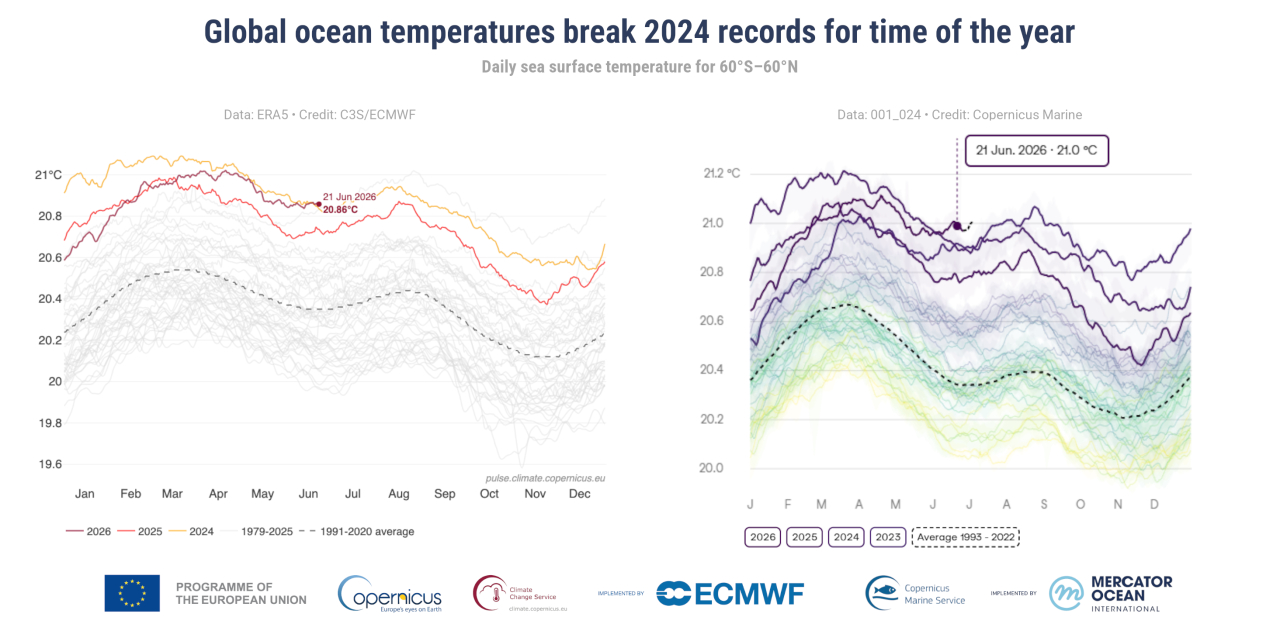
Two Copernicus services have independently confirmed that global sea surface temperatures have broken records for this time of year. Daily data from the Copernicus Climate Change Service exceeded the 2024 levels on 21 June, reaching 20.86 °C, higher than the 20.83 °C recorded in 2023 and 2024. Data from the Copernicus Marine Watch Service show temperatures of 21.0 °C on 21 June, beating the 2023 and 2024 records by 0.1 °C. This unprecedented warming is linked to the onset of El Niño (announced by the WMO and declared by NOAA on 11 June) and to record-breaking sea surface temperatures in the North Pacific; consequences are anticipated for weather patterns, the global climate and marine ecosystems.

0

Reaction: marine heatwaves last up to twice as long in deep water as at the surface

Most research has studied marine heatwaves at the sea surface. Now, a study published in Nature Climate Change analyses the effects of these phenomena at depths of up to 2,000 metres. The research, based on data from waves occurring between 1993 and 2019, shows that these waves tend to be more intense between 50 and 200 metres, and that their duration increases up to twice as much with depth compared to the surface, which has an impact on the marine fauna living in that area.

0

Reactions: Oceans Treaty goes ahead after more than 15 years of negotiations

The deadline passed and after two marathon nights of meetings, the delegations of the UN member states have managed to reach an agreement to make the so-called Oceans Treaty - or BBNJ Treaty, Biodiversity Beyond National Jurisdiction - a reality. New York City has seen the fifth session of this conference bear fruit with an agreement on the wording of the text, seventeen years after the talks began and with negotiations stalled last August due to a lack of agreement. The Treaty aims to protect and regulate the use of areas beyond national jurisdiction, which account for more than 60% of the oceans, or almost half of the planet. Marine genetic resources and how to share these benefits has been one of the main stumbling blocks.

0