COP17 on biodiversity concludes with minimal agreements
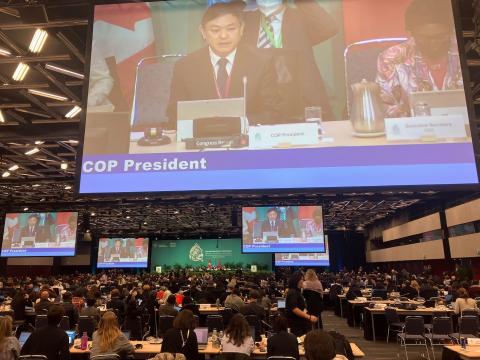
Following a long night of negotiations and a two-week summit, the 17th Conference of the Parties to the Convention on Biological Diversity (COP17), held in Yerevan (Armenia), has concluded with minimal agreements. One of these is the ‘Yerevan Pathway’, which aims to accelerate the implementation of the Kunming-Montreal Global Biodiversity Framework adopted at COP15 and regarded as the equivalent of the Paris Agreement. The new agreement sets out the implementation of national plans, the mobilisation of financial resources and greater involvement from all sectors of society. COP17 also assessed progress towards the targets set, including protecting one-third of the land and oceans by 2030. According to The Climate Watch, the assessment reveals significant gaps between commitments and their implementation.

COP17 Yerevan/Sergo Arakelyan.
Adrián Escudero - COP17 Ereván EN
Adrián Escudero
It is difficult to comment on the so-called Yerevan pathway when the final texts are not available. Although there was a sense of despondency because it seemed very difficult to reach agreements and recriminations between countries were widespread, the final session did yield agreements. 200 countries have signed it. It appears that the framework approved in the Kunming–Montreal texts is being further developed. The target of conserving 30 per cent of the Earth’s land and ocean areas by 2030 seems an almost utopian yet desirable minimum. Countries are committed to working towards this target.
How to finance these efforts to halt biodiversity loss is the key issue. The involvement of the business sector remains crucial to making progress. However, we do not yet know anything for certain.
Ultimately, the Yerevan agreement can be viewed as positive, above all because the first few days suggested complete deadlock. The mere fact that texts have been signed is a positive step. We will have to wait to see the final texts.
Jorge M Lobo - COP17 Ereván EN
Jorge M. Lobo
Researcher in the Department of Biogeography and Global Change at the National Museum of Natural Sciences (MNCN-CSIC)
The Conference of the Parties, or COP, is the decision-making body of an international convention. The COP on Biodiversity has now held 17 meetings since the first one took place in 1994, with the aim of establishing the institutional, financial and scientific mechanisms necessary to implement the Convention on Biological Diversity, which had been adopted two years earlier, in 1992. In 2022, COP15 took place, at which the Kunming–Montreal Global Biodiversity Framework was adopted – arguably the most significant agreement of recent decades on biodiversity conservation. It set out four major objectives for 2050 and 23 targets for 2030, including effectively conserving at least 30 per cent of terrestrial, inland water and marine areas, and effectively restoring at least 30 per cent of degraded ecosystems. The first of these targets is known as ‘30 × 30’ and has attracted significant criticism due to the restrictions it could impose on certain agricultural, livestock, forestry or fisheries practices.
Ultimately, this debate reflects a deeper conflict between the pursuit of short-term economic gains and the need to conserve the natural systems that make life possible. For far too long, much of economic development has ignored the environmental costs of its activities, passing on the consequences to society as a whole, to future generations and to nature itself. However, the scientific evidence is increasingly compelling: we are witnessing an accelerated loss of biodiversity, the degradation of ecosystems and an increased risk of extinction for numerous species. Paradoxically, many of the economic activities responsible for this deterioration depend on the functioning of the very natural systems they are helping to destroy. Beyond the sometimes bitter clash between different conceptions of progress, the issue is to recognise that economic development cannot grow indefinitely at the expense of limited natural resources, and that immediate benefits cannot justify any irreversible transformation of nature. Is a development model possible that generates well-being and wealth without destroying the ecological conditions that make our existence possible? And can such a model be achieved without questioning how wealth is generated and distributed?
Four years after the adoption of the Kunming–Montreal Framework, there is widespread international recognition that progress remains insufficient. COP17 has just concluded, at which it was agreed to promote the so-called Yerevan Roadmap, designed to accelerate the implementation of previous commitments. Its priorities include facilitating the implementation of national conservation and restoration plans, mobilising technical and financial resources, integrating biodiversity into public policies, and strengthening the scientific capacities needed to obtain reliable information on its status and trends. The main problem is that these commitments do not, in themselves, guarantee the necessary financial resources, regulatory reforms or local action. Furthermore, designating a particular area as protected does not necessarily mean that the biodiversity it harbours is effectively conserved. The management of these areas is essential, but there are also threats, such as climate change and pollution, which do not respect administrative boundaries.
The gap between the targets and reality is even more worrying when we consider that, according to data available in October 2026, protected areas and other effective conservation measures cover barely 19 per cent of land and inland waters and 10 per cent of the oceans. Moreover, these figures primarily reflect the area officially designated under some form of conservation status, not necessarily its effectiveness in safeguarding species and ecosystems. For all these reasons, the outlook remains worrying in the wake of this recent COP. The Yerevan Roadmap represents a new effort at international coordination, but insufficient funding, the slow pace of implementing measures and the persistence of economic activities harmful to nature seriously jeopardise the achievement of the 2030 targets. The problem is no longer so much reaching agreements on the need to conserve biodiversity as ensuring that those agreements genuinely transform the way we relate to nature.