The first thorium-229-based nuclear clocks are unveiled
Two independent studies published simultaneously in Nature claim to have developed the first functional nuclear clocks, both based on thorium-229 isotopes. Although their current stability is lower than that of the best atomic clocks, the authors maintain that future research could increase it by around four orders of magnitude, which would facilitate research in the field of fundamental physics.
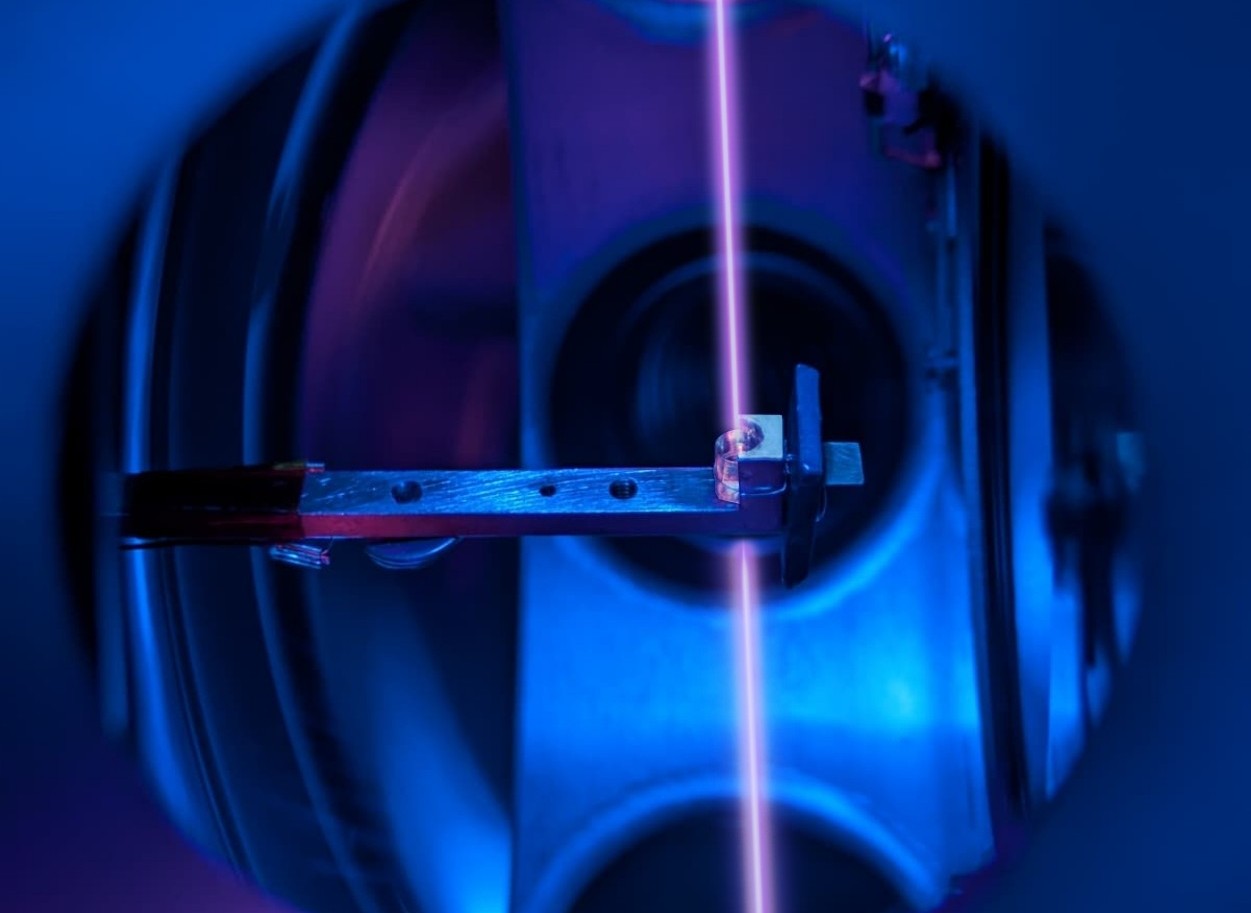
Photo of the crystal (in its holder) inside the vacuum system, with the laser beam probing the thorium nuclei. Credit: T. Schumm TU Wien.
José R. Crespo López-Urrutia - reloj nuclear EN
José R. Crespo López-Urrutia
Researcher at the Max Planck Institute for Nuclear Physics in Heidelberg (Germany)
The papers represent a significant breakthrough in a very new field, given that it has only been five years since the idea of a nuclear clock began to take shape. Both papers are clearly of a very high standard.
A very important point is that the project carried out by the Beijing team has, in a very short space of time, caught up with the pioneering teams in Braunschweig, Vienna and Boulder.
Although the accuracy of the nuclear clock does not yet match that of the best optical atomic clocks, its sensitivity to certain hypothetical forms of dark matter is almost ten thousand times greater than that of the latter. In general, the clock based on the thorium-229 (Th-229) nucleus is a unique case in physics: it is like placing a different oil tanker on each arm of a set of scales, and finding that their weights coincide to within one kilogram. Such is the balance of energies that determines the frequency of the nuclear clock in this truly unique and fascinating case. The ‘kilogram’ in this analogy can already be measured using the nuclear clock to an accuracy of thirteen or fourteen decimal places. The consequence is that, should a new particle or interaction emerge, or should there be temporal fluctuations in the physics we know, this balance would be disrupted sufficiently for us to be able to measure it. The new clock will therefore enable us to explore these frontiers of known physics in greater depth. The Vienna-Braunschweig collaboration is already carrying out an initial analysis of this possibility. This has enabled them to rule out almost three orders of magnitude in the possible range of interactions due to scalar bosons, which are hypothetical particles postulated as dark matter.
The experiments are compact. Although they rely on advanced laser systems, these require far fewer research resources than the large accelerator and detector facilities also used for these purposes. Of course, the nuclear clock does not cover all the types of dark matter that have been hypothesised, but neither do its ‘bigger brothers’ at high-energy centres.
By achieving greater precision than previous experiments, the new results confirm and expand upon what has been known for the past few years and demonstrate that the nuclear clock is now capable of ruling out the range of plausibility for certain hypotheses regarding the nature of dark matter. High-precision experiments such as these make it possible to test various hypotheses that would lead to deviations from what has been observed.
[As for possible limitations] It is logical that, in such a short space of time, certain aspects of the experimental set-ups have not yet been studied. These are the first nuclear clocks in the sense accepted by the very exclusive community of ‘atomic clockmakers’, who specialise in comparing their results internationally to the eighteenth decimal place. For example, the temperature stability of the calcium fluoride crystals containing the thorium-229 isotope can be technically improved. The purity and transparency of the crystals will also need to be improved. But the results demonstrated by both groups are already of a remarkable standard. In a few years’ time, we will see successive advances in this fascinating field: weighing up the balance between two fundamental interactions—the strong and the electroweak—to study or rule out the presence of possible factors hitherto unknown.
Conflicts of interest: “I know some of the groups that have authored the articles and have collaborated with them, but I have not been directly involved in this work.”
Dolores del Campo - reloj nuclear EN
Dolores del Campo Maldonado
Director of the Mechanical Magnitudes and Engineering Division at the Spanish Metrology Center (CEM)
In general, nuclear clocks (thorium in particular) are currently regarded as the next step beyond existing optical atomic clocks.
At present, there are not many research groups working on this type of clock; I know that the US National Institute of Standards and Technology (NIST) is also working on them. The advantages they offer over current clocks are not only that they can achieve greater accuracy (beyond 10-19), but also that they offer other benefits, such as reduced sensitivity to the environment and to electric fields. This greater accuracy will enable research into fundamental physics, such as investigating the accuracy of fundamental constants or dark energy.
But there is still a long way to go before we get there; these studies represent two further steps towards achieving the necessary stability and repeatability, so that these clocks can be compared with one another and with current ones, and can be used to define the second. Both studies focus on the same thorium isotope and aim to demonstrate that the nuclear transition is sufficiently reproducible to serve as a good oscillator. Their aim is to validate a robust platform for these to become clocks (the prerequisite being that they are good, reproducible and repeatable oscillators). In the Chinese study, the clock is about six times more stable in the short term than that in the Austrian study, but the strength of the Austrian study lies in the fact that it compares its results with a Yb [ytterbium] clock.
Both studies are aimed at improving the configuration of Th clocks and are significant in the context of future developments. Although it is unlikely that this type of clock will have a real impact on the new definition of the second (particularly if it is redefined in 2030; if it were postponed, they might stand a chance), they will undoubtedly play an important role in the medium term in future revisions or updates.
Rubiales - Reloj nuclear
Daniel Rodríguez Rubiales
The press release clearly outlines the significance of these papers: they describe the first nuclear clock—an optical clock based on a nuclear transition. To me, the most extraordinary aspect is the ability to control a nuclear transition using a laser and then use that transition to stabilize the laser itself; this has led to significant technical implications and developments.
The papers are of excellent quality and achieve a goal first proposed in 2003: using the transition between an excited state of the 229Th nucleus and its ground state to keep time—much like atomic and optical clocks do, though those rely on an atom's outermost electron. This clock, however, would measure the nuclear transition and count seconds based on the frequency (defined as the number of oscillations per second). Because it relies on a nucleus—which is more isolated than an atomic electron—it would be more robust against external disturbances. This is a unique case, as nuclear transitions typically involve energies far too high to be driven by a laser.
Driving this nuclear transition—which involves an unusually low energy level for a nucleus—required a laser emitting at a wavelength of around 148 nm, a capability that did not exist until recently. Consequently, the technology had to be developed over several years, with different research groups proposing various approaches. Measuring the transition energy has taken decades; two years ago, a measurement was achieved by embedding 229Th into a CaF2 crystal during an experiment at ISOLDE/CERN. The key difference now is that the transition is not merely observed—detecting its fluorescence was a major achievement in itself—but the signal from the crystal is actually used to correct the laser radiation being measured, thereby enabling the conversion of frequency into a time standard. There is still room for improvement in achieving greater stability and reproducibility; however, given that this involves a nucleus and a low-energy excited state, the precision achieved could offer enhanced sensitivity for studying, for instance, the origin and properties of dark matter.
[Regarding potential limitations] As I understand it, the clock's stability—which is the factor that can cause frequency measurements to vary or fluctuate over time—can currently be improved.
De col et al.
- Research article
- Peer reviewed
Huang et al.
- Research article
- Peer reviewed