Geomagnetic anomalies in the Southern Hemisphere that pose a threat to satellites are a recurring phenomenon, according to research
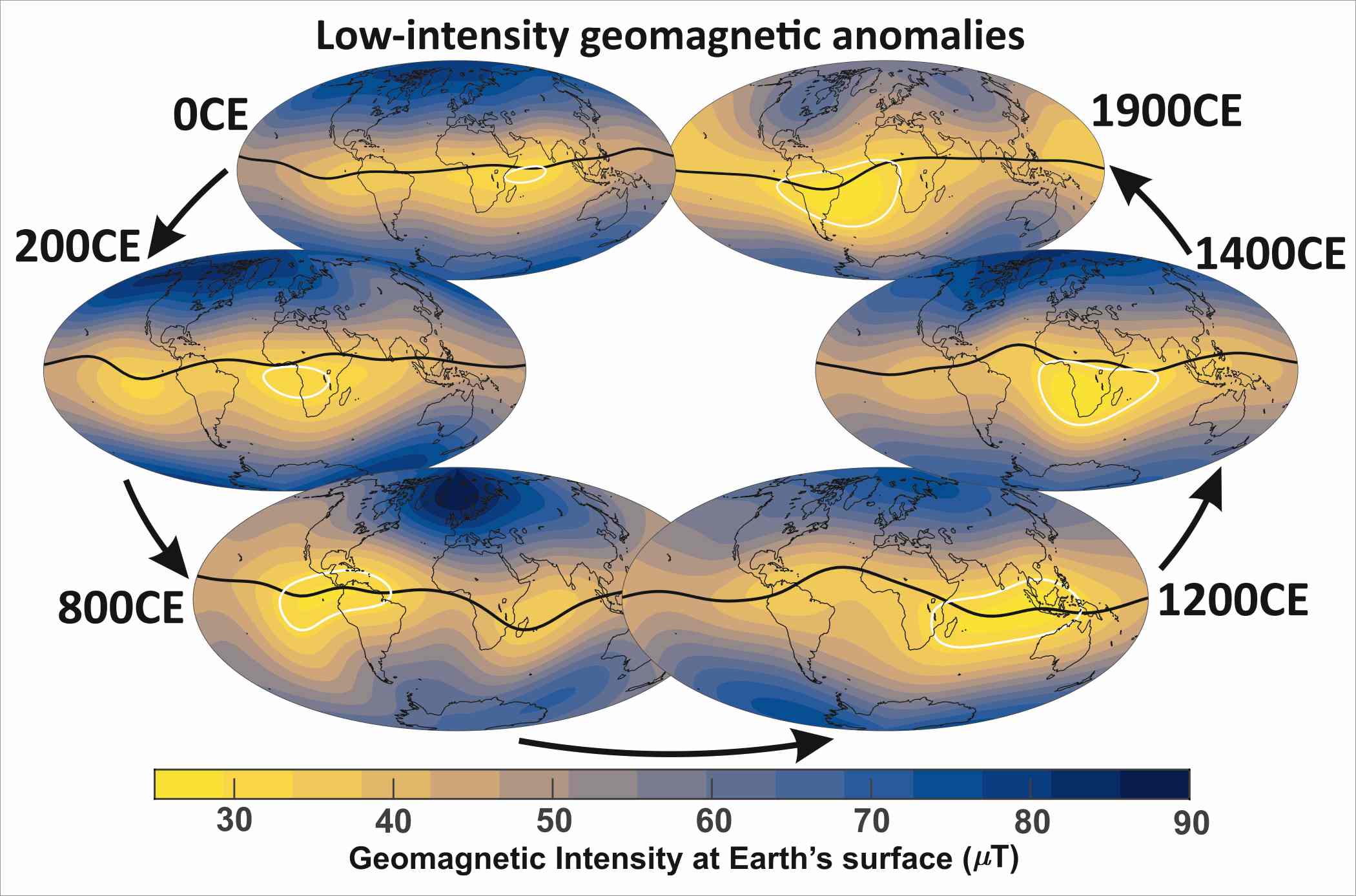
The geomagnetic field protects Earth from harmful cosmic radiation. Over the past two centuries, this field has weakened, coinciding with the growth of the South Atlantic Anomaly—a region of reduced magnetic intensity spanning South America and the South Atlantic Ocean—which poses risks to satellites and space missions. Research led by a Spanish team shows that this anomaly is a recurring event on timescales ranging from centuries to millennia, according to a reconstruction of the geomagnetic field over the past 2,000 years. The study, published in PNAS, shows that the current anomaly emerged after the year 1100 in the Indian Ocean and crossed Africa before reaching South America.
Santiago Belda - GEOMAGNETISMOS
Santiago Belda
Distinguished Researcher in the Geodesy and Spatial Dynamics Group of the Department of Applied Mathematics of the University of Alicante
The study is of very high quality and represents a substantial advance in our understanding of the Earth’s magnetic field in the Southern Hemisphere, where robust data has historically been scarce. The authors provide 41 new absolute geomagnetic intensity measurements obtained using rigorous experimental protocols, which significantly strengthen the existing database for South America. Combining these new data with updated global models allows for the reconstruction of the evolution of geomagnetic anomalies over the past 2,000 years and demonstrates that the current South Atlantic Anomaly is neither an exceptional nor a recent phenomenon, but rather the most recent manifestation of a recurring process operating on timescales ranging from centuries to millennia. Among the limitations, which are inevitable in this type of study, it is noteworthy that the data remain spatially uneven and that some inferences regarding the migration of ancient anomalies depend on models that, although well-founded, are still constrained by the scarcity of records in other areas of the Southern Hemisphere.
The main implication of this work is that it confirms the existence of a persistent asymmetry between the northern and southern hemispheres in magnetic field strength, linked to deep dynamic processes in the Earth’s core, possibly modulated by the structure of the mantle. Understanding the southern hemisphere anomalies is key because they have direct consequences for our planet: the South Atlantic Anomaly weakens protection against cosmic radiation, affects the operation and lifespan of satellites, and even impacts technological systems. Overall, the study does not imply that we are facing an imminent magnetic field reversal, but it does clearly improve the scientific basis needed to understand the future evolution of Earth’s magnetic shield and assess its potential technological and environmental impacts.
2026 05 04 geomagnetismo Josep M. Parés EN
Josep M. Parés
Coordinator of the Geochronology and Geology Programme at CENIEH
The Earth’s magnetic field can be understood as a protective shield that safeguards us from cosmic radiation and charged particles that bombard our planet via the solar wind. Without it, life as we know it would not exist. However, this field is neither static nor permanent; in fact, it is constantly changing over time. The direct information we have about the geomagnetic field is relatively recent and dates back to the development of the first instruments capable of measuring it accurately, namely magnetometers. To understand what the magnetic field was like before instrumental measurements existed, scientists must rely on indirect records preserved in geological and archaeological materials. The study of these records, which form the basis of palaeomagnetism and archaeomagnetism, makes it possible to reconstruct the evolution of the geomagnetic field over thousands and even millions of years. Thanks to this research, we now know that the Earth’s magnetic field not only varies in strength and position, but has also undergone numerous polarity reversals throughout Earth’s history.
The so-called South Atlantic Anomaly (SAA) is a “dent” in the Earth’s magnetic field over South America and the South Atlantic Ocean, where the decline in intensity of the Earth’s dipole field over the past 160 years is most pronounced. In order to better understand this phenomenon, Miriam Gómez-Paccard and F. Javier Pavón Carrasco, both with extensive professional experience and a strong reputation in the field, have led a palaeomagnetic study of more than 250 fragments of well-dated fired clay archaeological materials. Their results support the idea that the geomagnetic field follows large-scale recurrent patterns and depends on geodynamic processes operating at different scales. In this system, the Earth’s mantle and core interact and together influence the slow changes in the magnetic field over centuries and millennia.
The results are relevant not only for advancing our understanding of the geomagnetic field and, consequently, Earth’s history, but also due to the importance of the SAA for space safety, as satellites passing over this region are exposed to higher doses of incoming radiation because of the weaker geomagnetic intensity. This can cause failures or damage to critical hardware components and even disruptions in operation.
Improving our understanding of the geomagnetic field is therefore relevant not only for fundamental science, but also for technology, space exploration, and the protection of critical infrastructure.
2026 05 04 geomagnetismo Elisa M. Sánchez Moreno EN
Elisa M. Sánchez Moreno
Researcher in the Palaeomagnetism Group at the University of Burgos
Our understanding of the Earth’s magnetic field and its variations over time remains remarkably limited, particularly beyond the last few centuries covered by direct observations. Although it is well established that the geomagnetic field varies on multiple timescales—from rapid secular variation over decades to longer-term changes in field intensity, geometry and even polarity reversals over centuries to millennia—our view of these processes is still fragmentary and geographically biased. This lack of comprehensive knowledge makes it difficult to fully understand the mechanisms that drive geomagnetic variability and, consequently, to make reliable predictions about its future evolution.
In particular, the Southern Hemisphere has long been underrepresented in paleomagnetic and archeomagnetic records. This article makes a valuable contribution by providing new, well-dated archeomagnetic intensity data from South America, demonstrating that weak-field conditions similar to the present-day South Atlantic Anomaly (SAA) have occurred repeatedly over the past two thousand years. These findings are consistent with previous evidence, but they significantly strengthen existing interpretations by filling critical gaps during periods that were previously poorly constrained. A notable strength of the study lies in the quality of its sampling and methodology: the authors rely on carefully selected archaeological materials with robust chronological control and apply rigorous paleointensity protocols, including repeated checks for alteration, corrections for anisotropy and cooling-rate effects, and strict data acceptance criteria. Although this conservative approach reduces the overall success rate, it increases confidence in the resulting intensity record and limits the risk of artefacts or spurious trends, which is particularly important when reconstructing hemispheric-scale features.
Understanding geomagnetic anomalies in the Southern Hemisphere is especially relevant because the Earth’s magnetic field plays a fundamental role in shielding the planet from solar and cosmic radiation. Regions of reduced field strength, such as the SAA today and its past analogues identified in this study, imply a locally weaker magnetic shield. In the modern world, such conditions can affect satellite electronics, spacecraft operations and the performance of satellite-based navigation systems such as GPS, due to enhanced radiation exposure.
Importantly, the study supports the idea that geomagnetic field morphology is controlled by multiscale geodynamic processes, involving interactions between outer core dynamics and regional boundary conditions at the core–mantle boundary. The recurrent westward drift of low-intensity anomalies from the Indian Ocean to South America, and the identification of structured intensity trends over the past millennium, point to a persistent regional control, plausibly linked to large low-shear-velocity provinces beneath Africa. These observations caution against deterministic claims about the near-future evolution of the SAA, whether towards weakening or continued growth, and underscore the need for additional high-quality archeomagnetic data—particularly directional records from the Southern Hemisphere—to better constrain the range of possible geomagnetic futures.
Miriam Gómez-Paccard et al.
- Research article
- Peer reviewed