“Oh, no; oh, no. This is a huge blow. I hardly know what to say,” stammered David Maron, president of the American Society of Preventive Cardiology, according to an article in The New York Times. “It’s extremely disappointing news. We’d been looking forward to celebrating this for some time,” said Harlan Krumholz, a cardiologist at Yale.
Both referred to the results of the Lp(a)HORIZON clinical trial, announced on 4 September by the pharmaceutical company Novartis. A brief press release announced that its drug, designed to lower levels of lipoprotein (a) – a very specific type of particle that carries ‘bad’ cholesterol (LDL) through the blood – had failed to reduce cardiovascular risk. It was the first drug to be tested that succeeded in reducing levels of the particle, but without the expected effect – a point that cardiologist Davide Cappodano summed up as follows: “It was said that three things were certain in life: death, taxes and that reducing lipoprotein (a) would improve health”.
The third has not been achieved, despite the fact that a wealth of studies of various kinds had established a strong link between these particles and the risk of heart attacks or strokes. Reducing them seemed to be the missing piece of the jigsaw for improving treatments. The full results will be announced on 7 November at the American Heart Association’s conference and will be accompanied by corresponding publications in a scientific journal, which will allow for a more accurate interpretation.
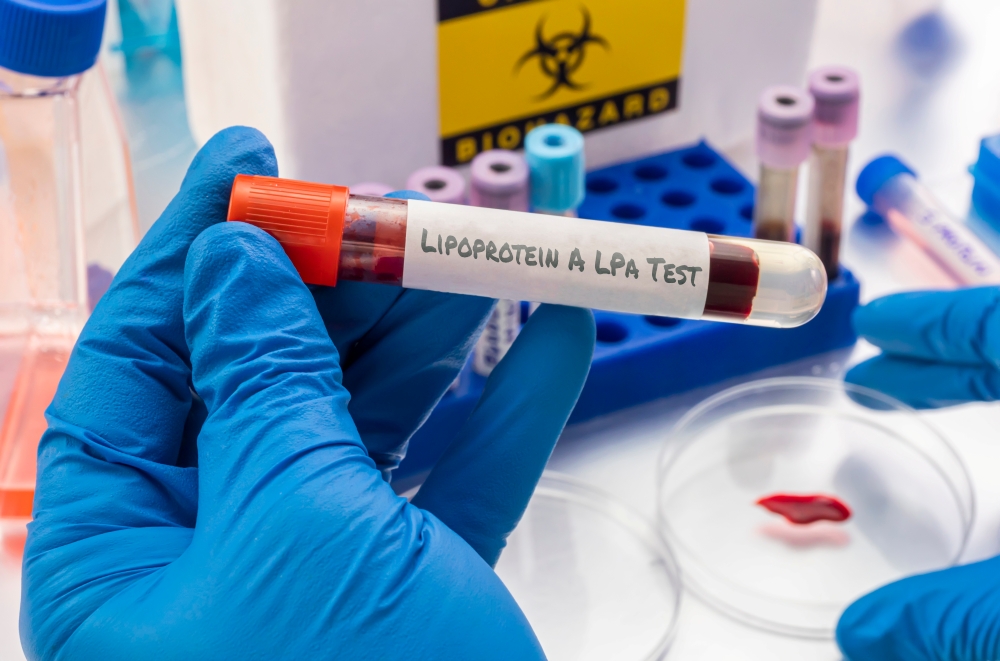
In any case, lipoprotein (a) is still considered a modifier of cardiovascular risk, and numerous scientific societies recommend that everyone of adult age should have their levels tested at least once in their lifetime.
Below, we explain what is known about the particle which, according to the consensus of the Spanish Society of Arteriosclerosis in 2024, “may be the most significant development in the field of lipidology in the last 50 years”.
What is lipoprotein (a) and why is it considered so important?
It is a particle very similar to those of LDL, the ‘bad cholesterol’. The differences between them are small but significant:
- It contains a protein called apo (a), which LDL does not have.
- Unlike LDL cholesterol, it is hardly affected by diet or lifestyle. It is 80–90 per cent genetically determined and remains fairly stable throughout life, which is why it may be sufficient to measure it just once. Twenty per cent of the population have levels higher than those considered normal.
- Numerous treatments, such as statins, reduce LDL cholesterol levels, but until now no medicines had been developed to lower lipoprotein (a). Only one type — iPSCSK9 — reduces it by 20 per cent, although its primary target is LDL.
- Although the number of Lp(a) particles is normally much lower than that of LDL, each one is considered to be around 5–6 times more atherogenic; in other words, it can cause more damage and plaque build-up in the arteries. This is why it is regarded as a missing link or hidden factor in the risk of cardiovascular disease, which remains the leading cause of death worldwide.
What evidence is there of its importance?
Lp(a) was discovered in 1963 (curiously, it is found only in primates and hedgehogs), but its importance was not fully recognised until after the year 2000. One of the first studies to clearly link it to cardiovascular risk was published in early 2008. After following more than 9,000 Danes for ten years, the researchers observed that the higher their lipoprotein (a) levels, the greater their risk of heart attack and death tended to be. Just one year later, a review involving more than 125,000 participants confirmed the link with atherosclerosis and vascular disease and, amongst many other studies, a major UK study involving some 460,000 people identified it once again in 2021.
These studies provide interesting, but not definitive, clues. They are observational, and although they attempt to isolate the factor under investigation, there may be another element that confounds the results. An illustrative example is the idea that having yellow fingers causes lung cancer, without taking into account that smoking is the underlying factor. “Proving causality is very difficult,” Daniel Escribano, a GP and specialist in dyslipidaemia at the Spanish Society of Family and Community Medicine (semFYC), tells SMC Spain. “For example, for years it was thought that coffee increased the risk of cancer. It was later found that this was not the case, but it appeared to be so because those who drank coffee tended to smoke more,” he explains.
The fact that lipoprotein (a) levels are genetically determined offers an advantage for its analysis. Certain studies, known as Mendelian randomisation studies, have underpinned this relationship: since 2010, an association has been observed between genetic variants that increase lipoprotein (a) levels and an increased risk of cardiovascular disease. “They do not prove it conclusively [that there is a causal relationship], but in reality all the evidence we had is very strong, very consistent,” Carlos Guijarro, a consultant physician at the Fundación Alcorcón University Hospital (Madrid), senior lecturer at Rey Juan Carlos University and former president of the Spanish Society of Arteriosclerosis, tells SMC Spain.
Is it recommended that everyone have it measured?
The Canadian Cardiovascular Society was the first to recommend measuring Lp(a) in the entire adult population at least once in their lifetime. Although there are no drugs to reduce it, the idea is that “if it is high, it may be necessary to intensify the available treatments, such as lowering LDL cholesterol further”, explains Escribano. In other words, it would provide clues about a risk that can be counteracted by other means.
The Canadian recommendation was issued in 2021, by which time the first clinical trials had already begun. Numerous European societies subsequently followed suit, and in 2026 the US organisations joined them. Interestingly, the Canadian College of Family Physicians opposed these recommendations. In Spain, the associations of primary care doctors have not issued an official position.
If lowering lipoprotein (a) were to reduce cardiovascular risk in a clinical trial, this would dispel doubts about its causal role and the appropriateness of measuring it. Hundreds of millions of people would be candidates for lifelong treatment. Many people took this for granted and were simply waiting to find out the extent of the benefit. However, the first trial has failed.
What is the Lp(a)HORIZON trial like, and what is known about it?
The Phase 3 trial involved more than 8,000 volunteers from over 40 countries and around 800 medical centres. All of them had a history of cardiovascular disease, such as heart attacks or strokes, and had a lipoprotein (a) level above 70 mg/dL (normal levels are below 50). Half received a monthly injection of the drug, called pelacarsen, which prevents the formation of this specific protein. The other half were given a placebo.
There were high expectations; it was thought that reducing it would also lower the risk, as is the case with LDL, but this hypothesis did not hold true
Daniel Escribano
The aim was for the treatment to reduce the number of heart attacks, strokes or deaths from either of these causes over a period of between two and a half and six years. However, although the drug reduces lipoprotein (a) by up to 80 per cent, “the findings did not show that this translated into a lower cardiovascular risk in the general study population”, acknowledged Shreeram Aradhye, president of development and chief medical officer at Novartis, in a press release. This is the only information available so far.
“There were high expectations; it was thought that reducing it would also lower the risk, as is the case with LDL, but the hypothesis was not borne out,” admits Escribano. “The feeling is one of frustration,” sums up Guijarro.
How should the results be interpreted?
What can be said with certainty is that the treatment did not improve cardiovascular risk in a statistically significant way in the study population. From there, the specific figures may provide some clues as to the future of the hypothesis and the role of Lp(a). The key figure is the relative risk, that is, the comparison of risk between those who received the treatment and those who received a placebo.
If there is no difference, the relative risk is 1. As Guijarro explains, “if it is favourable—for example, less than 0.9—it will be very important to analyse subgroups, because perhaps some participants might indeed benefit”. If the risk is “neutral, around 1, it would be considered discouraging. And if it were greater than 1.1 (that is, if the drug increased the risk by more than 10 per cent), it would be devastating for the study”, he says. This could be explained by side effects; however, based on previous studies, “it appears to be a fairly well-tolerated treatment”, says Escribano.
Once the full results are available, the subgroup analyses will be known: perhaps the treatment worked better in younger people or in those with the highest Lp(a) levels. This will provide information, but when making additional comparisons, an element of chance is introduced which may skew the findings. To draw conclusions, “clinical trials would need to be repeated in those specific populations. In principle, regulatory bodies do not accept subgroup analyses when approving treatments,” explains Guijarro.
One possibility that some voices are calling for us to consider is that Lp(a) may not be a risk factor, but rather a marker that accompanies the risk without causing it – much like wrinkles accompany ageing; or like PSA, which rises in the presence of prostate cancer but does not cause it. Or that its role may be more complex than expected, like that of amyloid in Alzheimer’s: although there is evidence of its significance, treatments to reduce it have had very modest effects.
For the time being, the Lp(a)HORIZON trial will not allow us to draw that conclusion. The only thing that can be established is that this particular treatment has not worked for this specific population and within the context of this trial.
What could explain the trial’s failure whilst still leaving the Lp(a) hypothesis standing?
There are reasons that would explain the negative results without ruling out the lipoprotein (a) hypothesis:
- Time: whilst lipoprotein (a) is present from birth, the treatment was administered for a maximum of six years. It is as if a bath had been filling drop by drop throughout a person’s entire life and, just as the water was about to overflow, we pulled the plug out a little. It is probably not enough to see the water level drop.
- The patients: it is possible that the drug’s effect is not evident in these patients but is in others. “Perhaps the trial criteria were designed to seek a rapid effect and to ensure the drug could be administered to as many people as possible. This may be why they included patients who had already suffered a cardiovascular event and did not require very high Lp(a) levels, but it has not turned out as they expected,” explains Guijarro.
- Other drugs: for the most part, the trial participants were already receiving intensive treatment to lower LDL and blood pressure; in that context, and in a large population, the role of Lp(a) may be less significant than expected.
In addition to this trial, there are at least four others with the same objective, conducted by different companies, testing other treatments and involving different populations.
Furthermore, the Lp(a)HORIZON trial is not the only one currently underway. At least four others with the same objective have already been launched by different companies, testing other treatments and in different populations: some achieve greater reductions in Lp(a); generally, patients with higher baseline levels are included; and at least one of the trials is being conducted in primary prevention, in high-risk individuals who do not yet have cardiovascular disease. The initial forecast is that they will be completed between 2028 and 2031.
Does the result of this trial affect the recommendation for universal screening?
The universal screening proposed by professional bodies is independent of the existence of an effective treatment for Lp(a), as it would provide information that would enable other therapies to be adjusted and reduce a hidden risk. However, these recommendations are aspirational; they are not systematically followed — not even in Spain — and, furthermore, they are qualified when put into practice.
The idea is that the test should be included when a person undergoes a vascular risk assessment – for example, when they are asked to have their cholesterol levels checked – but it is not advisable for the general public to turn out in large numbers
Carlos Guijarro
According to the position statement of the Spanish Society of Arteriosclerosis, “the idea is that the test should be included when a person undergoes a vascular risk assessment, for example, when they are asked to have their cholesterol levels checked”, explains Guijarro, “but it is neither necessary nor advisable for the general public to rush to have it done en masse. There are only a few cases in which it would be a priority, such as those who have had cardiovascular disease, those suffering from familial hypercholesterolaemia who do not respond well to treatment, or those with a family history of early-onset cardiovascular disease”, he states.
The actual significance of a high result in screening is also questionable. According to Escribano, those “who are at very high vascular risk are already undergoing intensive treatment for other risk factors, and in many cases this would not be altered”. In healthy people with normal test results, a high Lp(a) level is not usually excessively high, as this would imply abnormal levels of LDL cholesterol, and its impact on risk is lower. “Perhaps where it can provide the most information is in people at intermediate risk, because its influence can be significant and treatments can indeed be intensified,” summarises Escribano, who emphasises that “Lp(a) should never be interpreted as an isolated value, but rather in the context of the other results”.
“So, what am I going to do about Lp(a)?” wondered the American cardiologist Joseph Marine in an article. “I’m not going to rush to test all my patients. I look forward to critically examining the results of the clinical trials (…). Does this make me a bad doctor, or a sensible one?” In the same vein, Escribano believes that “recommendations and algorithms are helpful, but for a large part of the population they cannot be treated as gospel”. This is particularly true in a context where, as Guijarro acknowledges, “many GPs already face enough difficulties in reaching the entire at-risk population and ensuring they adhere to prescribed treatments”.
Why did they issue a press release before the full results were available?
One striking aspect has been the advance notice in the form of a brief press release, without waiting to share the full results on 7 November. However, as Guijarro points out, immediate disclosure “is a legal obligation in the case of publicly listed companies”.
Both the US Securities and Exchange Commission (SEC) and the European Union require, in such cases, the immediate and transparent disclosure of relevant information that could have a significant impact on share prices or an investor’s decision, as has recently been the case with a melanoma vaccine developed by the pharmaceutical companies Moderna and Merck. A few weeks earlier, NovoNordisk also reported that its ZEUS trial had failed; the trial had sought to reduce cardiovascular risk using a promising anti-inflammatory treatment.
What happens next?
The medical community is eagerly awaiting the full data on Saturday 7 November. Poor results do not rule out all theories regarding Lp(a), the role of which will only become clear as the various ongoing clinical trials are completed. “Right now, all I can say is that, for this general population, I will not be using this drug, nor am I authorised to do so,” summarises Guijarro.
It is highly likely that the target audience and market for these drugs will be smaller than expected. “Perhaps they are only effective for people with very high Lp(a) levels, and these account for considerably fewer than 20 per cent of the population,” he acknowledges. Hence, the expert highlights “the importance of negative results and the strength of a system which, despite expectations, vested interests and millions in investment, is capable of backtracking when a plausible hypothesis does not hold up”.
“To learn, you sometimes have to lose,” concludes Escribano.