A modified pig liver was transplanted into a living person for the first time
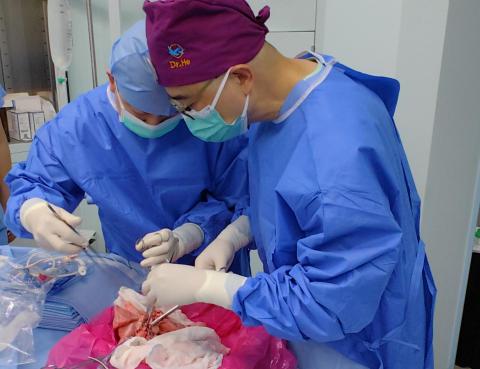
A team from China has reported the results of the first liver transplant from a pig to a living human. Earlier this year, a procedure that served as a proof of concept was published, but it was performed on a brain-dead person. In this case, after modifying 10 genes in the porcine liver, an auxiliary transplant—not removing the entire organ—was performed on a 71-year-old patient with cirrhosis and liver cancer. It worked well for the first month, but on day 38, the graft had to be removed due to the development of complications, and the patient died on day 171. According to the researchers, who published the case in the Journal of Hepatology, this is "a fundamental step that demonstrates both the promise and the obstacles that remain to be overcome".

Gil - Cerdo Humano Vivo (EN)
Beatriz Domínguez-Gil
Director of the National Transplant Organisation
This is the first auxiliary liver transplant from a genetically modified pig (with 10 genetic modifications) in a patient. Therefore, it is the first performed for therapeutic purposes. To date, two cases of liver xenotransplantation have been published (one in China and one in the US) in brain-dead individuals, where the timeframe for evaluating graft function is limited.
In this case, it was shown that the liver was able to function and support the patient for 38 days, with no evidence of rejection. However, the patient eventually developed xenotransplant-related thrombotic microangiopathy, requiring graft resection. Ultimately, the patient died on day 171.
We can say that this represents a new step in the advancement of xenotransplant therapy, which continues to progress in clinical development, but it also highlights the significant obstacles that remain to be overcome, such as the serious complication observed in this patient.
At the ONT, we insist that these transplants are experimental. Further work is needed to perfect the genetic modifications carried out, improve the immunosuppression used, and attempt to identify and address any complications that may develop early. Ideally, this should be done in properly designed clinical trials to evaluate their efficacy and safety in the short, medium, and long term. However, these cases allow us to glimpse a future in which xenotransplantation is a clinical reality as a bridge therapy (particularly in the case of the liver) or as a destination therapy.
I would like to add that, according to data from the Global Observatory on Donation and Transplantation, managed by the ONT as a WHO collaborating center, in 2024, in Europe alone, there were a total of 22,215 patients on the waiting list for a liver transplant, and only 11,019 received the transplant. Furthermore, in these countries, 2,314 patients died on the waiting list for a liver transplant.
Iván Fernández - trasplante hígado cerdo vivo EN
Iván Fernández Vega
Full professor of Pathological Anatomy at the University of Oviedo, Scientific Director of the Principality of Asturias Biobank (BioPA) and Coordinator of the Organoid hub of the ISCIII Biomodels and Biobanks platform
This study marks a historic milestone, as it is the first time that a genetically modified pig liver has been transplanted into a living patient and has functioned for weeks, producing bile, albumin, and coagulation factors. The procedure was performed on a 71-year-old man with cirrhosis due to hepatitis B and a very large hepatocellular carcinoma in the right lobe, with no known metastases, which was resected during the same surgery. The xenotransplantation was not considered a curative cancer treatment, but rather a supportive strategy to prevent liver failure after tumour removal, as the remaining liver was insufficient. Overall, the article is very well documented, with detailed clinical, immunological, and histological follow-up, which gives it great scientific value and makes it a reference for the field.
Until now, porcine heart and kidney transplants in humans had been described, as well as liver transplants from brain-dead donors. This is the first time that a porcine liver has been shown to integrate temporarily and perform critical metabolic and synthetic functions in a living patient. The case shows that the most realistic strategy is to use it as a bridge therapy, allowing time for the native liver to recover or for a human donor to become available. In a context of enormous organ shortage, this advance has enormous potential.
There are several limitations to consider. This is a single case. The graft had to be removed on day 38 due to thrombotic microangiopathy associated with xenotransplantation, a serious coagulation complication that reflects the current limitations of this strategy. The patient ultimately died months later. In addition, the intense and prolonged immunosuppression used (tacrolimus, sirolimus, mycophenolate, corticosteroids, basiliximab, rituximab) could promote the growth of residual tumour cells, if any. The paper does not describe the performance of a post-mortem study (autopsy), which would have been very valuable in confirming the absence of tumour recurrence, assessing the condition of the native liver, better understanding the haemorrhagic complications, and studying the systemic immune response. Significant questions also remain regarding safety against porcine viruses, duration of function, and ethical and social acceptance.
Rafael Matesanz - hígado cerdo vivo EN
Rafael Matesanz
Creator and founder of the National Transplant Organisation.
In the race established in recent years by researchers in the United States and China to take the lead in the field of xenotransplantation, the team at Anhui University Hospital in eastern China has taken a very important step forward with this study by demonstrating for the first time in a living human being that it is feasible to perform a genetically modified pig liver transplant.
A few months ago, another Chinese team demonstrated that this type of transplant was possible in a brain-dead patient. This time, however, the patient was alive and suffering from cirrhosis caused by the hepatitis B virus and a large tumour in the right lobe of the liver, which made resection unfeasible without a replacement liver. The transplant was carried out using a pig liver with 10 genetic modifications, achieving good function for 31 days, during which time it produced bile and was able to manufacture albumin and coagulation factors typical of a well-functioning graft. It had to be removed after this period due to the onset of thrombotic microangiopathy, a serious complication that can also be seen in some transplant patients with human grafts, and he finally died after 171 days from gastrointestinal bleeding.
The experience is very relevant because the fact that it has been demonstrated that the porcine liver can function without rejection or major complications, at least for a month, opens the door to its use in clinical trials as a “bridge organ” in patients with fulminant liver failure, awaiting a human liver for transplantation that does not always arrive in time. This is the approach of a trial already approved in the United States (although none have been carried out yet) and also the one proposed to the ONT by the University of Murcia, and this article demonstrates that they are perfectly possible.
An added value of this research is the fact that genetic modifications have been successfully introduced into the pig litter, including the elimination of potentially pathogenic viruses, which will greatly favour future production.
As with other pig organs transplanted to date, long-term survival is still a long way off, something that Chinese researchers are pursuing but which, for the moment, is not a near-term goal in the United States, where the focus is more on maintenance liver replacement until definitive transplantation.
As in other xenotransplantation experiments, there are more questions than answers, but a giant step forward has been taken with a possible immediate practical application as a bridge organ, something that had not been achieved in a credible way with other transplanted pig organs until now.
Zhang et al.
- Research article
- Peer reviewed
- People