Hominid fossils discovered in Morocco could be from ancestors very close to modern humans
An international team with Spanish participation has analysed hominid remains discovered in Casablanca (Morocco) and concluded that they could be very close ancestors of early modern humans. The fossils date from around the same period as the Homo antecessor found in Atapuerca—some 773,000 years ago—but are morphologically different. According to the authors, who published their findings in Nature, the fossils offer clues about the last common ancestor shared with Neanderthals and Denisovans, and support an African, rather than Eurasian, origin for H. sapiens.
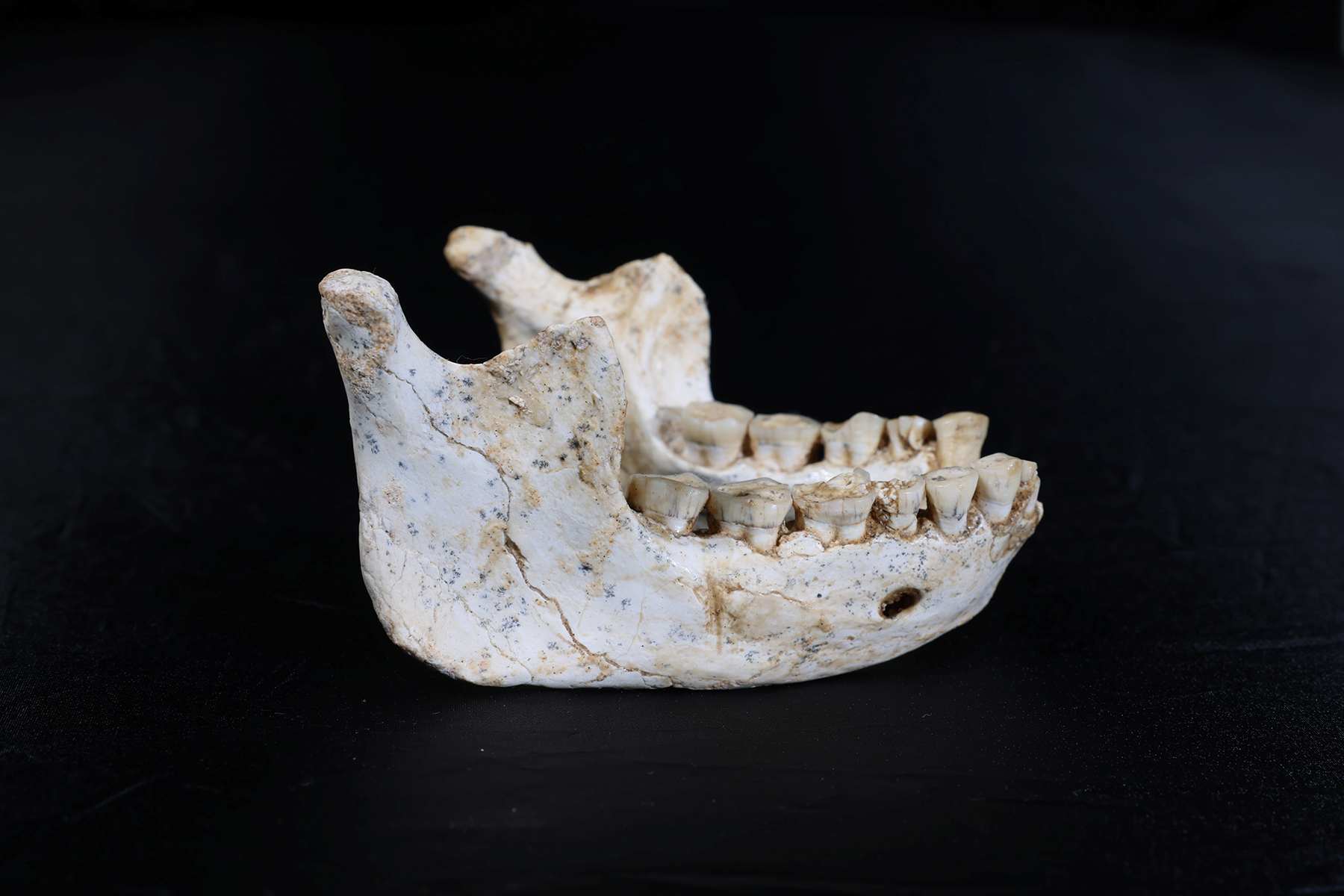
773 000 years old mandible ThI-GH-10717 from Thomas Quarry in Morocco. Credit : Hamza Mehimdate, Programme Préhistoire of Casablanca
Carles Lalueza - homínido Marruecos EN
Carles Lalueza-Fox
Director of the Museum of Natural Sciences of Barcelona and specialist in DNA recovery techniques in remains from the past
The new evidence, based on jawbones, does not rule out the possibility that a facial morphology such as that of Homo antecessor is a better candidate for the common ancestor of Homo sapiens, Neanderthals and Denisovans. It does confirm differences between fossils from North Africa and Europe around 800,000 years ago, highlighting the complexity of this still little-known period.
In any case, a well-known aphorism in paleoanthropology comes to mind, which says that ‘while the skull is God's creation, the jaw is the devil's work’; we will surely have to wait to discover what the skulls of these individuals looked like in order to clarify possible relationships with H. antecessor.
José María Bermúdez de Castro - homínido Marruecos EN
José María Bermúdez de Castro
Research Professor at CSIC and Coordinator of the Paleobiology Programme at the National Centre for Research on Human Evolution (CENIEH), Burgos
The article by Hublin et al. is excellent. It describes a very important piece of the puzzle that will bring us closer to the origin of Homo sapiens and Homo neanderthalensis, since there is very little record from the late Lower Pleistocene to early Middle Pleistocene period in Africa and Europe.
I think that the ThI-GH fossils could certainly be close to the last common ancestor of Neanderthals and modern humans (LCA), as is the case with the Homo antecessor fossils (Gran Dolina-TD6). However, the two hypodigms have been found in a "cul de sac": the Iberian Peninsula and North Africa. I still think that the Near East, the nexus between Africa and Europe, is an ideal region to find the LCA. I know there is a lack of evidence, and we will have to wait for it.
On the other hand, it would be very important for the team excavating at ThI-GH to find facial remains to test their hypothesis. In Homo antecessor, facial remains were decisive in the conclusions about the proximity of this species to the LCA.
Juan Ignacio Morales - homínido Marruecos EN
Juan Ignacio Morales
Ramón y Cajal researcher at IPHES-CERCA
"It is a very high-quality piece of work, especially because of how it anchors these fossils in a solid stratigraphic and chronological context, which is crucial when we are talking about ~773,000 years. The most interesting thing is that it fills a key gap in the African record right near the interval where genetics places the separation between the lineage that will end in Homo sapiens and the Neanderthal-Denisovan clade. In this sense, the Casablanca hominins can be read as an “African equivalent” of Homo antecessor (Atapuerca): two almost parallel windows on either side of the Mediterranean, with mosaic evolution, but with TD6 pointing more towards the Neanderthal trajectory and Casablanca towards the African one. Even so, the collection is partial (jaws, teeth and vertebrae) and does not allow us to identify the “last common ancestor” as such, which would be a population, not an individual.
Is it a good quality piece of work?
"It is a very good quality piece of work and, above all, very well constructed for a chronological period where uncertainty is usually at its highest. Its main strength is that it anchors the fossils in a very consistent stratigraphic and chronological context (around the Matuyama-Brunhes transition) and, from there, deploys a detailed comparative anatomical analysis. Put simply, it does not just “present some bones”, but places them quite accurately in time and brings them squarely into the debate on how human lineages diversified in Africa and Eurasia."
How does it fit in with the existing evidence and what implications could it have?
It fits into a classic problem: the lack of well-dated African fossils around the end of the Lower Pleistocene and the beginning of the Middle Pleistocene, precisely the interval in which the divergence between the African lineage that would eventually give rise to Homo sapiens and the Eurasian clade (Neanderthals/Denisovans) is estimated to have taken place. In this sense, the find serves as an essential reference point. Furthermore, the comparison with Homo antecessor (Atapuerca, TD6) is particularly useful: the hominins from Casablanca could be understood, in general terms, as an ‘African equivalent’ of H. antecessor, in the sense that both represent evolved forms of H. erectus s.l. at two extremes of the Mediterranean at similar times, with a mosaic anatomy (archaic features combined with more derived features). The interesting difference is directional: H. antecessor shows features that place it, on the whole, closer to the Eurasian Neanderthal trajectory, while Casablanca is interpreted as closer to the African populations that will lead to H. sapiens. This reinforces the idea that regional differentiation between Europe and North Africa was already underway very early on and puts the spotlight on the Maghreb as a key region for understanding this phase of diversification.
A particularly intriguing aspect is whether the remains from Thomas Quarry (Africa) and Gran Dolina (Europe) are the human forms closest to the last common ancestor of sapiens and Neanderthals. They are probably two of the best fossil candidates for approximating populations close to that divergence, especially because of their temporal position. But it is important to clarify something important: the ‘last common ancestor’ is not an individual, but a population or set of populations, and it is very difficult for a specific fossil to be ‘the’ common ancestor. What this work does contribute is to place Casablanca very close to the point of separation between African and Eurasian lineages and to offer an informative contrast with Atapuerca TD6: two almost parallel windows, on either side of the Strait, on the evolutionary stretch that precedes the clear differentiation between Neanderthals and sapiens.
Are there any important limitations to consider?
"Yes, and mentioning them does not detract from their importance. First, the fossil assemblage remains partial, which limits comparisons with other classic Middle Pleistocene fossils (such as Kabwe or Bodo) and forces us to base part of the argument on specific anatomical regions. Second, the taphonomic context suggests accumulation by carnivores, and part of the historical material has a less certain stratigraphic provenance, so not all pieces carry equal weight in the interpretation. And thirdly, although the main chronological anchor is convincing, some complementary dating approximations may provide more tense readings or should be interpreted as minimum ages, which makes it advisable to remain cautious with overly definitive statements".
Juan Luis Arsuaga - homínido Marruecos EN
Juan Luis Arsuaga
Palaeontologist and scientific director of the Museum of Human Evolution in Burgos
I find this article very interesting in relation to a topic we are researching in Atapuerca: the evolutionary separation of Neanderthals and sapiens and the last common ancestor. These new North African remains will have to be compared with the fossils of Homo antecessor in Atapuerca.
Hublin et al.
- Research article
- Peer reviewed