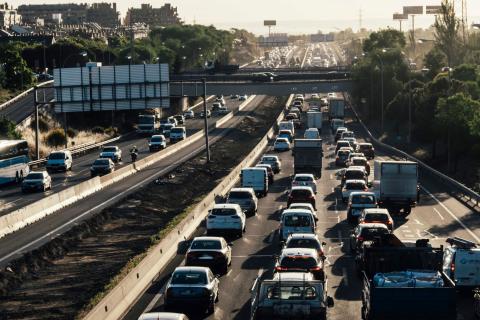
The poorest regions in Europe have higher mortality rates from air pollution
A study led by ISGlobal shows that European regions with higher levels of poverty and lower use of renewable energy face a greater risk of mortality from air pollution. The research, published in Nature Medicine, analysed 88.8 million deaths that occurred between 2003 and 2019 across 653 regions in 31 European countries, covering a population of 521 million people. Areas with higher GDP per capita, lower poverty rates, and longer life expectancy—mainly in northern and western Europe—showed lower mortality risks, while other regions, particularly in southern Europe, experienced up to double the associated risk.
2026 03 19 contaminación mortalidad Europa Ana Rosa Gamarra EN
Ana Rosa Gamarra
Researcher in the Energy Systems Analysis Unit at CIEMAT
This is a rigorous and highly relevant study for policymakers and society as a whole, at a time when the social debate is shaped both by the climate emergency and by climate denial. It evaluates the co-benefits and synergies between different policies aimed at transitioning to a decarbonised, more sustainable, and equitable model, including energy, environmental, and social policies.
The study examines the influence of socioeconomic conditions and the adoption of renewable energy on territorial inequalities in mortality linked to exposure to various air pollutants (PM2.5, PM10, NO₂, and O₃). The data analysed represent a broad territorial and temporal sample, drawn from a database compiled within the framework of a European project. These aspects provide the study with transparency and replicability, as well as robustness and representativeness in its findings. The results indicate that Europe’s more prosperous regions, with lower poverty levels and higher life expectancy, experience lower and declining mortality risks, while less advantaged areas show higher impacts. Consequently, the researchers conclude that the transition to renewable energy acts simultaneously as both a driver and a modulator, reducing concentrations of the studied pollutants and mitigating the effects of this reduction on mortality.
These findings highlight that socioeconomic and energy gaps exacerbate inequalities in environmental health and are consistent with other studies and scientific publications conducted in Europe. They offer added value by relying on a large dataset and highly detailed regional analysis. For the evaluation and formulation of public policies, the results underscore the need to integrate social equity objectives into decarbonisation strategies and to strengthen investments in clean energy in lagging regions, with the aim of improving air quality and public health across Europe.
2026 03 19 contaminación mortalidad Europa Yolanda Lechón Pérez EN
Yolanda Lechón Pérez
Research Professor at the Energy Systems Analysis Unit of CIEMAT
The study stands out for its high scientific quality and innovative approach, analysing nearly 89 million deaths across Europe and, for the first time, systematically combining socioeconomic factors, air pollution, and energy transition within a single analytical framework. Unlike previous studies, which usually focus solely on pollutant exposure, this work introduces a new dimension: the unequal vulnerability of populations and how it evolves over time in connection with the energy transition. Although it relies on models and has some limitations—such as the use of aggregated renewable energy data and methods that may smooth out local variations—its scale and integrated approach make it a highly robust reference.
The results reveal a two-speed Europe: poorer regions, particularly in the east and south, face a double burden, experiencing both higher exposure and greater mortality risk from pollution, while wealthier regions are progressing faster in reducing risks. This pattern aligns with previous evidence showing inequalities in pollution exposure. However, the study goes further by demonstrating that differences also exist in vulnerability and in the benefits derived from environmental improvements.
The main novelty is that the energy transition not only reduces pollution by cutting fossil fuel emissions but is also associated with lower vulnerability to pollution, partly linked to better socioeconomic and environmental conditions in regions further ahead in the transition. In other words, it is not just ‘less pollution’ but also less harm for the same level of exposure. This provides a more complete and realistic picture of how climate policies can translate into health benefits.
From a public policy perspective, the message is clear: the energy transition is not only an environmental issue but also one of equity and public health. The study suggests that policies should prioritise the most vulnerable regions, combining investment in renewable energy, air quality improvements, and strengthened healthcare systems. Otherwise, the transition could exacerbate existing inequalities. Integrating energy, environment, and health thus emerges as a key condition for a just and effective transition.
For Spain, these findings are particularly relevant. As a southern European country, it experiences frequent pollution episodes, especially from ozone, alongside territorial inequalities. The study suggests that advancing renewable energy can bring additional health benefits but also emphasises the need to complement it with specific public health policies, such as epidemiological monitoring, early warning systems for pollution episodes, enhanced healthcare for vulnerable populations, and coordination between environmental and health policies. In this context, the energy transition should not only be understood as a climate strategy but also as a crucial tool to reduce health inequalities and improve the population’s well-being.
Zhao-Yue Chen et al.
- Research article
- People
- Peer reviewed