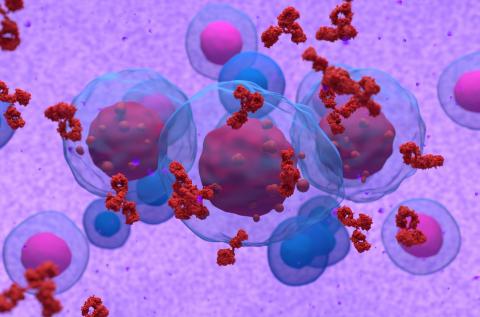
CAR-T therapy achieves remission in a patient with three autoimmune diseases
For the first time, CAR-T cell therapy has been used to treat a patient with three different autoimmune diseases – autoimmune haemolytic anaemia, immune thrombocytopenia and antiphospholipid syndrome – which were life-threatening and had resisted years of treatment. The patient, who previously required daily blood transfusions, has been in remission for a year without the need for further treatment since then. The case report, published in the journal Med, suggests that these therapies may help treat complex and severe autoimmune diseases.
Cristina Pascual - cart
Cristina Pascual Izquierdo
Head of the Haematology and Haemotherapy Department at Gregorio Marañón University General Hospital
The press release clearly explains how the novel CAR-T therapy is also effective in inducing remission in autoimmune diseases through the presentation of the published clinical case. This study provides evidence from a clinical case that could open the door to the use of CAR-T treatment in refractory autoimmune diseases.
The study published by Dr. Fabian Müller’s team at the University of Erlangen-Nuremberg corresponds to the detailed description of a single clinical case, and therefore cannot be considered a high-quality study in methodological terms of scientific evidence. However, its clinical relevance is notable, as it provides an important preliminary signal regarding the potential usefulness of CAR-T therapy in refractory autoimmune diseases. As a case study, the work lacks a control group, randomization, inferential statistical analysis, and the ability to robustly establish causal relationships; therefore, its findings must be interpreted with caution and as hypothesis-generating rather than definitive evidence.
The description of this clinical case is not isolated, but rather fits within a line of published studies on remission induced by anti-CD19 CAR-T therapy in other autoimmune diseases such as systemic lupus erythematosus, systemic sclerosis, and other refractory autoimmune conditions, which had already demonstrated immune reset of B lymphocytes and disappearance of autoantibodies.
What is novel about this publication is the demonstration of the effectiveness of CAR-T therapy in other hematological autoimmune diseases, such as autoimmune hemolytic anemia and immune thrombocytopenia in a patient with antiphospholipid syndrome.
The limitations of this study are those inherent to the publication of a single clinical case, along with a limited follow-up of 11 months.
This study provides highly suggestive preliminary evidence that anti-CD19 CAR-T therapy can induce deep and simultaneous remissions in B-cell–mediated autoimmune diseases, even in extremely refractory cases. However, as a case study, it lacks inferential power, and its results should be interpreted as hypothesis-generating. Controlled clinical trials are needed to confirm efficacy, safety, and general applicability.
Manel Juan - cart
Manel Juan
Head of the Immunology Service
In general, the press release reflects the content of the work quite faithfully, although, as often happens, it amplifies its relevance and simplifies certain aspects, potentially conveying a somewhat more conclusive impression than the data actually support. The case described is interesting, but it is important to put into context that the combination of autoimmune conditions presented (or at least two of them) is not exceptional, as these diseases tend to occur together with some frequency. The presentation of the data supporting the study is clear and well defined.
Regarding quality, this is, again, a study based on a clinical case, which limits the strength of its conclusions. Even so, it aligns with the growing body of evidence in this field. For example, another case was recently published in the New England Journal of Medicine (Gottschlich et al., 2026), describing a patient with two of these conditions treated with a BiTE (blinatumomab, anti-CD19/anti-CD3), with a functional mechanism similar to that of CAR-T therapies. In the present study, however, rituximab is used, which, although it can be effective, generally shows lower potency compared to CAR-T therapies or even BiTEs themselves.
This work aligns with a clear trend in recent literature: the development of therapies targeting B cells in refractory autoimmune diseases. In fact, recent reviews (Nature Reviews Drug Discovery, April 2026) already report more than a hundred clinical trials involving CAR-T therapies in this field. These strategies are bringing about a genuine therapeutic revolution, especially in patients who do not respond to conventional treatments. The first relevant results in a patient with an autoimmune disease were already described in systemic lupus erythematosus in 2021 (NEJM), and everything points to clinical trials demonstrating therapeutic efficacy.
As for limitations, in addition to the single-case nature of the study, it is important to consider possible confounding factors and the natural course of the disease, which may influence the observed response. Therefore, although it is always important to interpret the results of a single case with caution and not extrapolate them directly to general clinical practice, overall it represents a demonstration of the potential of this immunotherapy in autoimmune diseases.
In general terms, this study is another piece of evidence reinforcing the idea that the management of autoimmune diseases is rapidly shifting toward cellular and targeted therapies, although more robust evidence is still needed before their widespread adoption.
Corte et al.
- Research article
- Peer reviewed