The largest genetic database of Native Americans has been published, containing over a million previously unpublished variants
An international team led by the Institute of Evolutionary Biology (IBE), a joint center of the Spanish National Research Council (CSIC) and Pompeu Fabra University (UPF), has compiled the largest genetic database of Native American populations to date, including 128 new complete genomes. The research identified more than one million genetic variants not previously observed in other populations, revealing a unique genetic diversity. According to the authors, who published their work in Nature, “these results demonstrate the need to better represent these populations in genomics.”
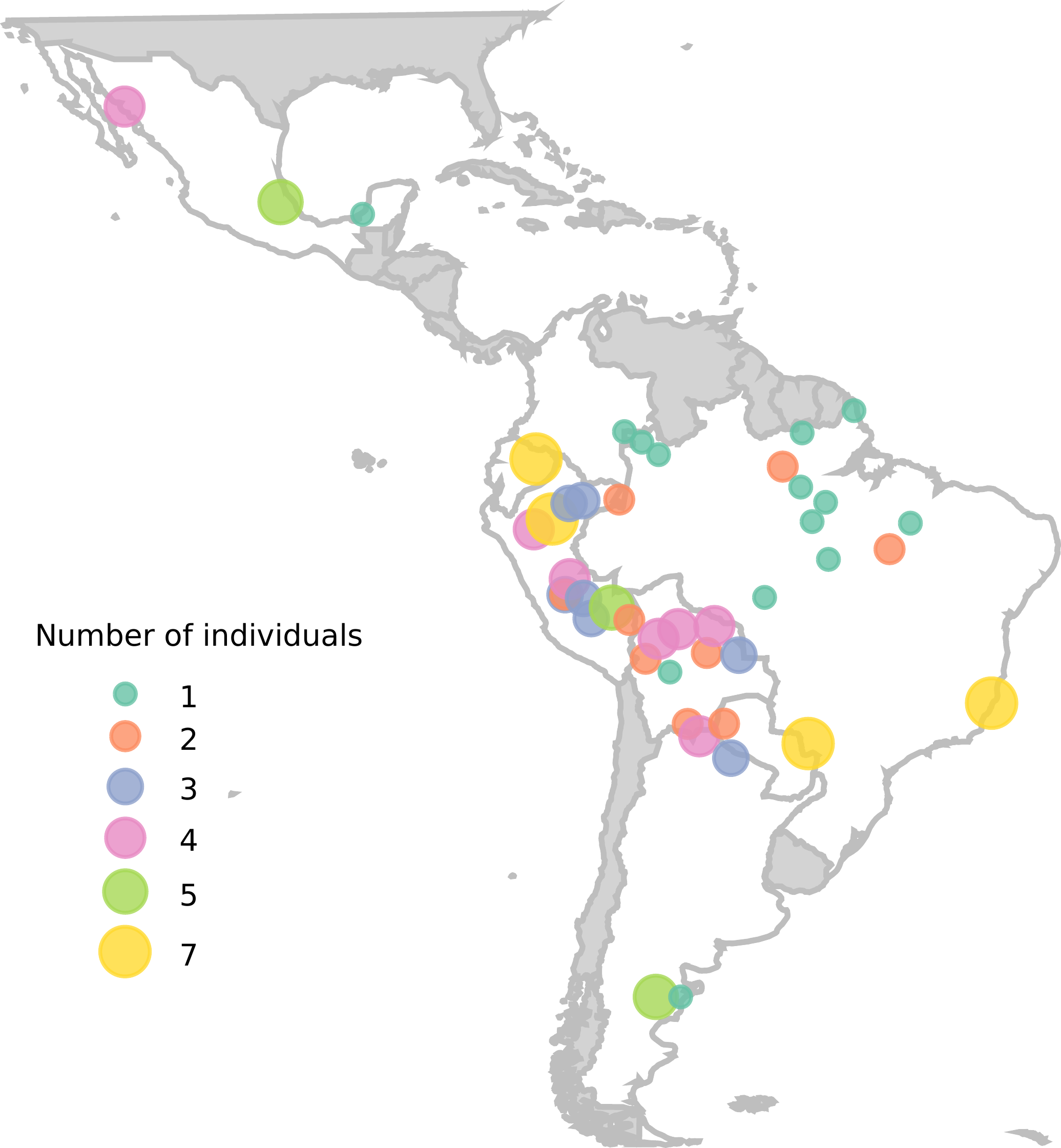
Geographic distribution of the indigenous American individuals included in the study. Each point represents a sampling location and its size is proportional to the number of individuals in that population. Credit: Hemanoel Passareli-Araujo.
Guigó - Nativos
Roderic Guigó
Coordinator of the Bioinformatics and Genomics Program at the Centre for Genomic Regulation (CRG) in Barcelona
This is an interesting article. First, genomic data is heavily biased towards populations of European origin because biological samples are mostly obtained from individuals of this ancestry (70-80%). This limits the possibility of applying the advances of genomic medicine universally, since the same mutation can have a different effect depending on the genetic environment, which varies among different human populations.
On the other hand, the article shows that genomics can also be a valuable tool in the study of history. In this specific case, it greatly helps to clarify the human colonization of the American continent.
Overall, it is not surprising to find new genomic variants that were not present in the sequences deposited in public databases, since, as I mentioned, these sequences mostly correspond to genomes of individuals of European descent.
Bertranpetit - Nativos
Jaume Bertranpetit
Emeritus Professor of Biology at Pompeu Fabra University (Barcelona)
This article represents a milestone in the genomic research of Indigenous American populations, providing an unprecedented dataset that reveals a genetic diversity far richer and more complex than previously thought. Its results not only significantly expand our understanding of the peopling of the continent but also challenge simplified models (what we called the three waves of settlement), demonstrating a dynamic evolutionary history marked by multiple migrations, adaptations, and interaction processes over millennia.
Beyond its scientific relevance, the work stands out for its ability to integrate high-resolution genomic analyses with a broad evolutionary perspective, identifying signs of natural selection, contributions of ancient ancestry (very interesting and unexpected), and previously invisible demographic patterns. Taken together, it offers a new narrative about human history in the Americas and underscores the importance of incorporating traditionally underrepresented populations into research, thus opening new avenues for both biomedicine and the global understanding of human diversity (and it doesn't have to have been done in the United States).
Marcos Araújo Castro e Silva et al.
- Research article
- Peer reviewed
- People