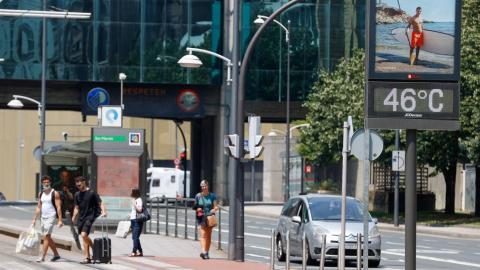
Urban forests are essential for climate resilience, biodiversity, and public health
An essay published today in the journal PLOS Climate examines the need for “immediate and sustained” investment to safeguard urban forests. The article reviews the necessary policies, ranging from maintenance and management to legal protections. The authors call on policymakers to “prioritize” these spaces in their strategies to combat climate change, given their positive role in climate resilience, biodiversity, and public health.

Daniel Jato - BOSQUES URBANOS
Daniel Jato
Professor of Environmental Engineering and Management at the International University of Valencia
This work should be interpreted as a synthesis and position paper rather than an original scientific article, as its objective is not to present new findings. Its main strength lies in bringing together a broad international group of specialists and rigorously synthesizing existing scientific knowledge on the role of urban forests in climate resilience, biodiversity, public health, and social equity. The article explicitly addresses key aspects of urban tree planning and management, such as multilevel governance, financing, continuous monitoring, adaptive management, legal protection, and the need to ensure equitable access to green infrastructure.
In the current context, marked by increasingly frequent, intense, and early heat waves, the role of urban trees in creating climate refuges could perhaps have been emphasized even more. The planning and spatial distribution of green infrastructure should be strongly guided by this objective, prioritizing those urban areas most exposed to and vulnerable to extreme heat.
Furthermore, although the paper includes numerous recommendations of great interest, many of them remain at the conceptual level. To facilitate their effective implementation, it is essential to move toward the development of quantitative indicators that allow for the measurement and monitoring of both the benefits and costs associated with urban forests. Having robust metrics is essential not only to support adaptive planning processes but also to justify investments and clearly communicate the value of this infrastructure to policymakers and urban managers.
Esperon-Rodriguez et al.
- Research article
- Peer reviewed