Researchers are investigating whether saltwater marshes in coastal areas can provide protection against flooding
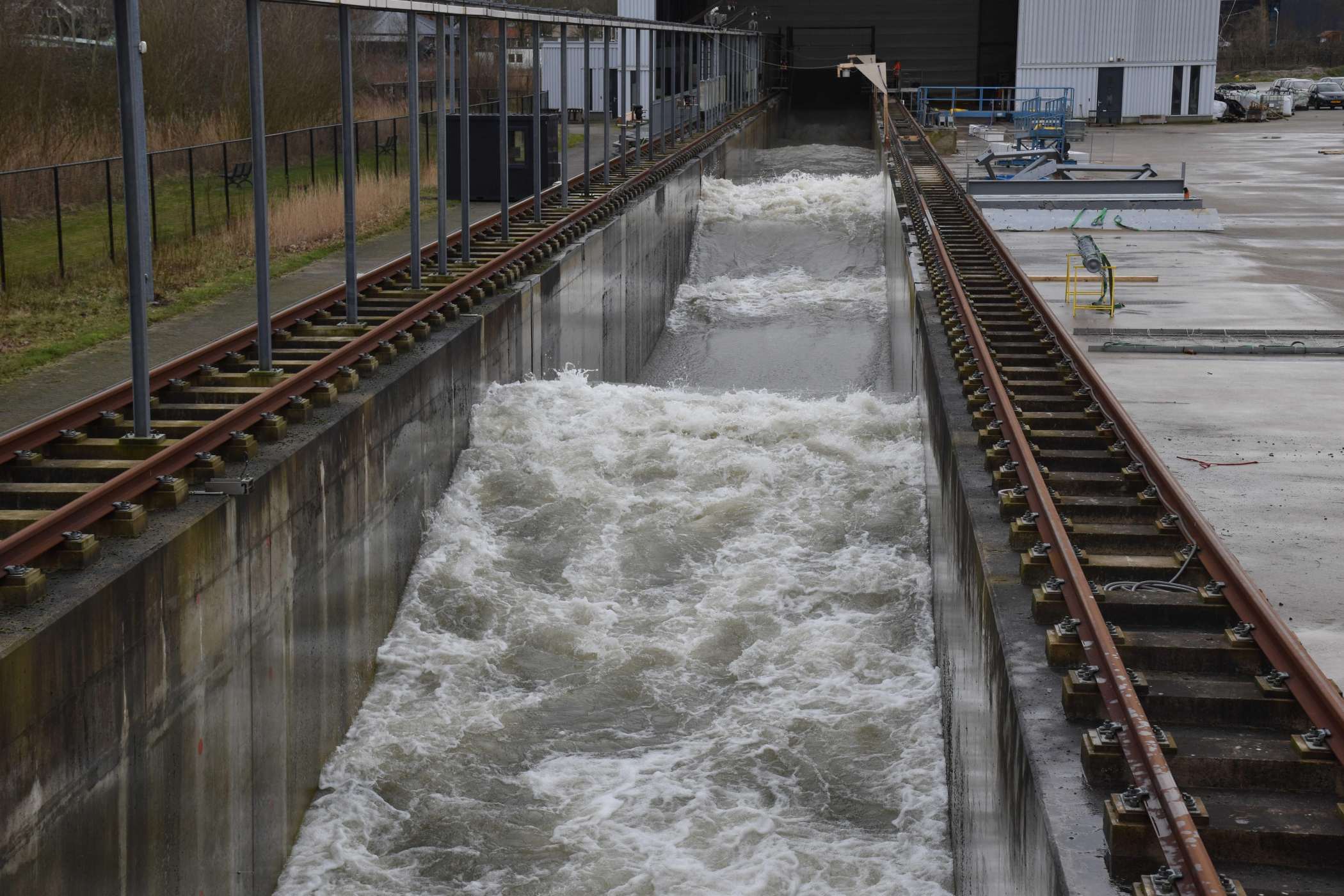
A team from the Netherlands has studied the role that salt marshes might play in protecting coastal areas subject to heavy swells from flooding. To this end, they transported and installed 306 square metres of salt marsh and vegetation in the Delta Flume, one of the world’s largest wave flumes. After 21 hours of exposure to waves up to two metres high, they found that the vegetation can reduce wave height by more than 10 per cent and by up to 50 per cent on low-energy marshy coasts — that is, those where waves reach a maximum of one metre. According to the authors, the restoration and conservation of salt marshes on storm-exposed coasts could be a promising strategy for mitigating the effects of storms. The findings are published in Nature.
Vicente Negro - marismas costeras
Vicente Negro Valdecantos
Our concept of a ‘marisma’ differs from the term marsh. As defined in our legislation, Law 2/2013 of 29 May on the protection and sustainable use of the coastline and amending Law 22/1988 of 28 July on the Coast, a ‘marisma’ is a very flat, low-lying area that is periodically flooded as a result of the ebb and flow of the tides or the seepage of seawater. Therefore, it bears no relation to the extreme wave action tested (Hm0 between 0.75 and 2.00 m) in the article and its use to protect against extreme events—which is understood to refer to wave action—an action entirely distinct from tidal waves.
Similarly, it states that the wetland remained exposed for a total period of approximately 29 hours; of these, 21 hours involved above-ground vegetation, whilst the remaining eight hours were spent without above-ground vegetation, but with largely intact below-ground biomass. In Spain, the tide is a semi-diurnal tridal wave with a cycle of 12 hours and 25 minutes; therefore, it does not align with the exposure regimes of the experiment conducted between high and low tides.
The correlations have very low coefficients; r2 should well exceed values of 0.95, yet this is not the case, as can be seen in the figures.
The experiment is set up on a very gentle, almost flat seabed; the ‘Holland’ structure is very flat, but is arranged on ‘boxes’—that is, embedded in the channel’s embankments—as shown in photograph b and figure d. If this initial confinement did not exist and the vegetation were planted in the natural seabed, the results would probably be worse.
At no point is reference made to the correlation between wave height and wave period used in the tests; there is only a reference to superelevations of 0.020 and 0.040. With this range of wave heights tested, the periods are relatively short, so extreme conditions could yield considerably worse results.
The comments regarding 100- and 1,000-year return periods seem excessive, given how the climate is evolving in the face of increasingly frequent and intense extreme events. The analysis should take a different approach.
The arrangement of vegetation to dissipate wave energy is not a recent idea. It remains to be determined what should be planted on a shifting seabed, and given that beaches are subject to very rapid erosion in response to storms, their behaviour would be even more uncertain.
I am unaware of the type of vegetation found on the Dutch coast. I am no expert in biology or marine ecosystems.
The results are clear. They show that vegetation proved more effective at attenuating wave energy on low-energy coasts (with waves up to 1 metre high), where attenuation exceeded 10 per cent (reaching up to 50 per cent); conversely, on high-energy coasts (with wave heights exceeding one metre), attenuation did not exceed 10 per cent.
These values are, a priori, very low.
Similarly, the results regarding the evolution of the stems are as would be expected in the face of extreme conditions.
Finally, I would like to highlight the ‘clout’ that research – in this case, that carried out in the Netherlands – can have in relation to the cost–benefit analysis of the tested proposal. The research is, of course, highly valuable and interesting, although the correlations between wave height and wave period, the cycles of submerged and emerged exposure, and the effects of moving seabeds should have been taken into account.
Willemsen et al.
- Research article
- Peer reviewed