A report analyses the impact of the Israeli invasion of Gaza on education and warns of the risk of a ‘lost’ generation
An international report led by the University of Cambridge (United Kingdom) warns that there is a serious risk of a ‘lost’ generation emerging in Gaza, due to the combination of educational, physical and psychological impacts after more than two years of the Israeli invasion. As of 1 October 2025, the UN Office for the Coordination of Humanitarian Affairs (OCHA) reported the deaths of 18,069 students and 780 education personnel in Gaza, with 26,391 students and 3,211 teachers injured. The study estimates that children in Gaza will have lost the equivalent of five years of education due to repeated school closures since 2020, first due to COVID-19 and then due to the Israeli invasion.

Gaza 2025. © UNRWA photo.
Pedro Ignacio Arcos - educación Gaza EN
Pedro Ignacio Arcos González
Epidemiologist and Director of the Emergency and Disaster Research Unit at the University of Oviedo
The study is relevant because it is well designed and shows another impact of prolonged complex humanitarian emergencies, which is that not only physical health deteriorates profoundly, but also mental health. One of the factors that helps to sustain the mental health of children in Gaza is the possibility of schooling.
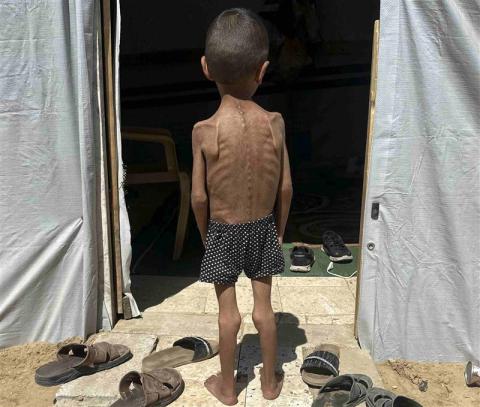
It also shows the relationship between malnutrition and the possibility of sustaining a minimum level of educational activity. It is well known that in Gaza, Israel has not only destroyed its health system but also its education system, as a new form of warfare aimed at undermining the future of Gazan children.
Salvador Peiró - educación Gaza EN
Salvador Peiró
Epidemiologist, researcher in the Health Services and Pharmacoepidemiology Research Area of the Foundation for the Promotion of Health and Biomedical Research of the Valencian Community (FISABIO) and Director of Gaceta Sanitaria, the scientific journal of the Spanish Society of Public Health and Health Administration (SESPAS)
The report is not a scientific manuscript, but rather a report that analyses the (devastating) cumulative impact of more than two years of conflict on the lives of Palestinian children (especially in Gaza) and is intended to inform policymakers, international agencies and public opinion.
Within this framework, the work is of good quality. It is well structured, draws on solid institutional sources (UN agencies, international NGOs, administrative data) and coherently combines quantitative information with qualitative evidence from interviews and testimonies on the ground. The approach is consistent with the usual standards for this type of report.
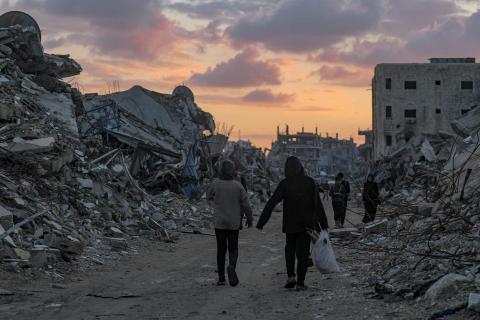
The report describes a situation of extreme deterioration in living conditions, marked by continued violence, food shortages, the collapse of basic services and the almost total disruption of the education system, as well as highlighting the emotional and social impact of the conflict on children. Its findings are consistent with the accumulated evidence on the impact of protracted armed conflict on children, particularly in terms of malnutrition, psychological trauma and loss of educational opportunities, although the scenario reported is unprecedented in recent times, showing that educational and health infrastructure has been widespread destroyed and densely populated urban areas bombed. The destruction goes far beyond the data expected in a conventional conflict or that reported in recent conflicts (Iraq, Afghanistan, Syria) that seemed particularly cruel.
The main contribution of the report is to integrate the dimensions of education, health and psychosocial well-being, and to show how their effects reinforce each other. The implications are primarily political and humanitarian, reinforcing the urgency of protecting children, ensuring access to basic services and preventing educational disruption from having irreversible effects in the medium and long term.
Like most reports produced in contexts of active war, it has significant limitations. Data collection is necessarily incomplete, there is a heavy reliance on secondary sources and indirect estimates, and it is not always possible to independently verify information from the field. These limitations probably tend to underestimate the magnitude of the problems. In addition, some quantifications (e.g., educational losses) are based on reasonable but simplified assumptions. Although these limitations may affect some figures, they do not invalidate the report's overall conclusions about the inadequacy of local efforts without a substantial and sustained increase in international aid, both for immediate response and for medium- and long-term educational recovery.
Isabel Portillo - educación Gaza EN
Isabel Portillo
Screening Coordinator at Osakidetza -Basque Health Service, researcher in the Cancer Biomarkers group at the Biobizkaia Health Research Institute, and secretary of the Board of Directors of the Spanish Epidemiology Society
I have read the full report and the position statement. Overall, it is a very enlightening article on the situation in Gaza and East Jerusalem regarding education since 7 October 2023 among the Palestinian population, mainly children and education professionals. The sources and methodology are of high quality (qualitative and quantitative study with official sources from the UN, OCHA, UNRWA, UNICEF, Palestinian authorities, and relevant NGOs working in the field).
It is a continuation of periodic reports from these organisations and high-impact articles in which these authors have also participated.
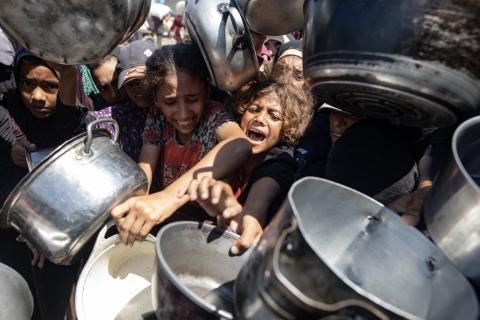
It should alert both governments and institutions to the need to resolve this situation in the medium and long term, which undoubtedly involves solving urgent problems (hunger, access to drinking water, gender violence, deaths, disability, mental health, infrastructure, materials, salaries and living conditions for professionals).
This is described in the methodology and conclusions, given that it is difficult to conduct studies in a changing situation, with displacement, difficulty in collecting data and the need to make projections and incorporate models that allow the objective of the article to be adjusted, which is the need for international involvement, both in the cessation of hostilities, aid, reconstruction, support in education, and recovery of infrastructure, materials, and physical and mental support for both students and teachers. It is difficult to assess the impact in conditions where education is not a priority for donors, despite being a right enshrined in 1989.
University of Cambridge, Centre for Lebanese Studies in partnership with UNRWA.
- Report