A Spanish team has discovered a decagonal wave at Saturn’s south pole for the first time
Thanks to the Voyager probe, we know that Saturn has a long-lasting hexagonal wave at its north pole, which is linked to a powerful jet of matter and energy. Now, a team led by the University of the Basque Country has discovered, for the first time, the presence of a decagonal wave at the south pole. The observations, carried out from the ground and using the Hubble Space Telescope, show that the decagon appears to have formed between 2023 and 2025 and may continue to evolve, in contrast to the more than 40 years of stability exhibited by the hexagon. The research is published in Science Advances and suggests that the ten-sided shape could be a meandering wave trapped by the curvature of a dominant atmospheric current.
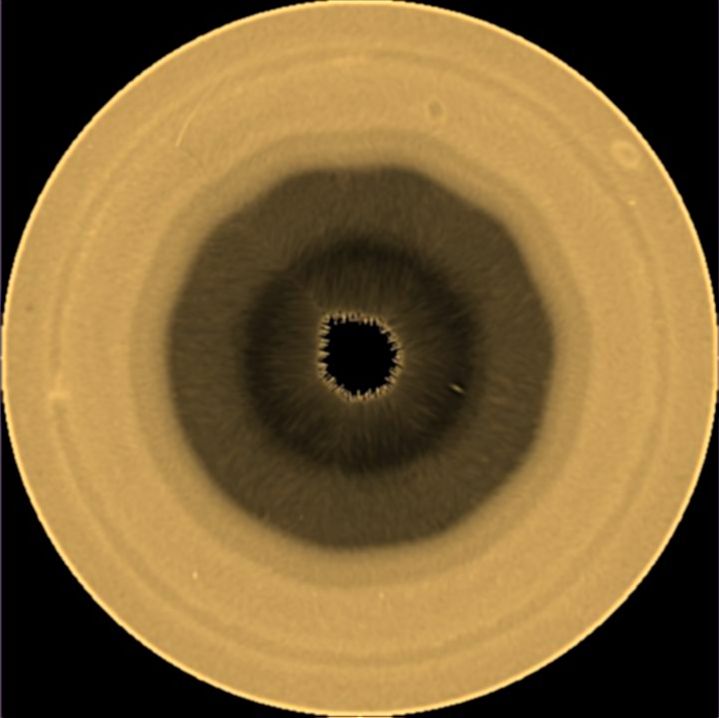
Polar projection of Saturn’s southern hemisphere at a red wavelengths at 763 nm obtained on 29 August 2025 by the Hubble Space Telescope. Credit: NASA, ESA, A. Sánchez-Lavega (Basque Country University, EHU).
Jesús Aceituno - Saturno onda decagonal EN
Jesús Aceituno
Is the research of high quality?
“Yes, the members of the research team have been well-known for a long time and their reputation precedes them. The article has two parts: one describes the observations and the other interprets the phenomenon. It also draws on observations from various observatories, including the Hubble Space Telescope, which makes the work exceptional. Calar Alto contributed data using the PlanetCam instrument on the 2.2-metre telescope, with observations taken between 29 August and 1 September 2025.”
Is this the first time this decagonal wave has been discovered on Saturn?
“This is the first time a decagonal wave has been characterised in Saturn’s southern hemisphere, although it is important to note that the Cassini space mission observed a partial structure in the same hemisphere back in 2004. This time, however, it is indeed the first time it has been possible to characterise it, as its dynamics have been measured. It moves at a speed of around 2.5 m/s; the vertices oscillate longitudinally with a period of 32 days, reminiscent of the hexagon in the northern hemisphere, although it appears more complex. Note: it should not be confused with the northern structure, as although there is a certain geometric similarity (they are polygonal structures), the latter has been much more stable for decades. The one in the southern hemisphere could be transient.”
How does it fit in with the existing evidence?
“The discovery is consistent with models of Saturn’s atmospheric dynamics. These models could explain the formation of the well-known hexagon in the northern hemisphere as a result of intense jets generating polygonal waves, so the observed decagon is consistent with this. What is interesting about this new structure is that it appears to be recent and seems to be temporary.”
What are the implications?
“As it is a new structure, it provides us with a new laboratory for studying Saturn’s atmosphere. Often in astrophysics we cannot set up an experiment in a laboratory and wait to see what happens; therefore, when the universe shows us this kind of phenomenon, it is an opportunity to study them and better understand the mechanism that produces them.”
Are there any significant limitations that need to be taken into account?
“The models discussed in the article are a first approximation to explain why it has formed, but further combined observations will still be needed to determine more precisely the models that explain the mechanism that has given rise to this phenomenon.”
Conflicts of interest: “I am the director of CAHA, a facility that has been involved in the observations described in the article.”
Alejandro Cardesín Moinelo - Saturno onda decagonal EN
Alejandro Cardesín Moinelo
An excellent piece of work that brings together observations from amateur astronomers and space missions, coordinated by the science group at the University of the Basque Country, a world leader in the study of planetary atmospheres and, in particular, cloud dynamics on Saturn, Mars and other planets.
This study presents the discovery and detailed analysis of a new atmospheric phenomenon – a decagon in Saturn’s clouds – which had never been observed before. This discovery is a fine example of collaboration between amateur observers and professional scientists working on space missions, and has significant implications for our understanding of atmospheric models on other planets. The study paves the way for observing this type of phenomenon over a longer period and through future space missions, to determine whether these events are merely temporary or can occur consistently over time, with major implications for the thermodynamic balance of Saturn’s south pole and, by extension, for other giant planets.
Miguel Ángel López Valverde - onda Saturno
Miguel Ángel López Valverde
This is a very interesting observation and piece of research, because the existence of hexagon-shaped standing waves exclusively in the clouds over Saturn’s north pole seemed to suggest that this was a unique phenomenon, and that there was a strong and as yet unknown asymmetry between the planet’s two poles. This discovery of a decagonal structure at the south pole demonstrates that there is no fundamental—let us say qualitative—difference between the two poles, but only a quantitative one, just as predicted by various numerical models and by some laboratory experiments using rotating fluids.
It demonstrates that polygonal structures form naturally at the boundaries of strong zonal winds (along bands parallel to the equator) when these bands narrow at high latitudes, due to phenomena of turbulence and shear. An everyday analogy might be the turbulence and circular eddies that occur when stirring a cup of coffee. The precise number of vertices, as predicted by these studies, could be 6—as had been observed at Saturn’s north pole—or greater or lesser depending on the specific values of the zonal winds, the depth of these jets, the latitude at which they are found, the planet’s rotation and radius, and so on. And this is exactly what this study is confirming.
This observation now opens up interesting avenues for deepening our understanding of the enigmatic atmospheres of the giant planets. In particular, it will be interesting to continue observing this decagonal structure to determine its stability over time; for example, the hexagon in the northern hemisphere is very stable, but the zonal winds in the southern hemisphere are weaker. Or to determine whether the origin of this structure is linked to nearby anticyclones, or whether the opposite is true—that these polygonal clouds generate adjacent cyclones and anticyclones.
It will also serve as an excellent test bed to finally clarify which of the various physical models proposed to explain the north-polar hexagon is the most accurate, as such a model should be able to predict and explain the details of both phenomena at both poles as part of a comprehensive explanation.
Furthermore, these models, validated by these observations, would then allow us to deduce as yet unknown properties of Saturn’s clouds, the planet’s differential rotation, and the connection between the cloud top and the depths of this gas giant, and to apply them to other planets, such as Jupiter or Venus, where stable structures have also been observed near their polar vortices.
Teresa del Río Gaztelurrutia - onda Saturno
Teresa del Río Gaztelurrutia
Images of Saturn’s northern polar region reveal a unique hexagonal structure, which has been present at least since Voyager took the first close-up images in 1980. The atmospheres of Jupiter and Saturn – gas giants that rotate rapidly with periods of approximately 10 hours – are characterised by the presence of fast zonal winds (blowing parallel to the equator). The hexagon is visible because a fast jet stream near the pole is deflected meridionally, forming a stable wave that carries with it the clouds which trace the movement of the winds. Cassini enabled this wave to be studied in detail; it extends from the troposphere to higher regions of the atmosphere.
This paper shows how, since 2023, a similar structure has appeared in the subpolar region of the southern hemisphere, this time in the form of a decagon. The paper provides an exhaustive description of the properties of this new structure at different altitudes in the atmosphere (which can be characterised in images taken with different filters). Unlike the hexagon, the decagon does not remain stable relative to the planet; rather, its vertices shift eastwards, not in a completely regular manner, but exhibiting a 32-day oscillation.
The study provides new insights into why gas giants tend to sustain periodic structures in their polar regions (which, on Jupiter, manifest as a regular set of vortices). In the case of the hexagon, it was initially postulated that it might have been generated by the interaction of the jet stream with a vortex, although the wave-like disturbance has outlived the vortex that may have generated it. Now, in the south, a vortex is observed near the decagon, and this study uses simulations to analyse the possibility that it is the origin of the new decagonal structure. Future observations will enable us to determine whether the decagon that has now formed is as stable as the hexagon in the north. In any case, for the time being, this study paves the way for further analyses that will allow us to better understand the fascinating dynamics of these atmospheres.
Miembro del grupo de ciencias planetarias de la EHU, ha colaborado en numerosos artículos con el autor principal del artículo, y ha dirigido la tesis de una de las coautoras.
Agustín Sánchez-Lavega et al.
- Research article
- Peer reviewed
- Observational study