What is believed to be the first diplodocus found outside North America has been discovered in Teruel
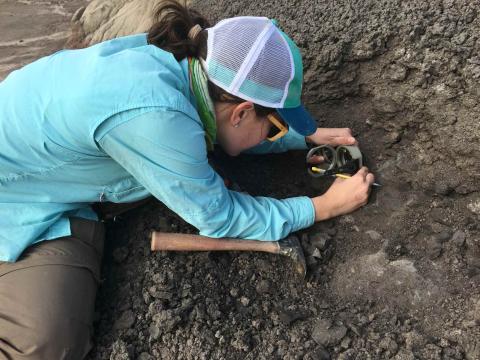
A team from the Teruel-Dinópolis Joint Palaeontological Foundation has discovered, at the La Tejería site in El Castellar (Teruel), the remains of what could be the first diplodocus found outside North America. The research, published in the Journal of Vertebrate Palaeontology, describes 14 exceptionally well-preserved caudal vertebrae from the tail and several cheurones (tail bones). According to the authors, “osteological comparisons and phylogenetic analyses consistently placed the specimen within the genus Diplodocus”. The specimen, which dates back some 150 million years, provides the first intercontinental evidence for this genus and constitutes one of the most robust pieces of palaeontological evidence for episodes of faunal dispersal and exchange between the two continents across the proto-Atlantic Ocean during the Late Jurassic.
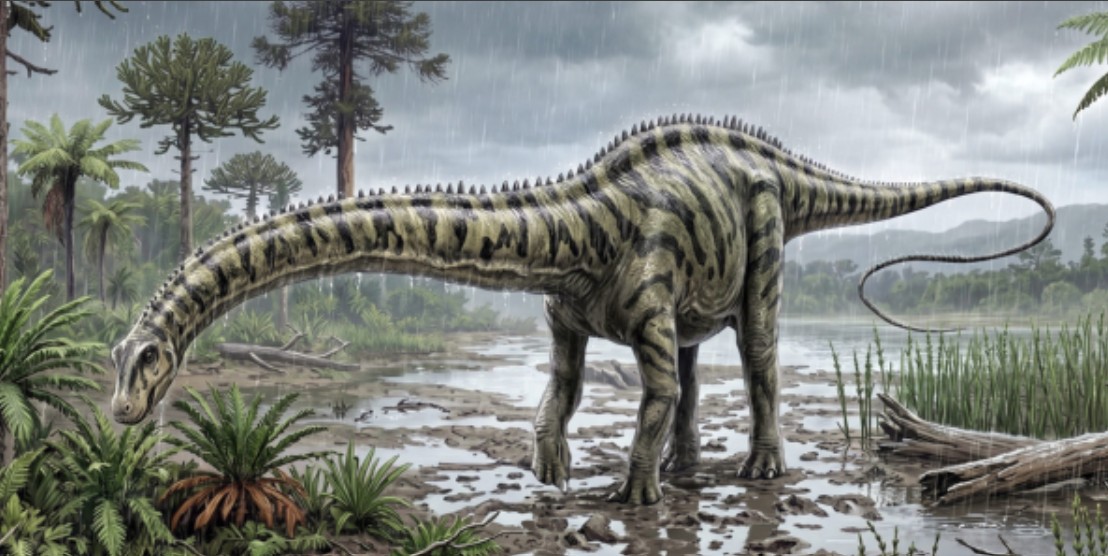
Illustration of the diplodocus by Carmelo López.
Francisco Ortega - diplodocus Teruel EN
Francisco Ortega
That’s excellent; it’s a sauropod from the Late Jurassic, and although we already have a huge collection of Late Jurassic sauropods on the Iberian Peninsula, adding ‘bricks’ to the wall of knowledge allows us to gradually piece together the bigger picture.
The material is incomplete, but the fossil record attributable to these organisms is relatively scarce in the Late Jurassic of Spain. The available information has enabled them to identify it as a species of Diplodocus, although it has not been possible to attribute it to a specific species.
The Upper Jurassic of the Iberian Peninsula, well represented on the Portuguese coast and in Teruel, bears striking similarities to the Upper Jurassic of the United States and, as such, ties in very well with the iconic faunas of the Morrison Formation. In fact, the transatlantic relationships of the Portuguese Jurassic faunas have been under analysis for some years, and some of the best-known taxa from that formation have been identified, such as Stegosaurus or the carnivore Allosaurus.
A number of sauropods had also been identified to date, with close affinities on both sides of the Atlantic. For example, Allosaurus fragilis, the most iconic theropod of the Morrison Formation, is found in Portugal. Over time, these similarities are increasingly being extended to the Teruel record, and we are beginning to understand that the Portuguese faunas appear in Teruel (and vice versa) and that both share similarities with their North American neighbours (during the Jurassic). Thus, some large carnivores, such as Torvosaurus, appear to be shared across all three records.
In the case of sauropods, the situation appears to be much the same; it has long been suspected that Supersaurus is a genus of Upper Jurassic sauropod dinosaurs shared between the Iberian Peninsula and the United States, and we are even aware of diplodocid remains with very similar representatives on both sides of the Atlantic. In this context, the discovery of Diplodocus in Teruel is yet another important ‘building block’ in our understanding of the process by which the North Atlantic opened up. At that time, the Atlantic was much narrower than it is today, and until very recently there was land connection between the North American and European coasts. Groups of dinosaurs had been able to move occasionally between the two continents, and now, even though they were isolated on either side, genetic drift has not differentiated certain species sufficiently for us to distinguish them by their bones.
In any case, the discovery of Diplodocus—one of the best-known and most culturally significant dinosaurs—in the Iberian fossil record highlights this process in a particularly striking way. From a biogeographical and palaeontological perspective, this is a significant new ‘building block’ in a process we are coming to understand better and better as research progresses. With the addition of Diplodocus to the already known Allosaurus and Stegosaurus, we are assembling the ‘complete set of dinosaur trading cards’ from the 1940s in the United States on the Iberian Peninsula.
Fabien Knoll - diplodocus Teruel EN
Fabien Knoll
Is the research of good quality?
“Yes, the research is of high quality. It is well executed and adheres to international standards.”
How does it fit in with the existing evidence?
“It fits in well. In fact, the similarity between the Jurassic dinosaur faunas of Portugal and the United States has been noted since the 1950s. Furthermore, the presence of Diplodocus itself in Portugal has been suggested on several occasions, although never formally published. It is therefore not surprising that a species of Diplodocus, or a closely related genus, inhabited what is now Spanish territory towards the end of the Late Jurassic.
The only point which, in my view, warrants clarification is that the material collected (14 caudal vertebrae and some chevrons) is not, for the time being, sufficient to state with certainty that it belongs to Diplodocus. The fact that the material is compatible with this genus does not imply that it belongs to it. Further field surveys, both in Spain and Portugal, as well as the formal publication of fossils already discovered, would enable us to improve our understanding of the sauropod fauna of the Upper Jurassic in the Iberian Peninsula and confirm (or otherwise) that the sauropod from El Castellar is Diplodocus, and not Supersaurus/Dinheirosaurus, another known genus or even a new one.”
Conflicts of interest: “I know the authors because I have worked at the same institution, but I have not been involved in any aspect of this research.”
Pedro Mocho - diplodocus Teruel EN
Pedro Mocho
The discovery of this new specimen of a sauropod dinosaur is of great importance for gaining a better understanding of the terrestrial ecosystems of the Iberian Peninsula during the Late Jurassic, approximately 145 million years ago. Although the specimen found in Teruel is fragmentary, it retains sufficient information to attribute it with a fair degree of certainty to the genus Diplodocus. This is the first time we have been able to confirm, with a reasonable degree of certainty, the presence of Diplodocus on the Iberian Peninsula, a genus known chiefly for occurring in rocks of the same age on the other side of the Atlantic Ocean.
This is undoubtedly one of the most significant aspects of this research. The find demonstrates the presence of the same genus of sauropod dinosaurs on both sides of the Atlantic at a time when the Iberian Peninsula and North America were geographically closer and separated by shallower seas. The discovery adds to the list of other dinosaur genera known to have inhabited both regions during the Late Jurassic, such as the theropods Allosaurus, Ceratosaurus and Torvosaurus, and the stegosaur Stegosaurus. The latter was a herbivorous dinosaur characterised by the enormous bony plates running along its back and the long spines at the tip of its tail.
The presence of Diplodocus in Teruel also supports recent suggestions by other researchers regarding the existence of a sauropod very closely related to this genus, Diplodocus, in the Upper Jurassic rocks of Portugal. All of this is particularly interesting because it allows us to understand that the sauropod faunas of the Upper Jurassic on the Iberian Peninsula were much more similar to those inhabiting North America than we had previously imagined. In particular, they bear significant similarities to the sauropod faunas of the Morrison Formation, one of the best-known geological formations of the Upper Jurassic in North America.
It is very satisfying to see that new discoveries, such as this specimen from Teruel, are providing us with the information needed to reconstruct the history and connections between the dinosaur faunas that lived on both sides of the Atlantic some 145 million years ago.
Xabier Pereda Suberbiola - diplodocus Teruel EN
Xabier Pereda Suberbiola
“This is a very interesting article because it describes, for the first time, the presence of Diplodocus—one of the dinosaurs best known to the general public—at a European site. The research is based on the discovery, at an Upper Jurassic site in Teruel, of a section of the vertebral column, specifically 14 caudal vertebrae and several hemal arches (tail region). To date, the material attributed to diplodocids found at sites in the Iberian Peninsula (and in Europe in general) has been rather fragmentary (with the exception of Dinheirosaururs in Portugal). It is therefore a significant discovery.”
Is the research of high quality?
“Undoubtedly. The authors of the article are renowned specialists and have published numerous papers on the Upper Jurassic dinosaur faunas of Teruel. In this study, the authors carry out detailed comparisons of the material with other diplodocids and conduct a phylogenetic analysis which leads to the identification of the fossils found in Teruel as belonging to the genus Diplodocus”.
How does it fit with the existing evidence?
“It fits well. This study adds to previous findings regarding the presence of ‘transatlantic’ or intercontinental dinosaurs found in both the Morrison Formation of North America and Iberian sites (in Portugal and Spain) during the Late Jurassic. This is the case for the theropods Allosaurus, Ceratosaurus and Torvosaurus, and the thyreophore Stegosaurus (some of which are also iconic dinosaurs). The intercontinental presence of other forms, such as the ornithopod Camptosaurus and the sauropod Supersaurus, is a matter of debate”.
Do history or palaeontology textbooks need to be revised?
“No, but that doesn’t mean this isn’t a highly interesting piece of research. Good palaeontology articles usually make contributions that enhance scientific understanding. Very few publications actually ‘change history or palaeontology textbooks’.”
What are the implications?
“The first implication is the presence of Diplodocus in Europe, which is in itself a novelty. It allows us to add a new genus to the list of intercontinental dinosaurs known to have lived in both North America and Europe. Furthermore, it increases the diversity of dinosaurs in the Late Jurassic of Iberia.”
Conflicts of interest: “I have no conflict of interest with the authors. I know them well – particularly Alberto Cobos (the last author) – as I am in contact with them in connection with other research projects. The first author, Sergio Sánchez-Fenollosa, will soon be defending his doctoral thesis.”
José Ignacio Canudo - diplodocus Teruel EN
José Ignacio Canudo
The research into a possible diplodocus find in Teruel is due to be published in one of the most prestigious journals in vertebrate palaeontology. The fossils are well described and well illustrated, so the research is of high quality. All research – and particularly in dinosaur palaeontology, where we work with fragmentary material – involves both data and interpretation.
The remains studied consist of a section of tail which our colleagues have interpreted as belonging to Diplodocus, which serves as evidence that there was an intercontinental connection between Iberia and North America during the Late Jurassic. This claim is not new, as it has been put forward by other authors for years; what is new is that it has been demonstrated for the first time with a sauropod, whereas previously it had been shown with other dinosaurs such as the carnivorous Allosaurus. Personally, I believe the remains are too fragmentary – they consist solely of caudal vertebrae – to assign them to the genus Diplodocus, and the conclusion regarding the palaeobiogeographical relationship between Europe and North America could just as easily have been proposed without resorting to such a precise classification, the accuracy of which only time will tell.
It is a fine piece of work and a valuable contribution to the history of Late Jurassic dinosaurs.
Sergio Sánchez-Fenollosa et al.
- Research article
- Peer reviewed