Bonobo Kanzi shows that the ability to imagine is not unique to humans
Two researchers from Johns Hopkins University (United States) have shown for the first time, through three experiments, that apes can use their imagination and play pretend, a skill previously thought to be unique to humans. During the study, Kanzi, a 43-year-old bonobo, tasted imaginary glasses of juice and bowls of imaginary grapes. According to the researchers, ‘imagination has long been considered a crucial element of the human condition, but the idea that it is not unique to our species is truly transformative.’ The results are published in Science.
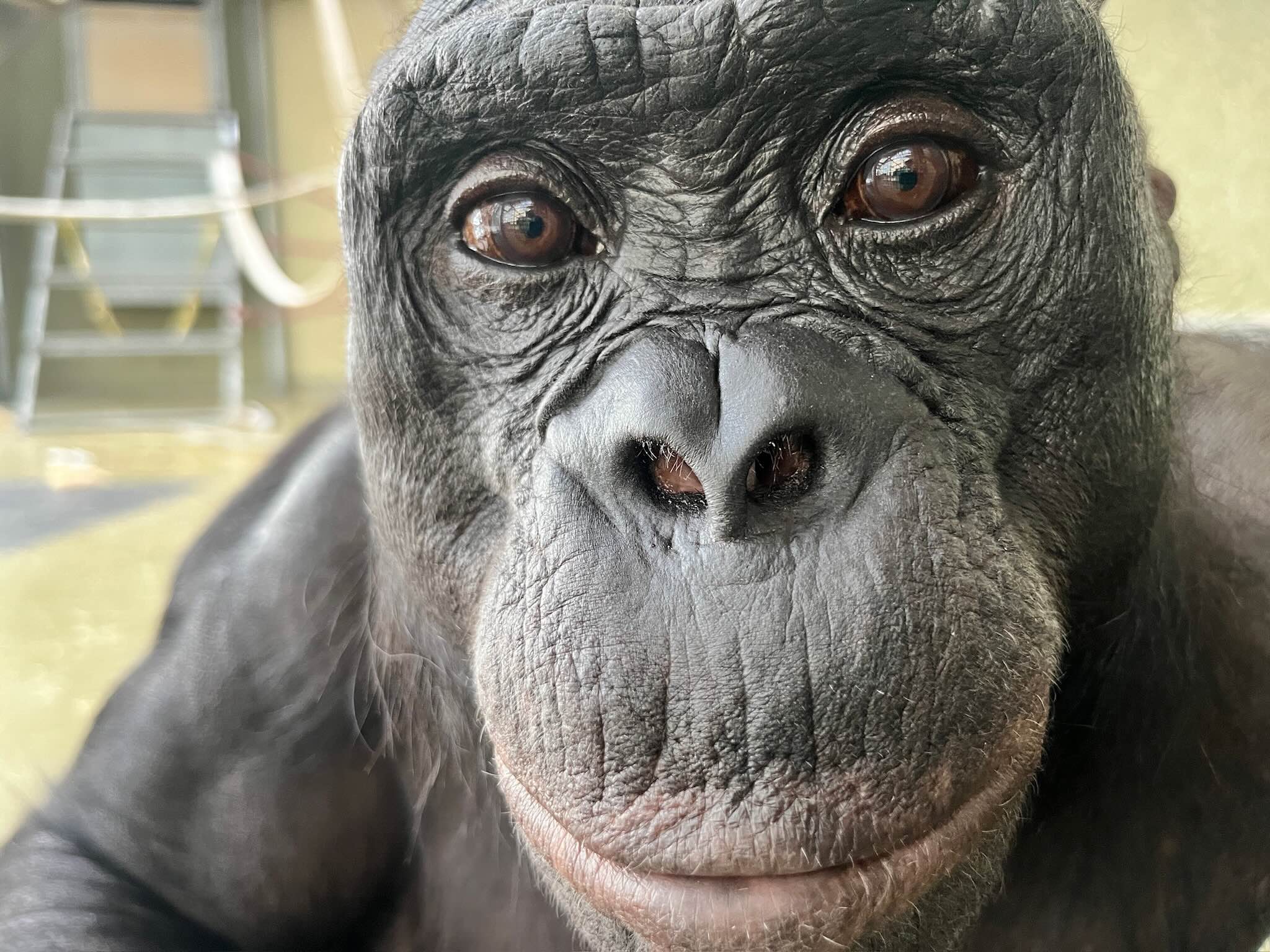
Kanzi, a 43-year-old bonobo living at Ape Initiative, who had been anecdotally reported to engage in pretense and could respond to verbal prompts by pointing. Credit: Ape Initiative.
260205 kanzi antonio EN
Antonio J. Osuna Mascaró
Postdoctoral researcher at the Messerli Research Institute at the University of Veterinary Medicine Vienna (Austria), animal cognition specialist
This study provides one of the clearest pieces of experimental evidence to date of secondary representations in an individual of another species. For years, anecdotal observations have accumulated of chimpanzees and bonobos interacting with imaginary objects (from playing with invisible cubes in the laboratory to treating sticks as if they were dolls), but experimental demonstrations were lacking. Bastos and Krupenye's work with Kanzi takes that step, showing that a bonobo can maintain and update imagined states superimposed on immediate reality.
The design is conceptually simple: Kanzi alternated between reinforced trials (where he was given a reward) and non-reinforced trials (without a reward), in which he had to indicate the location of imaginary juice or food after observing actions of “pretending to pour into a glass”. Although performance was below 70% in the main experiments (1 and 3), this level is to be expected in an experiment of this nature, which lends itself easily to distractions and attentional variability.
From a broader perspective, this work illustrates the difficulties inherent in studying imagination in other species. Exploring the imagination of other species requires designs that are inevitably deeply shaped by our own way of interacting with the world. It is no coincidence that the experiment relies on an exceptional subject such as Kanzi (who sadly passed away in 2025), trained to communicate with humans: here, language acts as a window into his mind, similar to what happened with Alex, the African grey parrot who revealed to the world the fascinating mind of birds.
That is why I believe the study says a lot about us and our limitations. Not only has it been necessary to work with Kanzi, but the experimental design itself is profoundly “human”. In the main experiment, an imaginary juice is poured into a glass with a jug; this is a far cry from the ways in which great apes must use secondary representations in nature.
There is experimental evidence of monkeys capable of mentally manipulating visual figures, and also of rats capable of voluntarily activating internal representations of their environment. All of this suggests that these abilities may not be unique to great apes. The challenge, as we move away from our own species, is to design species-specific experiments that allow us to evaluate them without resorting to overly anthropocentric frameworks. We will need designs that move away from the ease of asking “where is the juice”. It will be a matter of time and creativity on the part of scientists before we can have an answer.
260205 kanzi jcarlos EN
Juan Carlos Gómez
Psychologist and researcher in the Department of Psychology and Neuroscience at the University of St Andrews (UK)
This is an excellent experiment, which uses a simple but highly original task to explore for the first time in an experimental way a topic—imaginative play—that until now had remained in the background in the study of anthropoid apes.
Until now, there had only been highly debated evidence of the existence of this ability in non-human primates. This study reinforces the possibility that the rare examples of possible imaginary play observed in anthropoids are genuine, or at least tell us something about the evolutionary precursors of this capacity, which is so important and well developed in humans.
[Regarding possible limitations] The authors carried out controls that rule out many alternative explanations, but, as is often the case in this type of study, the possibility of other explanations remains. For example, perhaps Kanzi has learned that the correct response is to point to the cups that have something in them, and when urged by his carers to choose between two apparently empty cups, he thinks that the only one that might have something in it is the one that has not been turned over. He would therefore choose it, not because he understands that the human is pretending it has juice, but by process of elimination, just in case there is something in it that cannot be seen.
But, alternative interpretations aside, in my opinion the most important contribution of this study, beyond its promising results, is the fact that it provides for the first time an experimental paradigm that can continue to be used to systematically investigate the possible evolutionary precursors of imaginative play in non-human primates. The authors have taken a giant step forward by making it possible to experimentally investigate this important question, which until now had remained in the background largely due to the lack of reliable ways to investigate it.
Conflict of interest: "The first author of the article, Amalia Bastos, has just started working in the same department as me, and we are now colleagues at the School of Psychology and Neuroscience at the University of St Andrews, although we are not working together on any projects. The work discussed here was carried out before she joined the department".
Llorente - Kanzi
Miquel Llorente
Head of the Department of Psychology at the University of Girona, associate professor Serra Húnter and principal investigator of the Comparative Minds research group
This study by Bastos and Krupenye is of excellent methodological quality and addresses a historical challenge in primatology: how to demonstrate that an animal is imagining something that isn't there. The authors describe with great precision a capacity that until recently we believed to be exclusively human: the ability to hold two parallel realities in the mind. Kanzi is capable of operating with a secondary representation, meaning that he can project a fictional scenario (the juice game) onto physical reality (the empty cups) without the two interfering with each other. In other words, he possesses a cognitive structure that allows him to manage what is not present (by imagining) without ever losing contact with what is there.
However, an intrinsic limitation must be considered: the subject is Kanzi. We are dealing with an extraordinarily enculturated 'genius,' trained in artificial language, and with a cognitive development that, while stemming from a biological basis common to his species, has been amplified by a human environment. As with the great geniuses of our species, Kanzi sets the bar for bonobos' cognitive potential, but not necessarily the standard of what the average individual does in the jungle.
Even so, the study is consistent with the evidence accumulated over the last decade, which places great apes much closer to us in abilities such as future planning or the attribution of mental states (thinking what another person is thinking). The implications are profound: if the capacity for simulation is not exclusively human, it means that the cognitive framework for fiction, symbolism, and perhaps complex culture was already present in our common ancestor millions of years ago. Now the challenge is to understand not only what they can do, but how and why they use these mental tools in their own natural environment.
Bastos, Krupenye
- Research article
- Peer reviewed
- Animals