The largest known group of wild chimpanzees splits up and attacks one another, a very rare occurrence
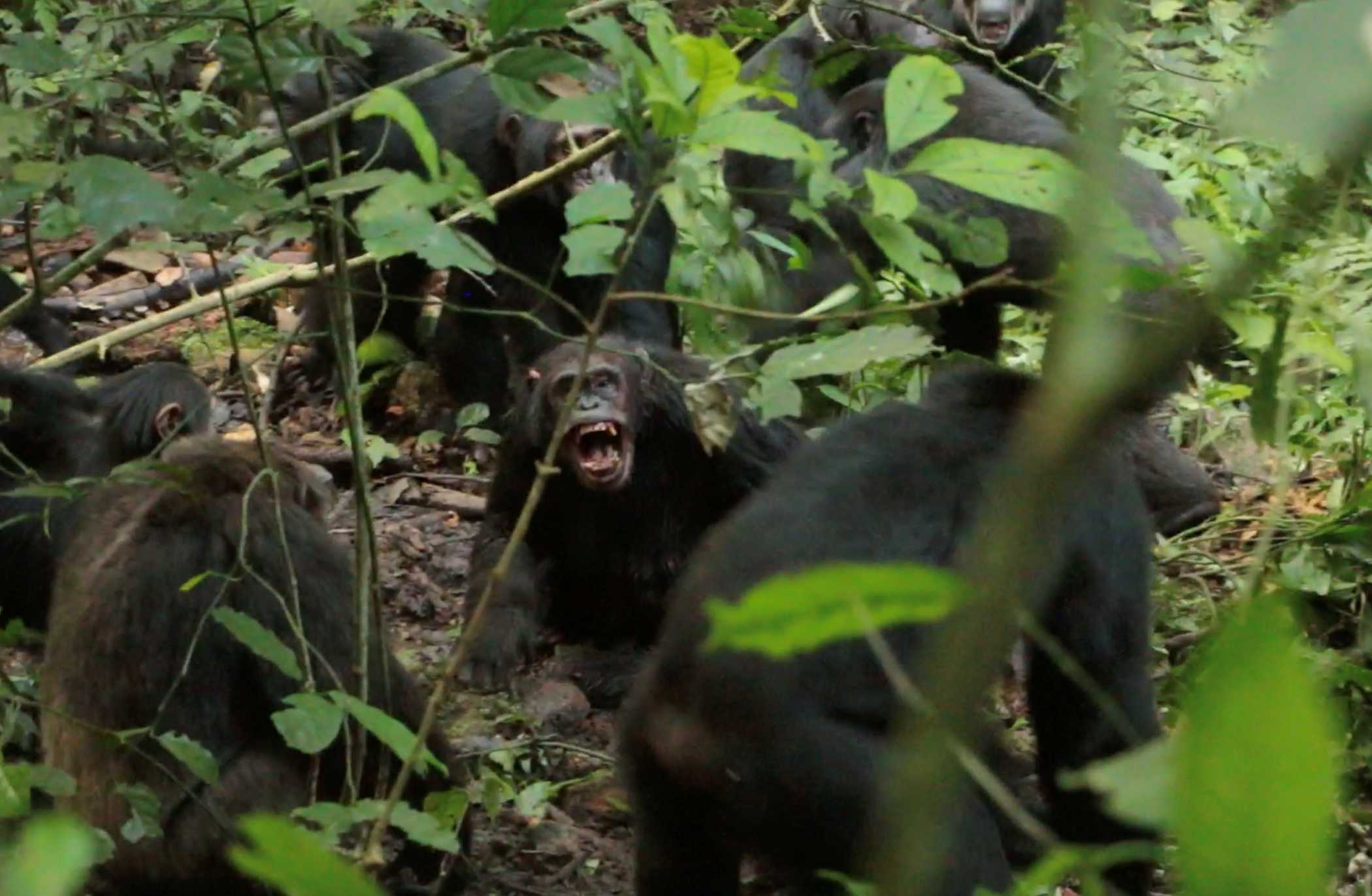
Permanent splits in chimpanzee groups are extremely rare—an event that occurs once every 500 years, according to genetic evidence. The journal Science reports on the split of the largest known group of wild chimpanzees following 30 years of observations. This involves the Ngogo chimpanzees in Kibale National Park (Uganda). The group shifted from cohesion to polarization in 2015 and eventually split into two distinct groups in 2018. From that point on, violence escalated, and members of one group killed at least seven males and 17 infants from the other. In the 1970s in Gombe (Tanzania), another case of this type was documented, but the chimpanzees had been fed by humans-
Ana María Fidalgo - chimpancés
Ana María Fidalgo de las Heras
President of the Spanish Primatology Association (APE), coordinator of the Primatology Research Group and co-director of the Master’s Degree in Applied Ethology and Animal-Assisted Interventions at the Autonomous University of Madrid
The study by Sandel and colleagues provides exceptional documentation of the permanent split within a community of wild chimpanzees and the serious conflict that subsequently arises between the two resulting groups. Based on nearly 30 years of continuous observations (which is also exceptional) of the Ngogo community (Kibale National Park, Uganda), it shows how a dynamic initially typical of fusion–fission gives way, starting in 2015, to a progressive process of social polarization that culminates in 2018 with a stable split. This fission is accompanied by social, spatial, and reproductive separation, as well as repeated attacks with a significant demographic impact, including the deaths of several adult males and numerous infants over the course of several years.
From an ethological perspective, changes in social structure are not in themselves extraordinary in chimpanzees, and Jane Goodall’s pioneering studies at Gombe already documented a group split followed by severe aggression. However, what makes this case particularly relevant is the permanent nature of the split and the fact that the conflict is directed against former members of the same group once social boundaries and group identity have been redefined—something extremely rare from an ethological standpoint. Likewise, the use of social network analysis allows for the objective detection of the progressive loss of cohesion and of key individuals acting as social connectors, showing that the rupture is not sudden but rather the result of a cumulative process.
However, as a significant limitation, it should be noted that the study focuses predominantly on the behavior and interactions of males, the primary agents of aggression and territorial defense, while the role of females in the fission process receives much less attention. Given that females participate in key dynamics such as social affiliation, use of space, reproduction, and dispersal, a more in-depth integration of their behavior could provide a more complete picture of the social factors involved in group fragmentation.
These results invite reflection on the role of relational dynamics and social cohesion in the generation of serious internal conflicts, even in the absence of cultural markers, without resorting to deterministic interpretations or simplistic analogies with human violence.
Miquel Llorente - chimpancés
Miquel Llorente
Head of the Department of Psychology at the University of Girona, associate professor Serra Húnter and principal investigator of the Comparative Minds research group
This work stands out, above all, for the incalculable value of long-term research, something very rare in science. Three decades of uninterrupted monitoring have made it possible to capture a phenomenon—the permanent breakup of a community—that is extremely rare to observe in nature. However, beyond the spectacular nature of the data, the study must be analyzed with scientific caution. Although the authors accurately document the ‘how’ and ‘when’ of this breakup, the ‘why’ remains, to a large extent, an inference based on correlations. Factors such as the group’s excessive size or the death of key leaders are mentioned, but we cannot determine with certainty whether these were the exact causes or merely symptoms of a prior structural instability not assessed in the study. An alternative explanation, which the study does not address, is that what we are seeing is not the breakup of a cohesive unit (the community), but rather the collapse of an ecological equilibrium: perhaps the energetic and social costs of maintaining such a large group outweighed the benefits of cooperation, forcing a split due to sheer resource pressure rather than a social “decision.” It would have been interesting, therefore, to assess how ecological factors might have been related to the community’s split into two.
Likewise, I believe it is essential to warn against the risk of using terms like ‘civil war’ to describe these events. Although it is an appealing label for public communication, it carries an obvious danger of anthropomorphism that can skew our interpretation. Human warfare involves ideological structures, symbolic identities, and shared political objectives that do not exist in the same way among chimpanzees. Labeling their violence as such can lead us astray, ignoring the fact that their conflicts are typically rooted in much more direct biological mechanisms, such as competition for reproductive success or physical territorial control over access to ecological resources. The parallels with our species are undeniable in biological and demographic terms, but the true relevance of this work should not be to “humanize” chimpanzees, but rather to help us understand which ecological and cognitive mechanisms we share that are associated with serious conflicts in these species. What Ngogo teaches us is that intragroup violence can escalate lethally when individual reconciliation mechanisms break down, a finding that underscores that social cohesion is a fragile process requiring constant maintenance, both in their species and in ours.
2026 04 09 chimpancés Andreu Sánchez Megías EN
Andreu Sánchez Megías
PhD candidate in the Department of Social Psychology and Quantitative Psychology at the Faculty of Psychology, University of Barcelona
Intergroup conflict is common among animals competing for the same resources, whether food, territory, or access to mating partners. Throughout history, conflicts and wars between human groups have also been frequent due to cultural differences—religious ones, for example. However, conflicts within a single human group, or civil wars, have likewise been common. This study documents the first known case of conflict between individuals within the same community in wild chimpanzees, observed over several decades and without human intervention, which resulted in the deaths of several individuals and the permanent division of the group into two subgroups.
The study proposes several factors that may have contributed to social tension and instability within the chimpanzee community: a group size too large to sustain cohesive social relationships, a change in the group’s leadership, and the loss of several individuals due to disease. These factors may have reshaped social relationships to the point of fragmenting the social network and giving rise to two new group identities. This social breakdown ultimately triggered lethal attacks between individuals who had previously belonged to the same group and had coexisted peacefully in the social context prior to the conflict.
Such events are estimated to occur only once every 500 years in chimpanzees, making these observations crucial for understanding the factors that trigger within-group conflict in non-human animals. Since chimpanzees do not exhibit human cultural elements such as language or ideology, this study shows that social changes alone can be sufficient to produce polarisation within a single group, leading to deadly aggression and the emergence of new group identities. This suggests that similar underlying mechanisms may drive conflict within human groups, offering a new perspective for understanding conflict in our own species.
Sandel et al.
- Research article
- Peer reviewed
- Animals