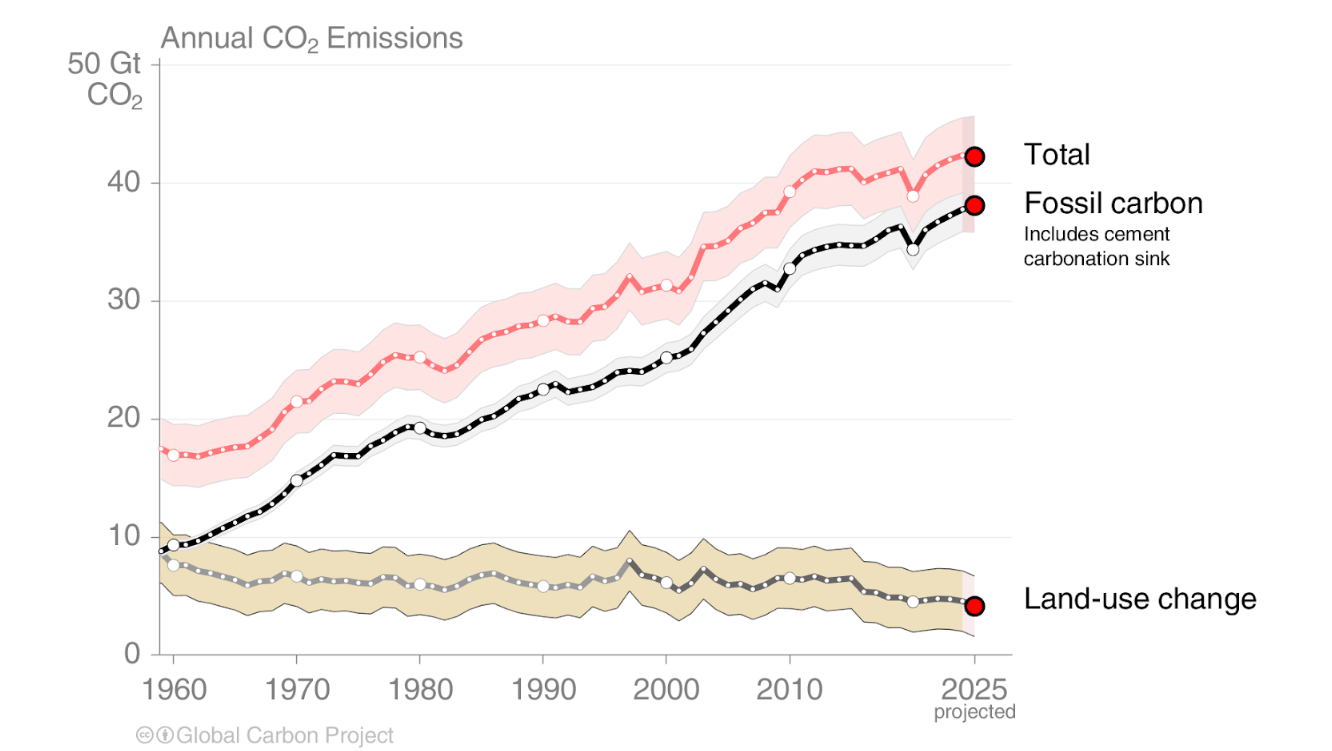
Carbon dioxide (CO2) emissions from fossil fuels continue to rise. In 2025, they will grow by 1.1% compared to the previous year, according to estimates by the Global Carbon Budget 2025, the largest report on the latest trends in global carbon emissions and their impact on achieving climate goals. Thus, they will reach 38.1 billion tons (GtCO2), and the increase will be similar to that recorded in 2024 compared to 2023.
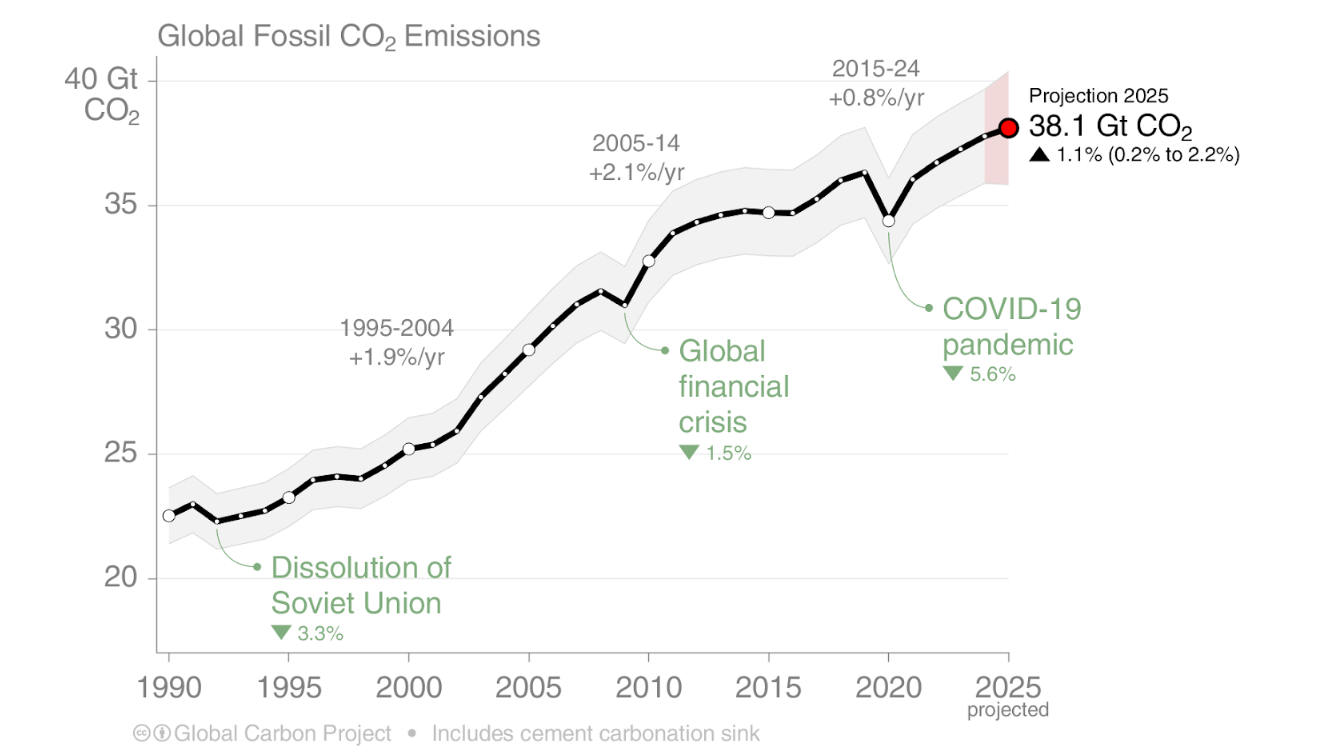
"They continue to increase, without reaching the peak we need to start decreasing. The most important thing this year is that all fossil fuel sources are contributing to this growth, even coal, which for many years we have seen as not contributing much, is starting to do so again after the pandemic," explained Pep Canadell, executive director of the Global Carbon Project, the international project responsible for producing this report, at a briefing organized by SMC Spain.
The report, now in its 20th edition and to be presented at the Climate Summit in Belém (Brazil), warns that if this rate continues, there is a 50% chance that global warming will exceed the 1.5°C limit in four years, as the carbon budget remaining to reach that limit is “practically exhausted.”
"In a few years, we will be 1.5 degrees above global temperature and we will go to 1.6, 1.7, and 1.8. Getting back to 1.5 is going to be such a tremendous effort that it will be very difficult to actually go down. But it is important to maintain 1.5. We cannot change the benchmark every year," emphasized Canadell, chief scientist at the CSIRO Climate Science Center in Canberra, Australia.
The analysis predicts that emissions will increase this year in the United States and the European Union, contrasting with their downward trends over the last two decades, and will also grow in China and India, albeit at a slower pace than in previous years.
In the European Union, the increase will be around 0.4%, which, according to the authors, could be explained by the fact that, although coal use continues to decline and solar energy is expanding, low hydroelectric and wind power production due to weather conditions has led to an increase in electricity generation from natural gas. In addition, a relatively cold February led to an increase in the use of natural gas for heating. According to Canadell, the major global challenge remains fossil fuels, which continue to dominate the global landscape.
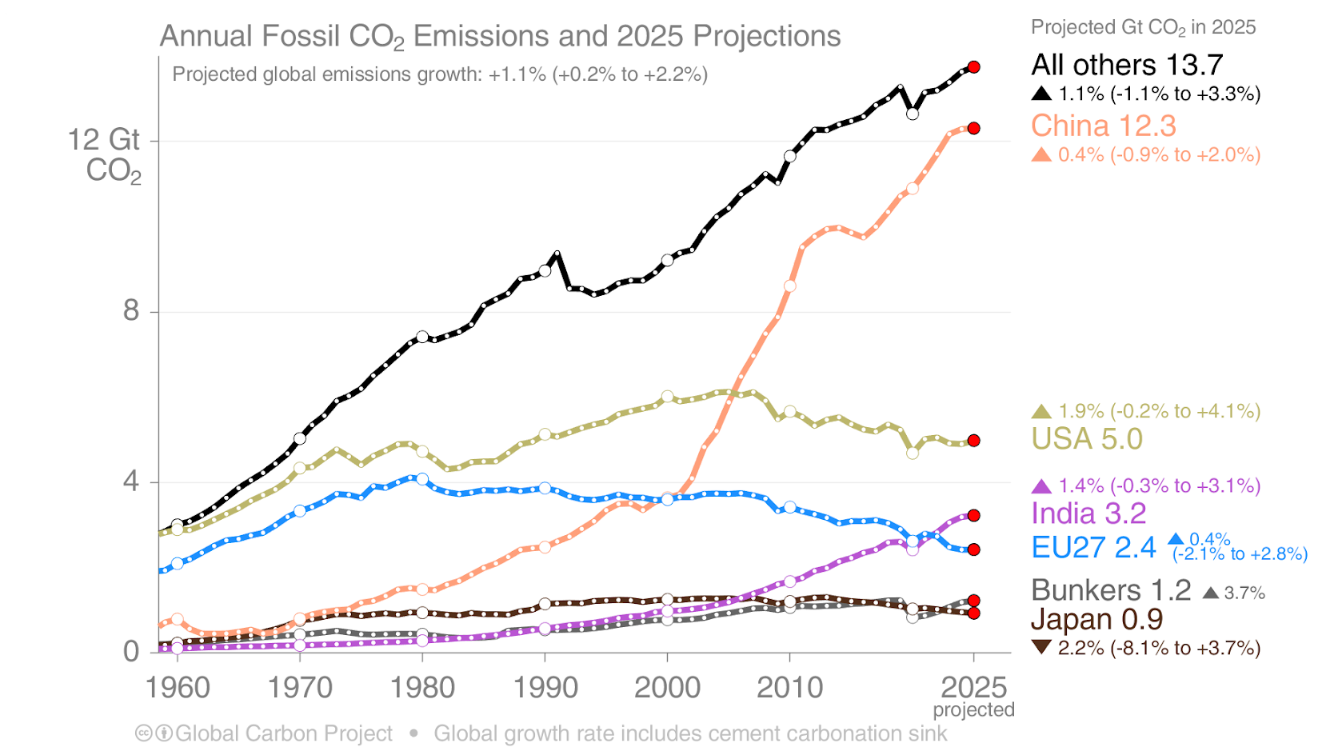
The report also estimates that emissions will increase by 6.8% in international aviation—which accounts for 1.5% of global emissions—surpassing pre-pandemic levels for the first time.
Decarbonization and economic growth
Among the positive data, the document highlights that 35 countries—including Spain and the United States—have significantly reduced their fossil CO2 emissions while their economies grew in the decade from 2015 to 2024, twice as many countries as in the previous decade. “Renewable energies have grown incredibly,” said Canadell.
Furthermore, emissions from land use change, such as deforestation, although still high, have declined every decade since the 1990s. In total, emissions from fossil fuel use and land use change in 2024 were 42.4 billion tons of CO2. A slightly lower figure of 42.2 billion tons is expected for 2025. This is because the expected increase in fossil CO2 emissions in 2025 is offset by the decrease in emissions from land use change.
With regard to natural carbon sinks, which purify the carbon dioxide that reaches them, the study estimates that half of all anthropogenic CO2 emissions released into the atmosphere are absorbed by terrestrial and ocean sinks. Thus, the ocean has absorbed 29% of total emissions in the last decade and the land has absorbed 21%, despite the fact that climate change is hampering their absorption capacity.
As for fires, so far in 2025, emissions have been 20% lower than the 2015-2024 average due to low fire activity in the tropics. In Spain, last August saw a historic record as a result of the wave of forest fires. The study provides data for Spain for 2024, does not make estimates for 2025, and shows a slight increase in fossil fuel emissions of 2%. “Oil has risen sharply since the drop caused by COVID-19 and is now almost at the same level as before,” Canadell noted.
The report, published in preprint format in the journal Earth System Science Data, also measures the concentration of CO2 in the atmosphere, which will reach 425.7 ppm (parts per million) in 2025, 52% above pre-industrial levels. The increase is lower than last year, which saw a record high mainly due to the effect of El Niño conditions in 2023-2024, which weakened the terrestrial sink.
Assessments by independent scientists
More than 130 scientists from over 90 research centers and universities around the world participated in the preparation of the Global Carbon Budget 2025. At SMC Spain, we have gathered reactions from independent experts who did not participate in the report.
"Coinciding with COP30, these findings highlight the idea that national climate commitments remain disappointingly inadequate to stabilize the climate. The report, which is a recognized reference, should serve as an essential scientific guide to inspire much more ambitious mitigation policies and a palpable acceleration of the global energy transition,“ says Ana Hernández, a researcher in biodiversity and natural resources at the Climate Research Foundation.
”The GCB suggests that the actions taken so far in terms of emissions reduction and decarbonization have been insufficient. Even so, in the run-up to COP30, actions to reduce fossil fuel emissions must continue to play a central role. Emissions reduction should be the pillar that underpins the discussions on adaptation and mitigation," says Ana Cristina Franco Novela, a researcher in the Earth Sciences Department at the Barcelona Supercomputing Center.
“Studies such as this one allow us to monitor the results of efforts and policies implemented to curb climate change, showing that greater commitment and ambition are needed to substantially reduce the constant increase in atmospheric CO2 concentrations, which are the cause of current climate change,” says Ernesto Rodríguez Camino, senior state meteorologist and president of the Spanish Meteorological Association.