energy

energy

energy

COP30 ends with a minimal agreement, leaving out any mention of fossil fuels

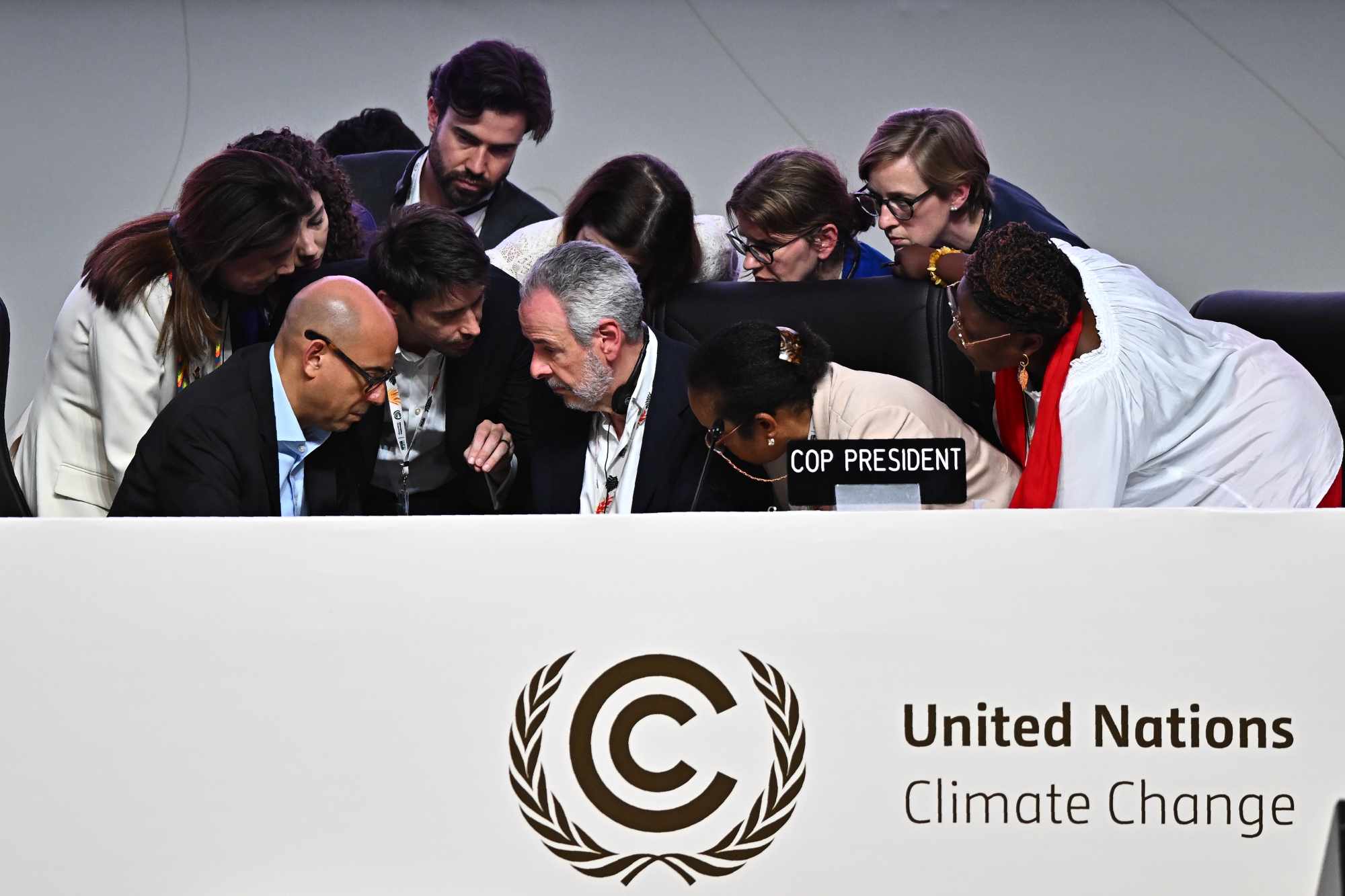
One day after the deadline, COP30 in Belém (Brazil) has finally reached a minimal agreement. The text does not mention a roadmap for abandoning fossil fuels, as requested by more than 80 states, including the European Union. The agreement states that countries agreed to accelerate climate action and triple funding for developing countries facing extreme weather events.


0

Fossil fuel CO2 emissions will hit a new record in 2025, according to the largest carbon balance report

The Global Carbon Budget's projections for 2025 estimate that carbon dioxide (CO2) emissions from fossil fuels will reach a new all-time high of 38.1 billion tons, an increase of 1.1% over 2024. This global report—now in its 20th edition and to be presented at COP30 in Belém, Brazil—estimates that emissions in the United States and the European Union will grow this year, in contrast to the decline in previous years, partly due to weather conditions and higher energy consumption. The study is published in the journal Earth System Science Data in preprint format.


0

Pep Canadell: “Coal is once again contributing to the increase in emissions after the pandemic slowdown"

At the current rate of carbon dioxide emissions, the 1.5°C temperature increase limit set in the Paris Agreement will be exceeded in four years. This is one of the predictions of the Global Carbon Budget 2025, the global report on the carbon balance, now in its 20th edition, which will be presented at COP30 in Belém (Brazil). Pep Canadell, one of its authors, analyzed its findings at a briefing organized by SMC Spain.


0

Attitudes influence energy savings at home more than income, according to a study

A team conducted a meta-analysis of 100 studies, including more than 430,000 participants from 42 countries, to understand what factors drive energy-saving habits in homes. Their conclusions are that attitudes and moral sentiments are more influential than socioeconomic factors such as education and income level, which were barely related to energy-saving behaviors. According to the authors, who publish the results in the journal Cell Reports Sustainability, "the research suggests that exploring these deeper psychological factors is a way to get as many people as possible committed to saving energy."

0

Solar panels in space could help Europe achieve its net-zero emissions target

Space-based solar power could provide electricity to support Europe's net-zero emissions target if its cost of supply is reduced sufficiently. This is one of the conclusions of an article published in the journal Joule, by the Cell Press group. Space solar panels would allow continuous capture of solar energy, rather than only when light reaches Earth, reducing the need for wind and solar energy on Earth by 80% in Europe. The researchers estimate that by 2050, space-based solar power could reduce the costs of the European electricity system, although this depends on the development of two NASA space-based solar power designs they have used for their research: the Innovative Heliostat Swarm and the Mature Planar Array.

0

Massive power outage on the Iberian peninsula leaves millions without power supply

The power outage that occurred after midday on Monday has left millions of people in the Iberian peninsula and some parts of southern France without electricity. According to Red Eléctrica, at 11:15 (peninsular time) on Tuesday, the peninsular electricity system was back to normal. ‘After surpassing the morning peak demand at 8:35 am with 28,677 MW, the night peak is expected at 21:10 pm with 31,200 MW’, they indicate.

0

Two low-pollution alternatives proposed to extract lithium from diluted brines like seawater

Lithium, a material widely used for battery production, is typically extracted from rocks and concentrated brines, but these reserves are expected to run out by 2080. The alternative is to evaporate more diluted brines (such as seawater), but the traditional process is inefficient, polluting, and consumes large amounts of water. Two new studies published in Science propose two more viable and environmentally friendly alternative methods: the first uses a membrane that filters lithium through a transpiration system similar to that of plants, requiring only solar energy. The second combines electrodes to mimic a battery and move lithium from the brine (cathode) to fresh water (anode).

0

Reactions: COP28 approves "transition away from fossil fuels" in Global Stocktake

After an intense night of negotiations in Dubai (United Arab Emirates), the countries participating in COP28 reached a historic agreement by mentioning for the first time "moving away from fossil fuels" in the Global Stocktake document - the assessment of progress made towards achieving the climate goals set out in the Paris Agreement. The agreement comes after the first draft presented by the presidency did not make this mention - it referred only to "reducing consumption and production" of these fuels - which was described as "unacceptable" by countries such as Spain.

0