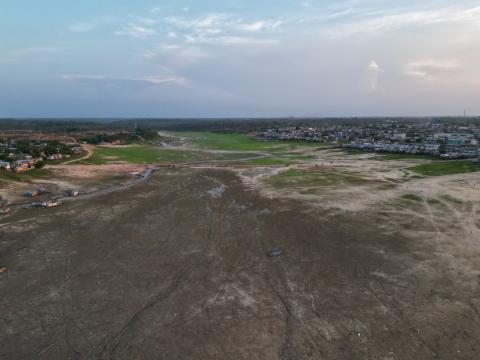
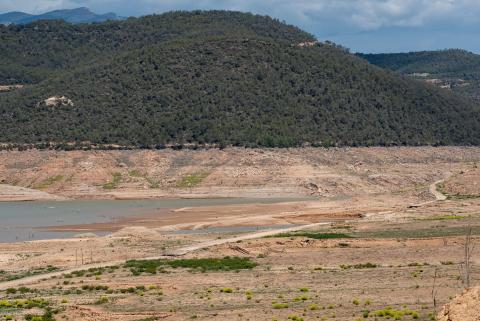
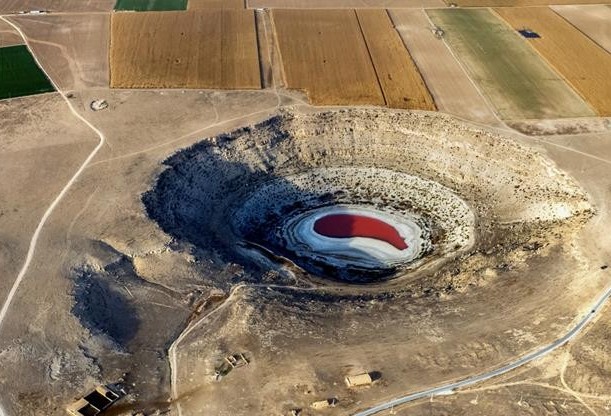
The world has entered the era of water bankruptcy, according to a new UN report
A new report from the United Nations University Institute for Water, Environment and Health (UNU-INWEH) toughens the discourse on the current water emergency by referring to an era of "global water bankruptcy". According to the report, the terms "water stress" or "water crisis" are no longer sufficient, as we find ourselves in a situation that goes beyond a temporary crisis, characterised by irreversible losses of natural water resources and the inability to return to historical levels. The report points out that, although not all basins are in water bankruptcy, "enough critical systems around the world have crossed these thresholds" and are interconnected through trade, migration, climate or geopolitics.
2026 01 20 Jordi Catalán bancarrota agua EN
Jordi Catalán
CSIC research professor at CREAF
What are the implications of the report and how does it fit in with existing evidence?
"This report is yet another effort to convey the urgency of addressing the environmental problems that population growth and natural resource use have experienced over the last fifty years. In this case, it focuses on the availability of water, the most essential resource. As with other aspects of human-induced global change, the evidence is overwhelming and grows year by year. The problem is not the evidence, but how to convey it to decision-makers and social actors so that it is taken into account effectively. In this task, the report increases the emphasis by using the term 'water bankruptcy'".
How is water scarcity being addressed now, and how should this report change that approach?
"The report points out that the language and actions used so far have suggested a temporary emergency that could be reversed with a few measures. This has not been enough, and the situation in many places has worsened dramatically. As in other areas, the world has exceeded safe limits in water use. Exceeding these limits means entering a situation where the unpredictable dominates over what can be reasonably managed. Recognising this does not necessarily imply resignation, but should be an incentive for more decisive action in the face of the climate crisis and uncontrolled development in the use of resources".
Are we already at a point of no return?
"Locally, there are many points of no return, because there are hydrological structures that, if destroyed, are difficult to rebuild. Other structures, however, can be restored within a reasonable time frame. Nevertheless, the issue is not local or regional irreversibilities. The high level of global interconnection generated by the needs of our current societies means that these problems do not remain confined to themselves, but spread by themselves or in resonance with them to other parts of the planet, in the form of water demand or in the form of conflicts or migrations.
Therefore, the solution lies in the governance of these global scales, recognising that it is no longer just a question of quality and efficiency, but of controlling demand in absolute terms. Naturally, this affects all economic and demographic activity across the planet. At this scale, there are clearly possibilities for a more honest world, based on knowledge and an agenda oriented towards social justice, as the report points out".
The discussion often centres on hotspots, such as certain areas of Africa, but this study raises a global alarm. What problems are characteristic of Europe?
"Europe is not a homogeneous space. The problems faced by some countries are not the same as those faced by others, and sometimes the importance attached to water-related issues depends more on who raises them than on an objective assessment of the issues themselves. Traditionally, southern countries have placed more emphasis on water availability and northern countries on quality. The Water Framework Directive was a remarkable effort to improve quality, which encouraged coordinated action in many countries. The climate crisis is shaking up many of the established objectives and methods. Recurring droughts in unusual areas are creating new challenges. In general, the instability of quality and resources demands much more knowledge, foresight and willingness to implement measures.
Beyond this, and linking to the above, globalisation means that water problems in other parts of the world also have an impact on Europe, in the form of trade, food resources and migration. Water is one of the most important natural resources, if not the most important, and perhaps it is an opportunity to spark effective and coordinated action in the face of the tremendous challenges of globalisation".
2026 01 20 Antonio Collados Lara bancarrota agua EN
Antonio Collados Lara
Senior scientist at the Geological Survey of Spain (IGME-CSIC)
The report makes a compelling central argument: the world has entered an era of global water bankruptcy.
The report provides a series of pieces of evidence to support this argument:
- Surface waters and associated aquatic ecosystems are collapsing.
- Overexploited and depleted aquifers and associated land subsidence.
- Significant reduction in the cryosphere.
- Agriculture at risk due to soil degradation and salinisation of water and soil.
- Droughts exacerbated by human activity through overexploitation, deforestation, soil degradation and climate change.
- Water pollution that renders much of the available water unfit for human or agricultural use.
The main message conveyed is that we must stop talking about water stress or water crises, concepts that imply a possible recovery of water systems and associated ecosystems. In many cases, this recovery is no longer possible, as the damage is irreversible.
The concept of 'water bankruptcy' is closely related to the overexploitation of water resources, which is a term commonly used in the field of hydrology, as in both cases it refers to a situation of excessive water use beyond renewable resources. However, the term 'bankruptcy' emphasises the irreversibility of the damage. This is very important when it comes to raising awareness in society of the global problem associated with water.
Furthermore, introducing an economic simile such as 'bankruptcy' to talk about water highlights the need to value water as it is a fundamental resource for life on our planet. Until now, from an economic point of view, other natural resources such as oil have been valued more highly, to the point of 'coining' new currencies such as petrodollars. Perhaps in the future we will have to do the same with water due to global problems related to its scarcity and poor quality. This is the scenario that this report seeks to avoid by calling for a renewed global agenda for water management.
2026 01 20 Ana Allende bancarrota agua EN
Ana Allende
CSIC research professor and expert in food safety and water quality
The idea of 'global water bankruptcy' put forward in the report fits well with the scientific evidence accumulated in recent years and represents a very apt conceptual shift from the classic approach of 'water crisis'. In my opinion, the use of this terminology is also a particularly effective strategy from a governance perspective, as it allows the seriousness of the situation to be conveyed to managers and policymakers who are accustomed to operating within economic and financial frameworks. The parallel with bankruptcy helps to understand that this is not a temporary or reversible problem, but rather that we have been living for decades beyond our 'water income', consuming natural capital such as rivers, wetlands, aquifers, soils and glaciers to levels that no longer allow us to recover the conditions of the past. In this sense, the report does not describe a future threat, but rather a diagnosis of the current situation, consistent with evidence of groundwater depletion, degradation of aquatic ecosystems, deterioration of water quality and increasingly anthropogenic droughts, and forces us to rethink water policies from a logic of biophysical limits and structural adaptation.
As to whether we are at a point of no return, the report clearly states that not all systems are 'bankrupt', but enough are for the risk to be global and systemic. In Europe, although traditionally perceived as a less vulnerable region, the problems are evident: overexploitation of aquifers, especially in intensive agricultural areas; degradation of rivers and wetlands; loss of water quality due to diffuse and urban pollution; and an increasing frequency of prolonged droughts, especially in the Mediterranean. The main implication for Europe is that it cannot continue to address scarcity solely through efficiency improvements, reuse or new infrastructure, without a thorough review of demand, land use and production models. The report points to the need to accept that some impacts are irreversible and that water management must be geared towards preventing further damage, redistributing risks and costs fairly, and adapting socio-economic systems to structurally lower water availability.
2026 01 20 José Luis García Aróstegui bancarrota agua EN
José Luis García Aróstegui
Scientific researcher in the Water and Global Change Department of the Geological and Mining Institute of Spain (IGME-CSIC)
This is a hard-hitting report that warns of the critical and extreme state of water resources worldwide and calls for a new paradigm based on the collapse of many water systems. Of particular interest is the way it defines the concepts of water stress, water crisis and water bankruptcy, the latter drawing a striking analogy with financial bankruptcy in order to frame the transition to a new phase.
The report argues that, at global level, hydrological limits have already been exceeded, for which there is abundant scientific evidence. As a result, many systems have entered what it terms ‘water bankruptcy’, meaning that the changes that have occurred are irreversible. This implies that returning to the pre-crisis state is unrealistic; instead, a permanent post-crisis condition must be managed. The report sets out an agenda for dealing with this new reality, which must begin with acceptance of this diagnosis and includes minimising irreversible damage, protecting the hydrological cycle and rebalancing rights and expectations. One of the implications of this new paradigm is that, for many systems, the focus needs to shift from mitigation — without ruling it out entirely — towards adaptation.
The condition of many aquifers, now severely depleted, is particularly significant. For these, recovery is not a realistic prospect, not only because of the high socio-economic costs involved but also because the dependent ecosystems associated with many of them disappeared decades ago. While the report places particular emphasis on quantitative aspects, the situation is, in many cases, even more critical once water quality degradation is taken into account. Nitrate pollution from agriculture is the most widespread form of water contamination globally, and there is little evidence of recovery when large groundwater bodies are affected, despite the vast sums of money invested.
In Europe, the Water Framework Directive makes clear that achieving good status is not optional but a legal objective to be met progressively, through continuous monitoring and sustained effort. After two extensions, the deadline expires in 2027. In south-east Spain in particular, where there is a severe problem of aquifer over-exploitation and depletion, concern is at its highest, as it remains unclear how the problem can be addressed. Aquifer depletion could reach 15 km³, making recovery unrealistic, and in many cases even halting further deterioration entails very high costs. Adaptation therefore means, among other things, focusing on specific cases. It must be acknowledged that this is not a crisis in the sense of a temporary situation, but a permanent condition with no prospect of recovery — in other words, the problem has no solution and must be managed as such.
The new narrative framework of ‘global water bankruptcy’ requires honesty in diagnosing, at local level and on the basis of scientific evidence, which water systems need to be addressed under this new agenda. In the European context, this approach should be aligned not only with the Water Framework Directive but, in an increasingly interconnected world, should also incorporate the concept of virtual water trade.
2026 01 20 Leticia Baena Ruiz bancarrota agua EN
Leticia Baena Ruiz
Researcher in the Water and Global Change Department of the Geological and Mining Institute of Spain (IGME-CSIC)
The report by the United Nations University (UNU-INWEH) introduces the concept of 'global water bankruptcy' as a new diagnostic category to describe the current state of numerous water systems around the world, highlighting the irreversibility and depletion of 'natural capital'.
For decades, we observed aquifer overexploitation, sustained declines in water storage, land subsidence, saltwater intrusion, and the degradation of groundwater dependent ecosystems. From a hydrogeological perspective, the report’s emphasis that many aquifers are not 'resilient' on human timescales is scientifically sound and often underestimated in water management.
Although this reality is undeniable—and many systems have already crossed critical thresholds (GRACE data, piezometric records from strategic aquifers, and the global expansion of subsidence support this claim)—the global nature of the term “bankruptcy” must be handled with caution. Not all systems are equally degraded, and the risk is that the message may be perceived as uniform when hydrogeological reality is profoundly heterogeneous.
As the report highlights, in many systems, normality no longer exists. The hydrological regime has changed, and the ecological foundation that sustained it has been degraded. Yet there is still time to act in many others which, although affected, can be restored with proper management. The solution lies in using less water and using it differently. This means accepting that not all uses are compatible with actual recharge and that not all historical rights can be maintained. Managed aquifer recharge, reuse, or even desalination can help, but they do not fix a bankruptcy if structural spending continues to exceed income.
Faced with this scenario, the key question is: have we reached the point of no return? Unfortunately, in some systems, yes—at least on human timescales. Compacted aquifers do not recover, subsided deltas do not rise again, and lost wetlands do not reappear. In other cases, it is still possible to stabilize the situation and prevent further damage. The challenge lies in identifying and prioritizing which systems are reversible and which are not.
In Europe’s case, one of the report’s most relevant messages is that the continent is not exempt. It is not a classic “hotspot,” but it suffers from a silent bankruptcy: chronic aquifer overexploitation in the Mediterranean, coastal saltwater intrusion, nitrate pollution, growing dependence on groundwater during droughts, and subsidence in urban and agricultural areas. The difference is that here, infrastructure and governance cushion the visible impacts. But the balance remains negative in many of its systems.
Madani K.
- Report