A transmissible melanoma-type cancer has been discovered in fish, the fourth known contagious tumor among animals
Since 2012, a population of brown catfish in a lake between Canada and the United States has been observed to have a very high incidence of melanoma, a tumor generally associated with sun exposure. Now, a team from Vermont (USA) has discovered that, in this case, it is a transmissible cancer that spreads from fish to fish like a parasite. This finding represents the fourth known transmissible cancer in the animal kingdom and the first in any species of fish or freshwater animal; previous examples include facial tumor disease in Tasmanian devils, a venereal tumor in dogs, and leukemia-like transmissible diseases in clams, mussels, and other bivalve mollusks. The researchers published their results in Nature and emphasize that the disease poses no known risk to humans.
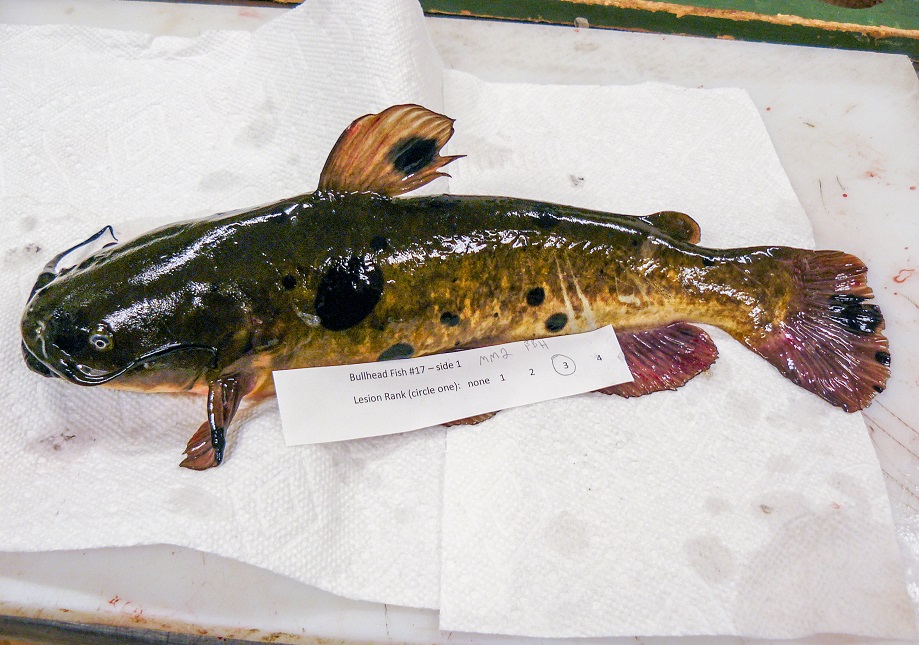
Fish with melanoma. / University of Vermont.
Murchison - Melanoma peces
Elizabeth Murchison
"It’s a very exciting paper which clearly shows, for the first time, that a type of melanoma in brown bullhead catfish is a transmissible cancer, spread by the transfer of living cancer cells themselves.
Transmissible cancers are an unusual type of disease in which the cancer cells themselves are infectious agents and spread between individuals; there are no viruses or other microbes involved in the spread of disease. Until now, transmissible cancers have only been found in dogs, Tasmanian devils, and several species of marine bivalve molluscs, including clams, cockles and mussels. This paper reveals for the first time that transmissible cancers also occur in some species of fish. This suggests that transmissible cancers may not be as rare in nature as was previously thought.
There are not important limitations, the paper is very clear and straightforward".
Considering potential public concern: are there cases of tumor transmission between humans? How frequent are they? Could any mechanisms similar to those being described in some animals occur in humans?
"There are rare cases of cancer transmission between humans, but in almost all of these cases cancer cells only spread between two people, and not further. These cases mostly involve organ transplants (accidental transplantation of organs from undiagnosed cancer patients), pregnancy and childbirth (e.g. mother to foetus transmission through the placenta), and accidents (e.g. surgical accidents in which a surgeon injures themselves with a scalpel blade contaminated with cancer cells). Although unlikely, there is potential for a transmissible cancer that spreads through populations, similar to those observed in animals, to arise in humans. However, it should be strongly emphasised that such transmissible cancers have not been observed in human populations and the risk of one arising is low".
Beata - Melanoma peces
Beata Ujvari
"I found the study fascinating and high quality with results presenting of immediate interest to conservation and evolutionary biologists, disease epidemiologists and cancer researchers.
The article addresses a very important topic, the discovery of a fascinating infectious disease, a transmissible cancer, in a new vertebrate host, a freshwater benthic fish. Transmissible cancers (that have been proposed to be new parasitic life forms) have so far only been discovered in two vertebrate groups, in dogs and Tasmanian devils. Recently several transmissible cancers have been discovered in marine ecosystems, where their presence is becoming concerning as they can wipe out populations of ecosystem engineers, i.e. bivalves. Studies investigating these infectious diseases are therefore urgently needed. The study highlights the importance of surveying other ecosystems, like freshwater bodies (that may or may not be exposed to pollution) to discover, mitigate and manage the emergence of these novel parasitic life forms.
[Regarding potential limitations] Sampling of additional populations of fish would be needed to discover the geographic spread, the age and the origin of this clonal cancer, as well as its impacts not only brown bullhead populations but also on the ecosystem they inhabit".
Considering potential public concern: are there cases of tumor transmission between humans? How frequent are they? Could any mechanisms similar to those being described in some animals occur in humans?
"Cancer cells passed from one individual to another are normally eliminated by a competent mammalian immune system. There is no need for public concern; tumor transmission between humans is exceedingly rare. Rare instances of human‑to‑human cancer transmission have been documented, including maternal–foetal transfer (0.1% of pregnancies), donor‑derived cancers in organ transplant recipients (0.04% of solid organ transplant recipients), and a handful of accidental laboratory or surgical exposures. Nevertheless, humans have a highly efficient immune system that is capable of recognising foreign cells, like transmissible cancer cells from fish, the likelihood of transmission from bullheads to humans therefore is as close to zero as it gets".
Conflicts of interest: “I was one of the reviewers of the article for the journal Nature.”
Adrián Báez-Ortega - melanoma peces
Adrián Báez-Ortega
What do you think of the article as a whole? Is it of good quality?
‘Yes: the methods are sound and the genetic evidence supporting a common origin for the tumours found in different individuals is overwhelming. It is not possible to explain the study’s results unless one accepts that this cancer has been transmitted directly from one animal to another; what remains to be clarified is the route of transmission.’
How does this fit in with the evidence already known, and what implications might it have?
“Until about ten years ago, it was believed that transmissible cancer was an extremely rare phenomenon affecting only two mammalian species: dogs and Tasmanian devils. However, over the last decade it has been discovered that this type of cancer is quite common amongst marine bivalves (cockles, mussels and clams), to the extent that it seems possible this is a completely ordinary occurrence in these species. The fact that transmissible marine cancers are so widespread has also begun to suggest that the aquatic environment may be more conducive to the transmission of cancer between individuals, and this new example of transmissible melanoma in fish reinforces this hypothesis. “I believe it is highly likely that there are many other cases of transmissible cancer in the wild that have gone unnoticed until now due to a lack of research, particularly amongst aquatic invertebrates, which do not have an immune system as developed as that of vertebrates.”
Are there any significant limitations to bear in mind?
“Although the study design, the quality of the tissue samples and the quality of the DNA sequencing may not be entirely optimal in this case, the genetic evidence, as I mentioned earlier, is more than sufficient to accept a common origin for the tumours.”
Are there any cases of tumour transmission between humans? Could mechanisms similar to those described in some animal species occur in humans?
“There have been no cases of ‘epidemics’ of transmissible cancer, and it is highly unlikely that we will ever see anything of this nature, mainly due to the effectiveness of our immune system in detecting and rejecting cells from another person. For cancer to be transmitted between humans in the way it is occurring in other animals, there would need to be a specific subpopulation of individuals with a chronic immune deficiency, rendering them unable to reject this type of invasive cell. However, there have been isolated cases of cancer transmission from one individual to another, usually as a result of an organ transplant: if the transplanted organ contains dormant cancer cells from the donor, these cells are capable of ‘waking up’ and causing cancer in the recipient, because treatment for an organ transplant involves permanent suppression of the patient’s immune system.”
Curd et al.
- Research article
- Peer reviewed
- Animals