A study challenges the theory that comets played a key role in the origin of life on Earth
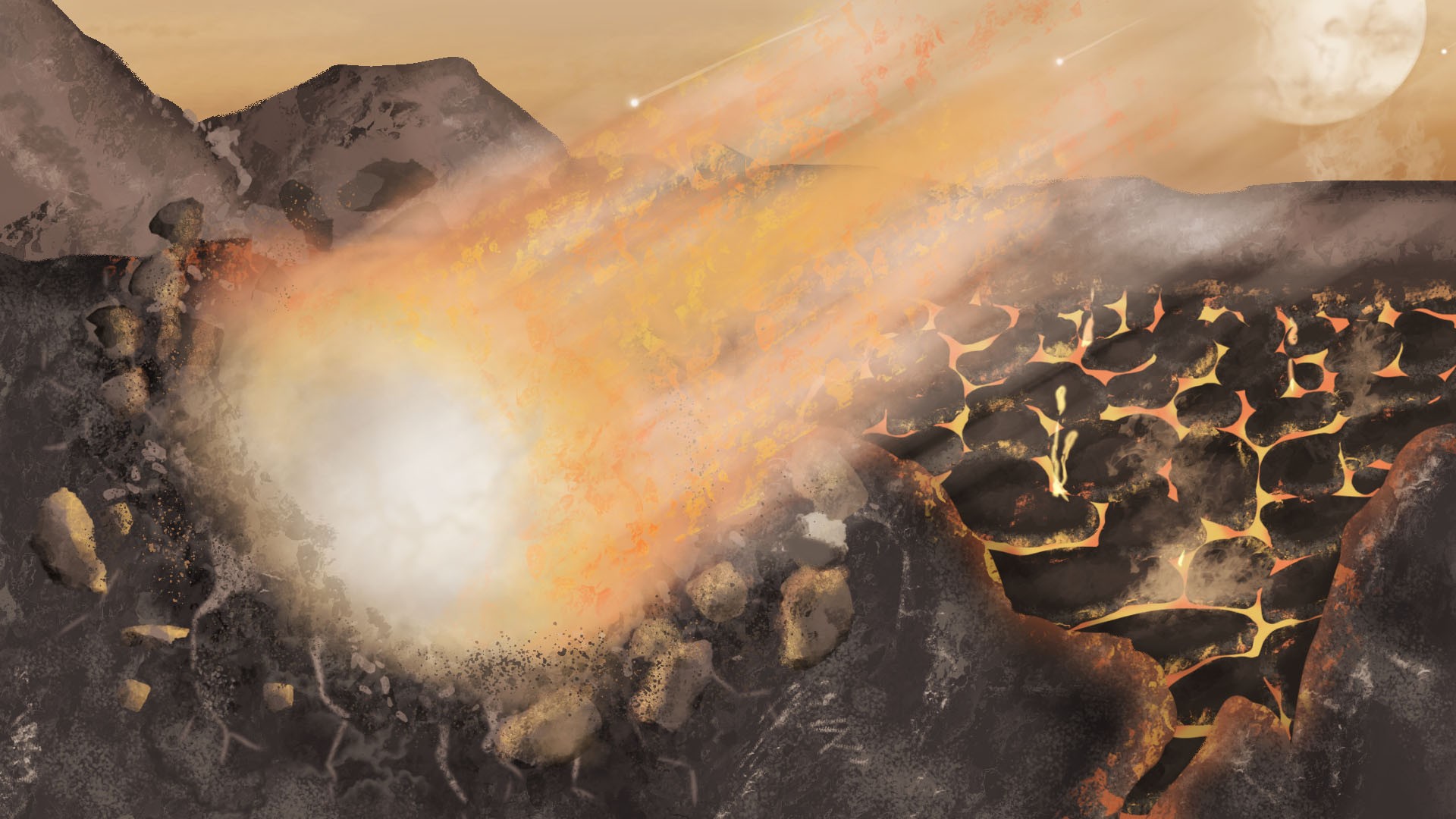
One theory regarding the origin of life on Earth suggests that comets brought the molecular building blocks necessary for life to develop. Now, a team led by the University of Cambridge (United Kingdom) is questioning this possibility. Using computer simulations focusing on hydrogen cyanide — an important prebiotic compound — they estimate that, whilst the possibility of such molecules arriving and surviving intact cannot be completely ruled out, the event would be extremely unlikely. “It’s quite a romantic idea, but our results suggest it is highly improbable,” the authors note in a press release. The study is published in Scientific Reports.
César Menor Salván - cometas origen
César Menor Salván
Astrobiologist and lecturer of Biochemistry at the University of Alcalá
Firstly, we must be very careful not to draw exaggerated conclusions: the study does not suggest that it is “highly unlikely that prebiotic components from comets reached Earth” [as suggested in the accompanying press release]. What the paper does say is that the conditions necessary for a comet to deposit significant quantities of hydrogen cyanide (HCN)—a molecule of great interest in prebiotic chemistry—must have been extraordinarily rare.
The paper is based on computer simulations and has many limitations. Firstly, it focuses on HCN, a prebiotic component. I believe we must be cautious about the scope of these results. The article does not prove that comets did not contribute to the origin of life, but rather calculates (I emphasise: it does not prove, it calculates) that a specific mechanism for the delivery of prebiotic molecules—the direct delivery of intact HCN in high concentrations—is unlikely. Comets contain a wide variety of organic compounds, and their contribution to the chemical evolution of the Earth cannot be reduced to the survival of a single molecule. Furthermore, impacts are not merely destructive processes. They can also trigger chemical reactions and generate hydrothermal environments and aqueous systems where prebiotic processes could continue to develop. The paper completely overlooks the geochemistry of cyanide, including processes such as the formation of reservoirs based on cyanide metal complexes (a topic we are working on in my laboratory).
The interesting thing about this paper – if we are to point out anything truly interesting – is that it imposes significant physical constraints and forces us to revisit some overly simplified hypotheses regarding the extraterrestrial supply of organic molecules.
However, we must not confuse the low probability of a particular mechanism with the absence of a cometary contribution to the origin of life. The chemical evolution that preceded the emergence of the first living systems probably involved multiple sources of organic matter, successive chemical transformations and prolonged interaction with the geological environment.
The methodology is sophisticated and well-suited to studying the physics of cometary supply. Its strength lies in integrating constraints that had previously been analysed separately.
However, there is a significant difference between what they actually simulate and the conclusion they draw regarding the origin of life.
Their methodology allows for the estimation of the frequency of impacts capable of depositing intact HCN in high concentrations, which implies very specific conditions. It does not allow for the simulation of the subsequent chemical evolution of that HCN, nor does it assess all possible contributions of impacts to prebiotic chemistry.
So be wary of extrapolations and interpretations based on non-sequitur fallacies. The fact that a model calls into question the cometary delivery of HCN does not imply that there are no other sources (asteroids, synthesis on the planet itself). Nor does the study imply that we need to revise our hypotheses about the environments in which life might have originated.
I do not find the study particularly interesting. As an experimental scientist, I am very cautious about computer simulations, which form the basis of this study. Studies of this kind are useful for planning experimental work or exploration, but they do not allow us to draw conclusions.
Jesús Martínez Frías - cometas
Jesús Martínez Frías
Planetary geologist and astrobiologist at the IGEO (CSIC-UCM). Academician of the Royal Academies of Sciences and Doctors of Spain. President of the Planetary Geology Commission of the Geological Society of Spain and of the Spanish Network of Planetology and Astrobiology.
This is a very interesting, high-quality article, focusing primarily on global computer simulations, numerical models, recent advances in simulations of cometary impacts and comet–atmosphere interactions, as well as on modelling the origin and evolution of comets. From the perspective of so-called ‘frontier or hybrid compounds’ between organic and inorganic matter, it focuses on HCN. It is within this specific context, combining simulations and models, that the study must be viewed.
This research does not clearly contradict existing knowledge, but it does highlight uncertainties, questions and limitations regarding the experimental evidence linked to cometary missions and numerous previous studies, based on the compositional analysis of cometary ices and on earlier simulations.
In fact, it is a study that aims, if not to refute, then certainly to challenge much of what we currently know about comets, their abundance of organic compounds and their contribution, alongside asteroids, as planetesimals relevant to the origin of life on Earth (and perhaps on other planets; Mars is mentioned, amongst others, from this astrobiological perspective).
However, there are significant limitations, not so much associated with the research carried out—on models and simulations, which I consider rigorous—but rather with its overly broad extrapolation regarding the implications of its conclusions. Furthermore, by focusing too heavily on HCN, it fails to address the astrobiological importance of water itself and of many other organic compounds present in comets. Nevertheless, in this regard, the authors themselves are cautious and state that ‘their results are not intended to rule out the significant contribution of prebiotic compounds from comets’.
Anslow et al.
- Research article
- Peer reviewed