The war in Iran, combined with the expansion of wind and solar power, could lead to a reduction in carbon dioxide (CO2) emissions from fossil fuels by 2026. The fall, of 0.4 per cent compared with the previous year, would bring these emissions down to 38,200 million tonnes, and would mark the first decline since the covid-19 pandemic, according to estimates from the Global Carbon Budget 2026, the leading report on carbon accounting.
“Had it not been for the war in Iran, emissions would surely have risen very little or perhaps hardly at all, but they would not have fallen,” explained Pep Canadell, executive director of the Global Carbon Project and chief researcher at the CSIRO Climate Science Centre in Canberra (Australia), at a briefing organised by SMC Spain.
Published in the journal Earth System Science Data as a preprint and in another article in Nature Climate Change, the report also reveals that, although global energy demand continues to rise, two-thirds of this increase is being met by greater use of solar and wind power and electric vehicles. However, the study states that the growth of clean energy is not yet fast enough to achieve a lasting reduction in global CO2 emissions from fossil fuels.
“What we do see is that, as renewables are growing exponentially in many places, in three or four years’ time they will be keeping pace with the growth in energy demand,” estimated Canadell. Once that happens, emissions will peak, renewables will begin to dominate and CO2 emissions will start to fall, according to his forecasts.
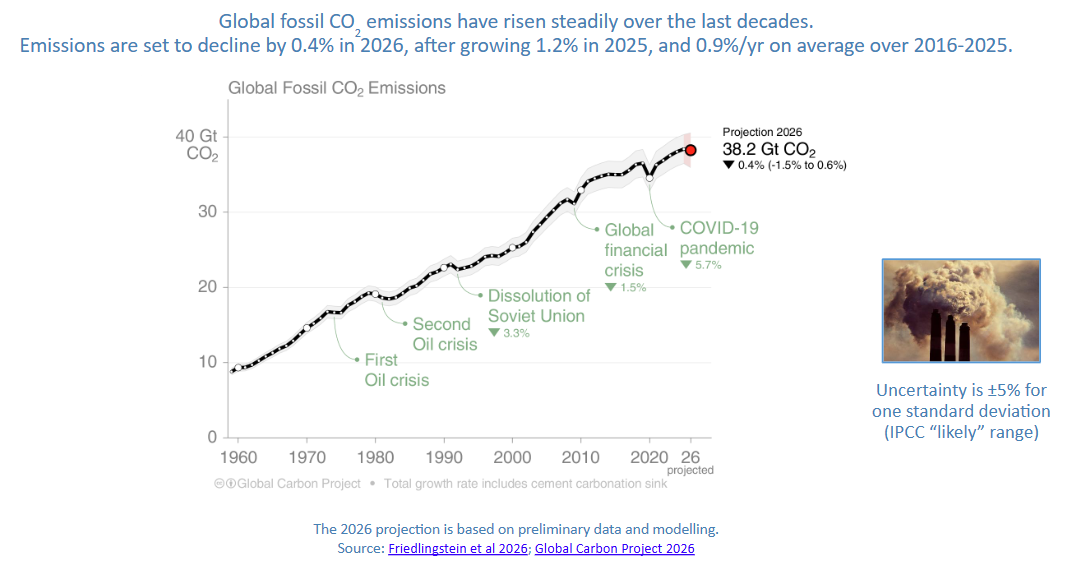
The report, now in its 21st edition and due to be presented at the Antalya Climate Summit (Turkey), warns that, if this pace continues, global warming will exceed the 1.5 °C limit in less than four years, as the remaining carbon budget to reach that limit is practically exhausted.
“We are going to exceed the 1.5 °C target, which is why we need to step up our efforts and apply more pressure,” the expert stated ahead of COP31. In his view, the fact that Australia is chairing the summit negotiations is positive because “they are very pragmatic”. “They aren’t interested in grand announcements. They know that electrification is necessary and what needs to be done to speed up progress,” he added.
The example of China and the slowdown in the United States
By region, it is forecast that the European Union, China, the United States and Japan will all reduce their emissions, in contrast to countries such as India, where emissions will continue to rise. The report highlights that, although China accounts for 32 % of global fossil fuel emissions, it is also the country most active in deploying clean technologies and increasing carbon sinks through reforestation.
As for the United States, its emissions are forecast to fall by 1.3 per cent, mainly due to a reduction in coal emissions, which soared last year because of high natural gas prices and cold weather. Despite this decline, Canadell acknowledged that Donald Trump’s policies opposing the energy transition are having an impact. “The rate at which renewable energy was growing has slowed considerably and, in some cases, has come to a standstill,” he emphasised.
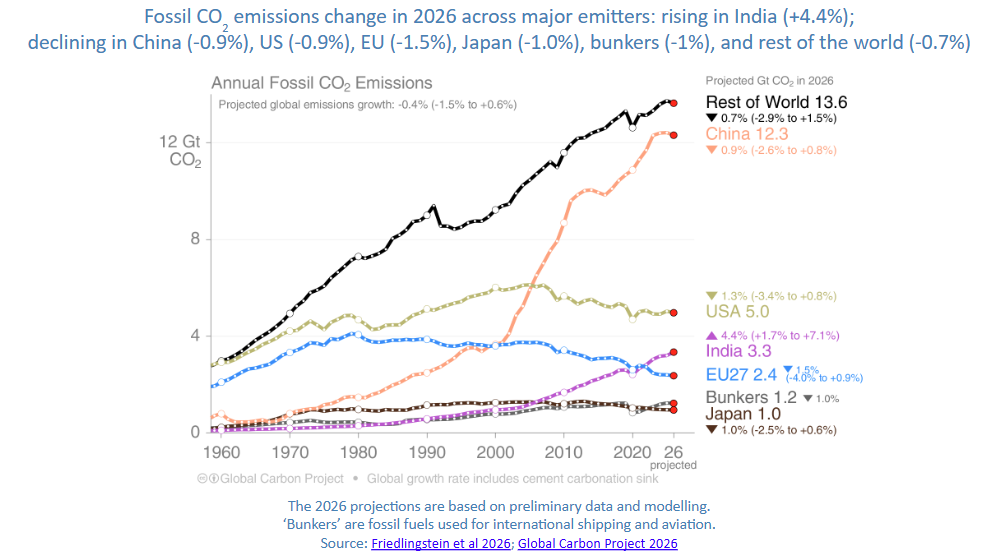
With regard to emissions from international aviation and shipping, the report estimates that both will fall by 1 %. The decline in aviation is due, in part, to reduced activity in the Middle East. Furthermore, the concentration of CO2 in the atmosphere is forecast to reach 427.7 ppm in 2026, 54 % above pre-industrial levels and slightly higher than the previous year’s figure.
Overall, as emissions from land-use change – such as deforestation – are estimated to rise by 2026, total CO2 emissions – including both fossil fuel emissions and those from land use – will reach 43,300 million tonnes in 2026, compared with 42,800 million tonnes last year.
The report also analyses natural carbon sinks, which absorb the carbon dioxide that reaches them. Terrestrial sinks have returned to pre-El Niño levels following a severe weakening during the 2023–2024 episode, and the effect of the current El Niño phenomenon — dubbed ‘Super Niño’ due to its intensity — is expected to be felt next year. The land and the ocean have absorbed 49 per cent of total anthropogenic emissions over the last decade, although both are adversely affected by climate change.
Independent reactions
More than 140 scientists from research centres and universities around the world have contributed to the preparation of the Global Carbon Budget 2026. Here at SMC Spain, we have gathered reactions from independent experts who did not take part in the work.
“The report emphasises that the relatively favourable figures for fossil fuel CO₂ emissions this year are, in part, influenced by geopolitical events that have significantly reduced emissions; we must therefore be cautious when quantifying the trends observed,” says Ernesto Rodríguez Camino, senior state meteorologist and president of the Spanish Meteorological Association.
‘The main limitation is that the figure for 2026 is a projection based on partial data and with a wide margin of error, so a slight increase cannot be ruled out once the 2026 data is finalised,’ says María José Sanz, director of the BC3 (Basque Centre for Climate Change Research).