What types of algae are there?
Algae are autotrophic aquatic organisms; in other words, they are capable of producing their own food from inorganic matter. Marina Aboal Sanjurjo, a Professor of Botany at the University of Murcia, tells SMC Spain that “they are of great global importance as carbon dioxide sinks and oxygen producers”. It is currently estimated that algae growing naturally in the oceans sequester 173 million tonnes of CO₂ per year. The AlgaeBase database lists 183,995 identified species of algae.
“It is important to distinguish between microalgae and macroalgae, which are usually referred to interchangeably as ‘algae’,” Cristina Blanco Llamero, a lecturer and researcher in the Department of Health Sciences at the Francisco de Vitoria University, explains to SMC Spain. The former are single-celled organisms, microscopic algae; the latter are larger, more complex organisms – the ones we see on beaches – which can grow to lengths of up to 60 metres.
They can live in fresh, brackish or salt water. Green algae are mainly found in inland waters, whilst the most common types in marine waters are red and brown macroalgae.
Furthermore, they can grow in different ways: benthic algae develop on substrates – that is, they grow on rocks or the seabed – whilst planktonic algae are found in the water column.
Do algae only appear in summer?
No. Although algae are usually discussed mainly during the summer months, there are many species that are perennial, especially benthic algae, as they are anchored to the seabed throughout the year. Aboal Sanjurjo points out that “for algae to develop and proliferate, the presence of nutrients is required, as well as a suitable temperature and photoperiod”.
Why is there more algae in summer? “The enrichment of waters with nitrogenous or phosphorous compounds, together with high temperatures, usually explains the blooms in all aquatic systems during the summer months,” says the researcher.
The enrichment of waters with nitrogenous or phosphorous compounds, together with high temperatures, usually explains the blooms in all aquatic systems during the summer months
Marina Aboal Sanjurjo
Are there invasive species on the Spanish coast?
Invasive species constitute one of the main threats to biodiversity globally, as they can cause significant impacts, both ecological and economic. As María Elena Cefalì, PhD in Environmental Sciences and a researcher at the Balearic Islands Oceanographic Centre (IEO-CSIC), explains to SMC Spain, these are non-native species with a great capacity for adaptation and reproduction, which means they can spread very easily. “Generally speaking, invasive species lead to a decline in biodiversity and disruptions to the functioning of native ecosystems, as well as competing with keystone species that are fundamental to the habitat, though this depends on each specific species,” she adds.
In Spain, there are several cases of invasive algae. Some have serious consequences for ecosystems, whilst others need not necessarily be so harmful. For example, on the Cantabrian coast, two Japanese species stand out, both of which settle mainly on the seabed: Sargassum muticum and Undaria pinnatifida. The first of these was introduced to Europe, specifically to Normandy and Brittany in France, in the mid-1970s by accident, as a side effect of shipping and the transport of molluscs. It reached the Galician coast in the mid-1980s.
The second was imported for cultivation and industrial development, also to Brittany, although it had already appeared previously in the French Mediterranean. It is known as wakame and has long been used as food in Asia. It first appeared on the Spanish coast in Galicia in the 1980s. Although this species, Undaria pinnatifida, was listed by the IUCN (International Union for Conservation of Nature) as one of only two seaweed species included on the list of the world’s 100 most harmful invasive species due to its extremely high reproductive capacity, there is a lack of conclusive data on its harmful effect on biodiversity: a study published in Ecology and Evolution concludes that, although it may cause some ecological impact, it does not appear to bring about substantial changes to ecosystems.
The spread of the Asian seaweed Rugulopteryx okamurae along the Andalusian coast represents a more worrying example of invasion. It probably arrived in Europe via imports of Japanese oysters Crassostrea gigas and was first detected on Spanish territory on the coast of Ceuta in 2015, but has now spread throughout the Strait of Gibraltar. Cefalí explains that “it is having an almost devastating effect on some marine habitats due to its enormous capacity to cover the seabed”, which can reach 90 per cent, leading to the displacement of other species. It is a perennial species, meaning it is present on the seabed all year round, but with peak growth in spring and summer.
It is having an almost devastating effect on some marine habitats due to its enormous capacity to cover the seabed, which leads to the displacement of other species
María Elena Cefalì
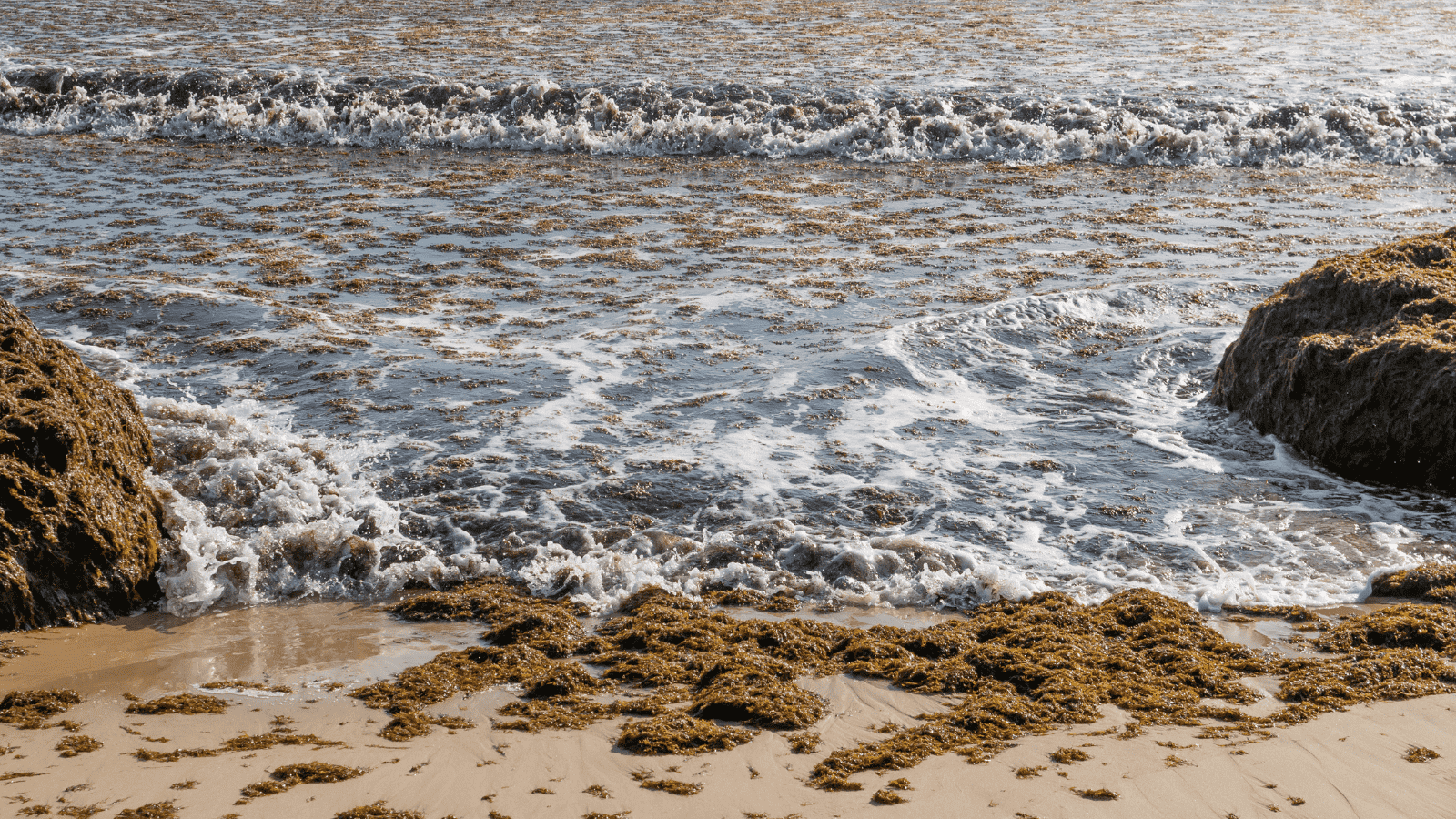
Along the Andalusian coast, according to the Regional Government of Andalusia, this seaweed is found from Punta Negra in Almería to Puerto de Santa María in Cádiz. Its spread is also becoming significant in the Canary Islands, Murcia and Alicante, and, since last summer, in the Cantabrian Sea as well. The main problem it poses is its mass reproduction. José Lucas Pérez, a Professor of Ecology at the University of Cádiz and President of the Spanish Society of Phycology, tells SMC Spain that “the large drifts of this seaweed that wash up on beaches and intertidal rocky areas also have not only an ecological impact but an economic one as well, as local councils have to remove hundreds of tonnes of rotting seaweed”.
In Tarifa, as much as 11,000 tonnes were removed in a single summer, as it is estimated that, in the Strait of Gibraltar area, the annual biomass of Rugulopteryx okamurae is around 100,000 tonnes fresh weight. In the north, its spread is also causing increasing concern. According to the Ministry for Ecological Transition and the Demographic Challenge (MITECO), it was detected in the vicinity of major ports, such as Bilbao and Santander, in 2023, and in August last summer, the Government of Cantabria removed as much as 1,600 tonnes from Noja beach in less than a week. As well as the damage this causes to fisheries, it affects other marine organisms by blocking out light.
How is the spread of Rugulopteryx okamurae being tackled?
Measures are being implemented to manage this algae and to protect fisheries and the environment. In 2022, MITECO published the Control Strategy for the algae Rugulopteryx okamurae in Spain and, in 2024, a guide for drawing up biomass management plans for this algae. In a press release published on 2 July, the ministry acknowledged that, based on current scientific knowledge, it is not possible to eradicate the species and that cooperation is needed to contain its spread.
Consequently, some regions have taken action. Andalusia approved its Biomass Management Plan in July 2025; Galicia followed suit in November 2025, and Melilla in December 2025, with all plans focusing on the prevention and control of existing populations of this algae.
Apart from invasive species, what are harmful algal blooms and what dangers do they pose?
Harmful algal blooms occur when certain microalgae reproduce excessively due to an overabundance of nutrients in the aquatic ecosystem, which facilitates the proliferation of toxic genera capable of releasing toxins. They pose an ecological threat and also a risk to human health, particularly in areas where fishing or aquaculture takes place. Of the thousands of species that make up today’s phytoplankton, only 2 per cent are harmful.
Bivalve shellfish are the marine organisms most likely to accumulate biotoxins from these blooms, as their diet consists of filtering microalgae from the plankton. If a person consumes contaminated shellfish, they may suffer from serious forms of poisoning such as paralytic shellfish poisoning or neurotoxic shellfish poisoning, amongst others.
Pérez explains that algal blooms are more common in spring and summer because these seasons provide the ideal environmental conditions. “Microalgal blooms are favoured by stable water conditions, that is, low turbulence and high nutrient levels. These conditions are often found, for example, along the Galician coast in summer, as the water temperature is higher and there is less turbulence. Furthermore, as a result of forest fires or other types of pollution, the influx of nutrients to the coast is higher,” adds the scientist.
And what are red tides?
Red tides are a type of algal bloom in which the massive growth of microalgae turns the water a reddish colour. In 2018, in the Galician Rías Baixas, specifically the Vigo and Pontevedra estuaries, an intense and prolonged proliferation of the dinoflagellate Alexandrium minutum was observed, leading to the accumulation of toxins. Furthermore, in 2019 there was also a significant red tide in the coastal waters adjacent to the Guadiana estuary, this time caused by Lingulodinium polyedra, known for producing toxins that can accumulate in shellfish at high levels of toxicity.
Although harmful algal blooms have been occurring for many years, the effects of climate change mean that certain areas are now more prone to more severe episodes than before. For this reason, water monitoring programmes are being carried out, such as that conducted by the Galician Institute for the Control of the Marine Environment (INTECMAR).
There are also red tides that may not be harmful, as this depends on the species of microalgae that is reproducing.
What uses can they be put to?
Algae are increasingly being used in various fields, mainly for food due to their nutritional value, but new applications are also being developed in sectors such as cosmetics, medicine, agriculture, biofuel production and the textile industry.
Blanco states that “both macroalgae and microalgae are of nutritional interest, but their cultivation methods are very different”. Macroalgae (such as the common varieties kombu, wakame and nori) are particularly notable for their content of dietary fibre, minerals and bioactive compounds. They are especially rich in iodine, iron, calcium and certain polysaccharides with a potential prebiotic effect. Furthermore, they contain antioxidants and bioactive molecules that are being studied for their potential benefits for metabolic and inflammatory health. Hydrocolloids such as agar, carrageenans and alginates are derived from macroalgae and are widely used as thickeners and stabilisers in the food and pharmaceutical industries.
Macroalgae —such as the common varieties kombu, wakame and nori— are particularly notable for their content of dietary fibre, minerals and bioactive compounds
Cristina Blanco Llamero
“On the other hand, microalgae (usually marketed in the form of ‘green powder’ such as spirulina or chlorella) have profiles more geared towards the production of proteins, lipids and functional compounds with high added value. Some species can achieve very high protein content and produce omega-3 fatty acids such as EPA and DHA, which we currently obtain mainly from fish, making them a unique alternative as a plant-based source,” he explains.
They can also be used as cellular platforms to produce proteins, pigments, antioxidants, omega-3s, pharmaceutical compounds or biomaterials. There is also interest in their use for biofuels, CO₂ capture and wastewater treatment.
As we have seen, due to the uncontrolled growth of the invasive alga Rugulopteryx okamurae, a team from the University of Seville has investigated how to transform this waste into a useful resource. They are exploring its use as a raw material to produce energy such as biogas and, subsequently, methane for industrial applications. Furthermore, the by-products generated from this process can be used as organic fertilisers for agriculture.