A study links early use of social media with lower scores in standardised tests
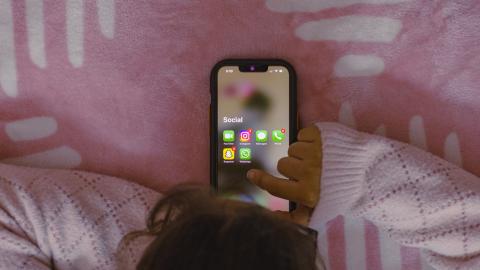
Pupils who set up a social media account in early adolescence appear to perform less well in subsequent standardised tests, according to a study published today in Nature Human Behaviour and based on a sample of 5,227 Italian pupils. The study is observational, so it does not allow for a causal link to be established between social media use and academic performance. Furthermore, it was carried out using questionnaires in which students had to recall and report on their use of these services when they were younger.

Kucirkova - RRSS
Natalia I. Kucirkova
Lecturer of Early Childhood Education and Development at the University of Stavanger (Norway)
Because the study’s primary measure of social-media exposure is the timing of account creation, it does not tell us whether the account was actively used, how often it was used, on which platforms, for what purposes, what content was seen or created, or whether use occurred in the classroom, before sleep or while socialising with friends. Or even whether the account was later abandoned. All these details matter because social-media use is not a uniform experience. By treating the timing of account creation as a proxy for a wide range of potentially very different activities, the study leaves much of the actual exposure unmeasured, limiting how confidently its conclusions can be interpreted.
Paz Pérez - RRSS
María Paz Prendes Espinosa
I believe the press release summarises the main findings of the study well, but they must be interpreted within the context of this study and should not be generalised or taken as definitive. On this subject, there are many studies, and they do not all agree; therefore, as the authors themselves acknowledge, the results must be analysed with caution.
It is a quantitative study with a very large sample (more than 5,000 students from Lombardy, Italy), which is its main strength. However, a retrospective questionnaire was used. This means that information about the past was gathered from the respondents – in this case, adolescents – with all the biases that this may entail, as the results are influenced by memory. It is striking that the questionnaire was developed specifically for this study (ad hoc), and no explanation is given as to how it was validated, nor are any data provided on this (validity and reliability statistics) – aspects that are fundamental to any rigorous social science research. Therefore, whilst the robustness of the data is supported by the size of the sample (which the authors claim is representative), the study design itself may introduce factors that introduce bias into the results and undermine their validity. Furthermore, it is curious that only three subjects were studied (it is unclear why these three and not others) and that the study shows social media use influences only two of them (Italian and mathematics), but not the third (English).
Social media has attracted interest ever since it entered our lives and has been the subject of numerous studies, but it has suddenly become the focus of the political debate on teenagers and their use of digital technologies. This study, whilst undoubtedly interesting, overlooks many aspects that cannot be ignored when analysing the consequences of social media, as the exclusive causal link between social media use and its impact on academic performance is difficult to accept. Does the family context not play a role? What about the social context? Do peer groups not have an influence? What about the adolescents’ personality traits? Does socio-economic status not play a part? And there are many other factors that could be added. In such a complex issue, which must not be oversimplified, there is also research demonstrating the usefulness of social media in promoting communication, social relationships, or even as tools for academic tasks integrated into students’ learning environments.
The main limitation may stem from the questionnaire, which collects data on the respondents’ self-perceptions of their past. Can a teenager accurately recall exactly how much time they spent on their mobile and for what purposes when they were at primary school? Will they tell us this in a precise and reliable manner? In this type of research, it is useful to combine data collection with other qualitative techniques within a mixed-methods research design, so that the information can be triangulated. Relying exclusively on a questionnaire to collect data is very limited, particularly when a teenager is required to recall and describe what they did when they were a child.
The main implication is that social media form part of our reality from an early age, and this study confirms this. Given this situation, banning the use of technology will not solve the problems associated with it. On the contrary, we must promote an education tailored to the real-world context in which we live; we must train and educate people to know how to manage the use of technology. In a digitalised society and in the age of artificial intelligence, we must not only be concerned about social media, but about technology in general. And this concern must lead us to strengthen our education system so that it can meet this need for training in digital literacy, recognising that digital literacy goes far beyond technical knowledge, as it involves the responsible, safe, critical and ethical use of technology and, by extension, of social media. If we want to protect our teenagers from the potential risks of technology, we must prepare them to live in a society shaped by technology.
Gortázar - RRSS
Lucas Gortázar
Researcher specializing in educational policies and reforms and director of the Education Department of the EsadeEcPol Center for Economic Policies
The press release is clear about the study and its limitations.
It is the first longitudinal, quasi-experimental study to address the relationship between social media use and learning outcomes on a global scale. I believe that is the major contribution of this paper. The conclusions are well-supported and, whilst further studies are needed, the evidence is consistent in showing that the earlier a social media account is opened, the greater the effect. That said, it is a pity that they have not reported results by gender or socio-economic status.
This is the first contribution of its kind to this body of literature; clearly more is needed, but it is a major finding that provides further evidence on a fundamental question, one of which public authorities should be more aware.
All the factors that could be taken into account have been considered. It is possible that they could carry out some additional robustness tests, but I think that, generally speaking, it is sound.
It is a solid finding that points to the need to delay the age at which teenagers start using social media to, at the earliest, 15 or 16 years of age.
Gui et al.
- Research article
- Peer reviewed