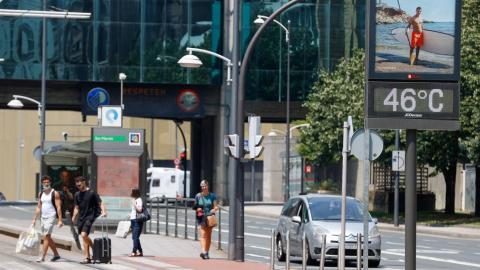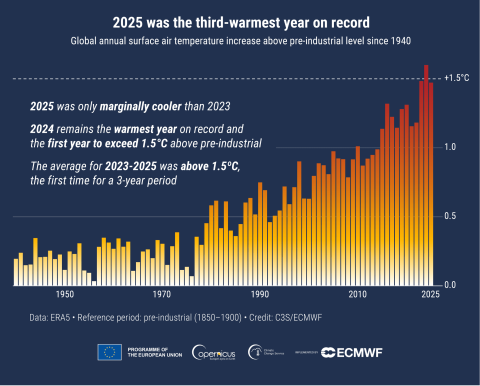
The year 2025 was the third warmest on record globally, and 95% of Europe experienced annual temperatures above average. With the end of May bringing extremely high temperatures for this time of year—and 84 deaths in Spain attributed to the heatwave in that final week—and with summer just around the corner, climate control and air conditioning systems are an essential tool for adapting to climate change, especially for the most vulnerable.
However, these devices are controversial. On the one hand, their environmental impact fuels the processes that cause rising temperatures. On the other, their presence remains limited in both public and private spaces. While students and teachers suffer from the heat in many schools across Spain, a significant portion of the population cannot afford these units—and, above all, the resulting electricity bills.
In this regard, the World Health Organization (WHO/Europe) today presented its new guidance on action plans for heat and health. In it, the organization acknowledges the need for a “nuanced policy” regarding air conditioning. On the one hand, it notes that this is an “unsustainable” solution. On the other, it highlights the need to ensure equitable access, especially for the most vulnerable.
Air conditioning is the typical example where mitigation, emission reduction, and adaptation come together
Marta Olazabal
“The debate isn’t about whether or not to use air conditioning, but rather how to reconcile our needs with existing buildings in order to use systems that are as environmentally friendly as possible,” explained Manuel Ruiz de Adana, a researcher at the University of Córdoba and head of the Applied Thermal Engineering Research Group, at a recent briefing organized by SMC Spain.
For her part, Marta Olazabal, head of the Climate Change Adaptation Research Group at BC3 (Basque Center for Climate Change Research), emphasized that air conditioning is “the classic example where mitigation, emissions reduction, and adaptation come together.” In her view, these three factors “are inseparable and must go hand in hand.”
What effects do air conditioning systems have on the environment?
The purpose of air conditioning systems is to transfer heat from an indoor area to the outside. This process has a threefold impact on the environment.
First, the heat transfer requires electricity, which leads to an increase in electricity consumption. If the electricity powering these devices comes from fossil fuels, it will contribute to climate change.
Second, the heat emitted outward contributes to rising outdoor temperatures and fuels the urban heat island effect: “In the vicinity of buildings, heat from HVAC systems is a very significant factor,” explains Ruiz de Adana.
Finally, the refrigerant used by some of these units is also a greenhouse gas. In theory, the fluid circulates in a loop without escaping. In practice, it is inevitable that small leaks will accumulate over the device’s lifespan or if it is not properly recycled. This can directly impact climate change.
“The most widely used technology is the compression of a vapor or refrigerant gas, which has those three effects,” says Ruiz de Adama. However, “there are a lot of HVAC systems, and air conditioning is the bare minimum needed for people to be comfortable. The levels of complexity and demands increase as we change the setting.” An apartment is not the same as an office, nor is an office the same as a hospital, even if we lump them all together.
There are less polluting alternatives
“We know that air conditioning has its problems, which is why we must also combat the heat island effect with green and blue infrastructure and renaturalize our cities, but the key point is that electricity consumption can already be met with renewable sources today,” says Emilio Santiago, a researcher at the CSIC and an expert in climate anthropology at SMC Spain. In other words, “there is an aspect of its traditional unsustainability that we can minimize.”
Ruiz de Adana explains that the energy efficiency of these technologies “has improved significantly” in recent years, but “there are still problems to solve.” In some cases, such as the heat expelled from inside buildings to the outside, it won’t be possible to do so. “Therefore, the more homes that are climate-controlled, the more heat we’ll be dissipating into the building’s surroundings.” Some of this heat could be reused through aerothermal energy, “a conventional air-cooled HVAC system where the heat, which is normally dissipated outdoors, is reused, typically to heat water,” explains Ruiz de Adana. “Since these are more efficient, state-of-the-art systems, they have low energy consumption and can be combined with photovoltaic systems to meet demand using renewable energy,” he adds.
Evaporative cooling systems, which are used in schools in Andalusia, consume little energy and are easy to power with photovoltaics, offering a sustainable solution for cooling classrooms
Manuel Ruiz de Adana
Regarding refrigerants, Ruiz de Adana notes that there are alternatives to the most common ones used in compression systems, such as R32, whose global warming potential is 675 times that of CO2. He therefore cites CO2 itself and propane as alternatives, as their impact on the ozone layer and climate change is lower, though not nonexistent.
However, he asserts that there are alternatives to compression technology, such as absorption, evaporative cooling, and renewable district cooling and heating networks, all of which are more sustainable.
“Evaporative cooling systems are already in use in schools in Andalusia, which a few years ago implemented a plan for bioclimatic design in public schools, and they have minimal electricity consumption and moderate water use,” explains Ruiz de Adana. “Since they consume little energy, it is easy to power them with solar energy, so we would have a sustainable solution for cooling classrooms,” he adds.
On the other hand, renewable district heating and cooling networks have made it possible for neighborhoods and districts in Spain to already have this 100% renewable system, from Zamora and Burgos to Madrid and Valladolid. “Decarbonizing energy consumption associated with air conditioning is already technologically viable and cost-effective for residents. All that’s left is for the authorities to get to work, because these networks currently lack regulatory protection and there are no specific regulations for implementing them, which is a roadblock,” says Ruiz de Adana. “The other alternative—continuing to use individual units—keeps leading us back to the same problem,” he adds.
Democratizing thermal comfort
According to a survey by the National Institute of Statistics (INE), one-third of people in Spain in 2023 reported that they were unable to keep their homes at a comfortable temperature during the summer, compared to one-quarter in the 2012 survey. These figures exceed the proportion of people who said they could not keep their homes at a comfortable temperature during the cold months: 27.5% in 2023 and 17.9% in 2012.
In this context, how can we ensure access to systems that allow us to cope with the temperatures? Olazabal points out that “it is families who bear the cost of air conditioning in buildings, while public spaces are the responsibility of regional and national authorities.”
Failing to propose a policy for redistributing air conditioning today is medically irresponsible, socially unjust, and rooted in cultural bias
Emilio Santiago
“We need behavioral, legislative, and regulatory solutions, as well as passive adaptation measures, but we also need a redistributive policy for air conditioning—to ensure the right to thermal comfort so that it is not a privilege, but rather to democratize it and make it a right,” says Santiago. All of this, “without undermining climate shelters, urban greening,” and other strategies, because air conditioning is not “a magic bullet” either.
That is why, for Santiago, and given that heat is a public health problem that kills thousands of people each year, the goal is to do “everything at once everywhere.” In his view, “failing to propose a policy for the redistribution of air conditioning today is medically irresponsible, socially unjust, and stems from a cultural bias, because no one suggests that people should be cold in winter.”
“We have the right to decent housing, where temperatures do not have negative impacts on health. That also falls under the description, and I believe we are not considering it, even though it is an issue that intersects with energy poverty, with a clear link between social vulnerability, climate impact, health impact, and access to goods and resources that should be public,” adds the expert.
What about ventilation?
Air conditioning systems don’t just impact the environment; they also conflict with the need for building ventilation.
“Ventilation is very important, as we saw during the COVID-19 pandemic, but it’s one of the most energy-intensive aspects—it’s a significant cost, yet it’s a priority,” says Ruiz de Adana. That’s why he considers it essential to integrate it into HVAC systems. “Sometimes when we talk about air conditioning, we think it’s just about controlling the temperature, but there’s more to it,” he says. In fact, these systems can control other variables: relative humidity, air velocity, and radiant temperature (from surfaces like walls).
Refuges, trees, and architecture: other tools against heat
The list of strategies for adapting to rising temperatures is long: climate shelters, bioclimatic architecture, urban shading, passive retrofitting, urban renaturalization…
Olazabal, an expert in urban climate governance, stresses the importance of taking action in cities. “In addition to addressing building climate control itself, a whole range of interventions in public spaces are critical to maintaining thermal comfort within the city,” she asserts. “We don’t realize how much urban design and our streets affect the interior temperature of buildings,” she says. “We have fewer and fewer trees, and we’re renovating entire streets without taking climate criteria into account, but it’s not just a matter of how pleasant it will be outside—it’s also about comfort inside the adjacent buildings,” the researcher warns.
We have fewer trees and are redesigning streets without considering climate criteria
Marta Olazabal
All those interviewed for this article agree that the debate is not about whether or not to use air conditioning. It is simply one more tool that should be used in combination with others, but it will remain essential as the climate crisis worsens and we see summer temperatures reaching as high as 48 °C.