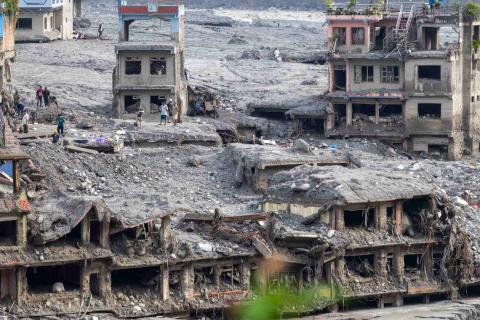
Almost 300,000 people could be living in flood-prone areas in regions near the Himalayas
A study published in Scientific Reports estimates that the total area occupied by buildings within potentially flood-prone zones near the Himalayas increased by approximately 45 per cent between 2016 and 2023. In total, the study estimates that around 300,000 people could be at risk of flooding in the Nepalese, Indian and Chinese regions of the mountain range. Floods in the Himalayas are usually caused by monsoons, torrential rain or, on rare occasions, by devastating debris flows and glacial lake outbursts — such as the one that occurred last August. Climate change is expected to increase the severity of these events, whilst the narrow, steep valleys of mountainous areas can exacerbate the height of the floods and their consequences.
Javier Lillo - Himalaya inundaciones EN
Javier Lillo Ramos
Honorary Researcher with the Consolidated Research Group on Terrestrial Global Change and Environmental Geology at Rey Juan Carlos University
The Himalayas are a region with a high incidence of extremely dangerous natural phenomena, stemming primarily from the monsoon climate, the rugged terrain and active tectonics. It is precisely this terrain that is one of the main factors behind the high concentration of human settlement in the valley floors and, consequently, where there is the greatest exposure to major flash floods and flooding caused by the seasonal monsoon, extreme rainfall events or the overflowing of glacial lakes caused by mass movements of debris, rocks or glacial avalanches, which in themselves can trigger disasters such as the one that occurred on 26 August in Nepal.
Bearing in mind that risk (the probability of loss of life and property) is the result of three components: hazard (the probability of a natural hazard occurring), exposure (elements that may be affected by that hazard) and vulnerability (the capacity of those elements to respond to the hazard); in their paper published in Scientific Reports, Scott Watson and colleagues assess exposure in areas potentially affected by flash floods in the Himalayas, estimating that currently almost 300,000 people may be living in flood-prone areas in the Himalayan regions of Nepal, India and China.
Between 2016 and 2023, the area occupied by buildings in potentially flood-prone zones increased by 45 per cent (from 12.38 to 18.04 km²), and in areas at high risk of glacial lake outbursts, the increase was even greater: 78 per cent (from 0.72 to 1.28 km). The population living in flood-risk areas is projected to increase by 6 per cent between 2015 and 2030, although the authors themselves caution that there is uncertainty surrounding the estimates, both in terms of the total area occupied and population growth.
What is certain, however, is that population growth in areas at risk of flooding, combined with the effects of climate change (increased frequency and intensity of extreme rainfall, accelerated glacial melt, etc.), will result in a rapid rise in the loss of human life and material assets in these Himalayan regions. As the authors of the study point out, validated, multi-temporal exposure datasets are essential to mitigate these catastrophic effects.
C. Scott Watson et al.
- Research article
- Peer reviewed