A study confirms that the thawing of permafrost and the weakening of glaciers due to climate change contributed to the flash floods in Nepal
A combination of geological and climatic factors — the latter influenced by anthropogenic climate change — lay behind the catastrophic rock and ice avalanche last August on Nepal’s northern border, according to a review carried out by World Weather Attribution and glaciology experts. The team carried out an attribution analysis to examine the role of climate change in the rise in temperatures in July and August preceding the collapse, as well as in the region’s rainfall. According to the study, human-induced warming has raised the freezing line by around 100 metres per decade, leading to the thinning of glaciers and the thawing of the permafrost that held the mountain together. These factors, together with the destabilisation caused by a magnitude 7.8 earthquake in 2015, are believed to be the main causes of the landslide, which left more than a thousand people dead and thousands missing.
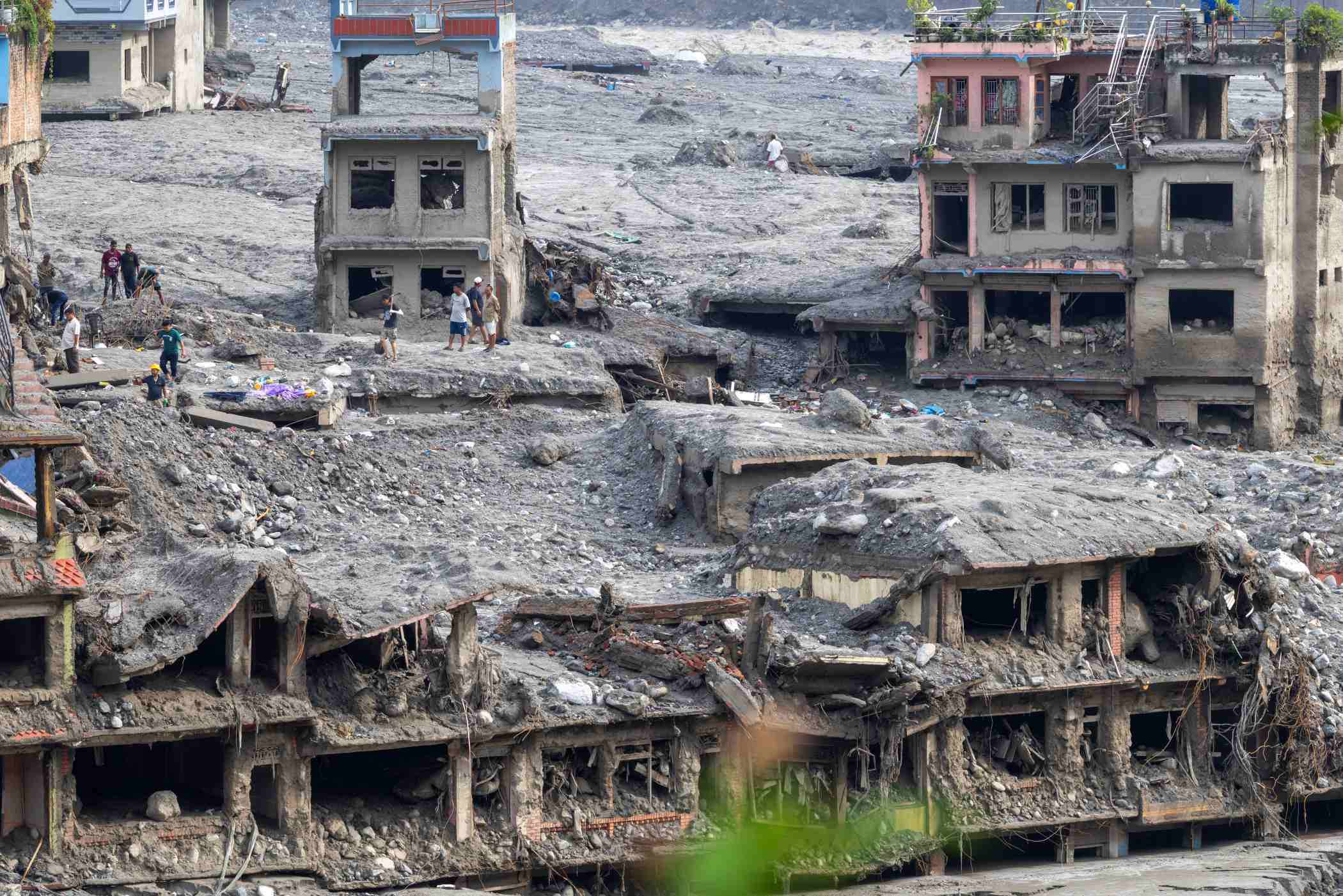
Residents are carrying out search and rescue operations in Dunge, in the Nuwakot district of Nepal, following the devastating floods caused by a massive flash flood. EFE/EPA/NARENDRA SHRESTHA.
Javier Lillo - riada Nepal WWA EN
Javier Lillo Ramos
Honorary Researcher with the Consolidated Research Group on Terrestrial Global Change and Environmental Geology at Rey Juan Carlos University
In this study published by World Weather Attribution, an international team of scientists analyzes the role of climate change among the possible factors behind the catastrophic event that occurred in the Himalayas on August 26, which caused devastation resulting in an extremely high loss of life and extraordinary property damage—far exceeding the limits of adaptation to such extreme events.
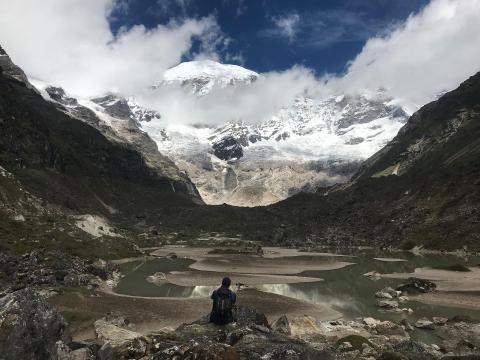
According to the study’s authors, the collapse on Lantang Lirung Mountain—which triggered the massive avalanche of ice, water, and debris that caused the terrible catastrophe—was the result of an extraordinary combination of various geological and climatic factors, in which global warming played a critical role. The Himalayas are a region of highly active tectonics which, like other mountain ranges and glacial areas, is experiencing the impact of global warming more acutely: melting and retreat of glacial masses, melting and fragmentation of permafrost, and changes in the pattern and intensity of precipitation.
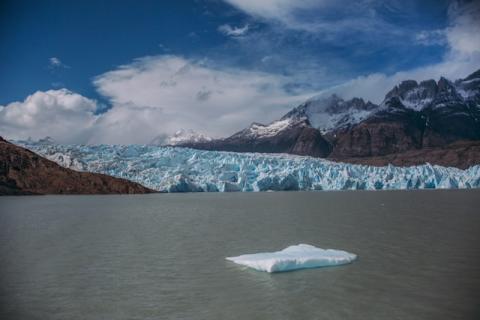
High-mountain areas, as the authors of the study explain for the region under investigation, are extraordinarily sensitive to global warming. The recorded increases in temperature—both annual and seasonal—lead to a greater presence of liquid water, both in the bedrock and in the glaciers. This, in turn, leads to greater instability in rocky slopes and glacial masses. Although the events at Lantang Lirung and the China-Nepal border have exceeded what was imaginable for an event of this nature, this summer has seen a high incidence of rock and glacial avalanches in the Alps and the American mountain ranges. The events in the Swiss town of Blatten in 2025 are representative of the changes that have been taking place in recent years in mountainous areas, which were previously considered relatively stable and at relatively low risk of these slope-movement phenomena.
Furthermore, the very topography of the Himalayas—where valley floors are the most densely populated areas—makes it, as the authors point out, very difficult to reduce vulnerability to these situations involving such a high level of danger.
Luis Carcavilla - riada Nepal WWA EN
Luis Carcavilla Urquí
This study, carried out in record time by a team of 24 researchers from 14 institutions across nine different countries, analyses the role that climate change played in triggering the tragedy that occurred on the border between Nepal and China on 26 August. The authors, who are affiliated with global research centres and NGOs dedicated to international scientific research and advisory work, analyse the impacts, triggers, mechanisms and characteristics of the event, as well as the vulnerability and exposure of the area. The multidisciplinary nature of the team is essential for analysing the range of factors that played a part in this event and the multiple sources of information.
Studying a catastrophic event of this nature is complex, as it was not caused by a single extreme weather event, but rather represents a multifaceted phenomenon resulting from a chain of processes triggered or, at the very least, exacerbated by various causes. Analysis of the triggering factors shows that the effects of climate change played a decisive role in destabilising systems and variables that were key to the unfolding of the disaster. It is precisely the study of how these factors evolve in the context of global warming that holds the key to understanding the magnitude of this event.
In future, it is essential to continue studying how the determining factors—both known and potential—of multiple events such as this evolve over time within the context of global change, in order to prevent future tragedies. In any case, events such as this, which are influenced by various variables and trigger a chain of processes, are difficult to predict.
Pilar Brufau - riada Nepal WWA EN
Pilar Brufau
Researcher and Lecturer in the Department of Materials and Fluids Science and Technology at the University of Zaragoza
The analysis presented in the report treats the disaster in Nepal as a cascade of events rather than an isolated incident. Debris flows are usually produced in the following way: there is typically a triggering factor, combined with the collapse of ice, rock and sediments, which, when joined by surface water flow, rapidly generates a large volume of a mixture of water and solids that propagates at high speed, increasing in volume as it entrains all the suspended material in its path.
This type of flow cannot be treated as a conventional flooding process, in which water flow predominates with only a small amount of sediment being carried along; rather, in this type of flow, it is the solid material that governs the flow and makes it a more catastrophic phenomenon. From the perspective of numerical modelling, this type of flow is also more complex than flooding, as it must take into account processes of erosion, transport and sedimentation.
Ben Clarke et al.
- Research article