How the solar eclipse was experienced from different parts of Spain
We hadn’t seen a total solar eclipse on the Iberian Peninsula since 1912, and this Wednesday, just before sunset, the celestial bodies aligned once more. That perfect cosmic dance between the Sun, the Moon and the Earth could be seen from numerous regions across Spain. Among the millions of people who observed the phenomenon in Spain, eclipse experts share their impressions with SMC Spain.
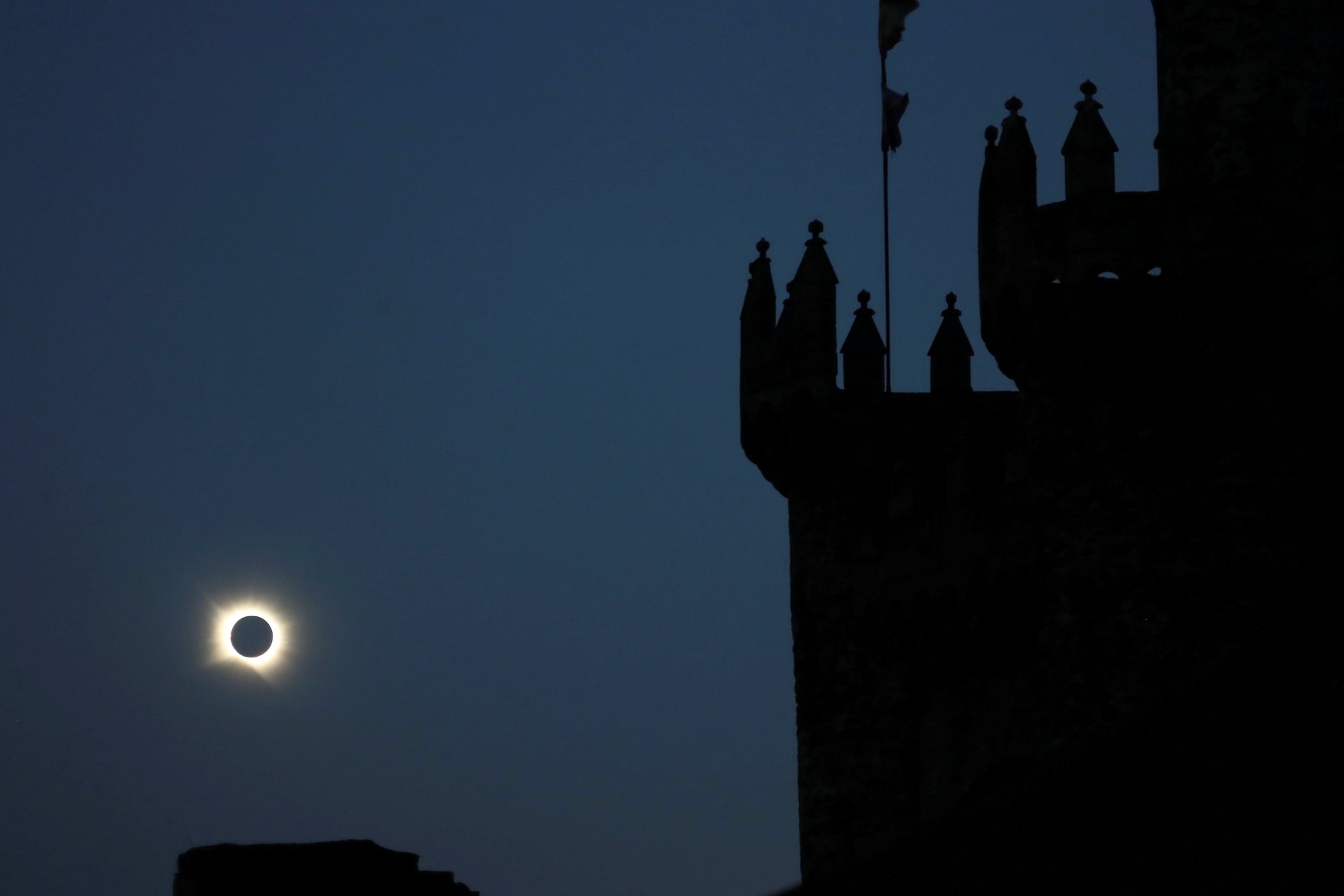
On Wednesday, the Knights Templar Castle in Ponferrada became one of the main international scientific gathering points for observing the total solar eclipse, with researchers arriving from various countries and scientists affiliated with NASA in attendance. EFE/Ana F. Barredo.
Marcos Pérez - después del eclipse EN
Marcos Pérez Maldonado
We watched the eclipse on the seafront promenade in A Coruña, at the Domus, with a group of staff from the science museums – and some of their family members too – in keeping with the idea that the best way to enjoy this phenomenon is with friends, family and work colleagues, experiencing the social aspect of sharing such an exceptional moment. My first impressions are that, whilst it’s true there were a few clouds that deprived us of a view of the solar corona and also of the appearance of the stars and some planets – at least the brightest ones – the truth is that it was a tremendous experience: very exciting and awe-inspiring. I’m lost for words. It far exceeded my expectations and, generally speaking, that was the reaction of many of my colleagues who were seeing it for the first time too.
What really caught my attention was the speed at which the light changed during the final phase of the partial eclipse. The last five minutes of the partial phase were spectacular; there was a dramatic drop in light and a change in the colours of the sky. I had the feeling that the temperature was going to drop quite a bit, and I stayed in short sleeves the whole time to experience that change. Totality arrived and it was incredible, a true marvel, as if someone were swallowing up the Sun. I understood perfectly all those ancient myths, about people who thought the Sun was dying or being stolen by someone, or that some monster or beast was devouring it, and I think I experienced some of that atavistic fear myself.
I made an audio recording of those minutes leading up to totality, and there’s an outburst of exclamations – people whistling, shouting, clapping… I’ll have to listen to it more calmly to piece that memory together more clearly, but it seems like a memory that’s hard to put into words.
One thing is clear: today we’re witnessing a spectacle of nature; it’s a natural phenomenon with this dramatic and exceptional quality that makes it awe-inspiring, but it’s not the only one. The Perseids, like the ones we’re seeing tonight, the Northern Lights, huge storm clouds, sunsets… There is a whole list of beautiful phenomena, but city life – with our eyes fixed downwards on our mobile screens – causes that gradual disconnection we feel from nature. Today’s phenomenon might just help us realise that we need to reconnect not only with natural spaces, but also with the phenomena of nature itself, and I think this memory will be a help in that reconnection.
My eyes are filled with beauty, my heart full of impressions, and, as the Perseids last for several days, tomorrow, when things have calmed down a bit, I’ll look for a spot far from the city to enjoy these other phenomena, which are also marvellous.
Javier Armentia - después del eclipse EN
Javier Armentia
Astrophysicist, science communicator and former director of the Pamplona Planetarium
I’d been looking forward to this eclipse, but it never fails to surprise. Once again, it has turned astronomy into a thrilling experience as the solar corona unfolded on that extraordinary night.
I had the pleasure of witnessing it in Lerín (Navarre), a village that had brought together 5,000 people to turn the total eclipse into a celebration of astronomy. This achieved something very special: it ensured that an experience which was moving for each individual attendee was also a collective one. People were grateful that we’d insisted they shouldn’t miss the chance to observe it, especially those who were most doubtful or sceptical about the media hype. Now people have been deeply moved by the eclipse. They’ll remember it for the rest of their lives and, perhaps, some will want to experience it again, as has always been the case, but now, perhaps even more so, because the world needs more stories like this.
Salvador J Ribas - después del eclipse EN
Salvador J. Ribas
I observed the eclipse from the Ebro Observatory in Roquetes (Tarragona) and it was truly spectacular, despite the challenge posed by the low altitude – which ultimately turned out to be an advantage, allowing me to capture a unique image featuring the local landscape and the beautiful protuberance we saw during totality.
Observing the eclipse, guiding the event and broadcasting live from the very same spot where the scientists at the Ebro Observatory observed the previous eclipse in 1905 gives it a very special personal significance. It is like a tribute to all the observers who have watched the Sun daily from this location since its foundation in 1904.
Eva Villaver - después del eclipse EN
Eva Villaver
Deputy Director, Canary Islands Institute of Astrophysics
I watched the eclipse from the Yebes Observatory in Guadalajara. After spending so long looking forward to the eclipse, talking about what it’s like, telling people they couldn’t afford to miss it, explaining what they’d be able to see and how to view it safely, and assuring them it was beautiful, the best part of the whole experience has been witnessing that excitement. For me, it has been very special to share our passion for the stars and to see how the work we’ve been doing for months resulted in people feeling moved, crying or simply speechless, overwhelmed for a few seconds that they will never forget for the rest of their lives.
As a ‘sky professional’, this has been one of the most rewarding experiences of my life: a ‘see, I told you so, I assured you it wouldn’t disappoint you’. We astrophysicists experience the cosmos as a beautiful place every day, but yesterday we were also lucky enough to be able to share it; that is really what moved me. Getting millions of people to look up and see something that seemed out of this world – an eclipse that didn’t disappoint a single person, that had us all gazing at the Sun in anticipation, and that left us completely awestruck.
Víctor Lanchares - después del eclipse EN
Víctor Lanchares
I watched the eclipse wearing solar eclipse glasses, using binoculars and a telescope in a park near Logroño, just a 10-minute walk from home, accompanied by family, friends and local residents who had chosen this spot as their viewing point.
The telescope allowed us to see first contact and the start of the eclipse before those who were only watching with solar eclipse glasses realised it had begun. We followed the Moon’s progress across the Sun’s disc, alternating between using the telescope and looking directly at the Sun through the eclipse glasses. By then, the people around us had come over to look through the telescope, marvelling at what they saw and at the sunspots, which really caught their attention.
A couple of minutes before totality, the dimming of the light heralded the arrival of the second contact – the most eagerly awaited moment. We all prepared for it. The ‘diamond ring’ appeared, followed by the solar corona. There was a general outcry and applause. It was time to use the binoculars. The corona looked spectacular, as did part of the chromosphere. Venus shone brightly in the sky. Totality lasted 80 seconds, which flew by in the blink of an eye. Another diamond ring and fresh applause heralded the Moon’s retreat and the end of a sight and a day to remember.
Anna Larroy - después del eclipse EN
Anna Larroy
A group of us from Astrobanyoles travelled to El Olivar Monastery in Estercuel (Teruel). From there, we were able to witness what, for many of us, was our first total solar eclipse.
By about seven o’clock we were all ready and eagerly awaiting the event, and the clouds were holding off. And then the spectacle began. With our glasses on and our eyes fixed on the sky for no more than a few seconds at a time, we shared our feelings.
And then totality arrived. My first emotion was one of wonder. Surprise, a sense of reverence – I was receiving a gift from the universe which, although expected, was no less astonishing for that. It didn’t last long – about 90 seconds – and then the light returned. All that remained was to watch the eclipsed sunset and celebrate.
Álex Mendiolagoitia - después del eclipse EN
Álex Mendiolagoitia
I watched the eclipse from Osorno La Mayor (Palencia) and it was absolutely stunning; the haze turned what would otherwise have been a silvery corona into a golden one. A solar flare (a burst of incandescent gas ejected by the Sun) was visible to the naked eye.
As for the Sonde Balloon Mission, it was a success, as the balloons launched into the stratosphere captured a unique image of the eclipse, showing the Moon’s shadow over Spain.
Alejandro Sánchez de Miguel - después del eclipse EN
Alejandro Sánchez de Miguel
EMERGIA post-doctoral research in the Sky Quality Office
We watched the eclipse from Boadilla del Camino (Palencia) and it was breathtaking.
We were setting up the live broadcast of the eclipse for the European Space Agency, using two cameras: one for close-ups and the other for the corona, fitted with a rotating polariser to capture the polarisation of the corona, which is linked to the magnetic field.
And it was breathtaking – a complete success and everyone was absolutely delighted. Overall, it went very well. Everyone is already getting ready for next year.
You can see the result on my YouTube channel and in the European Space Agency’s broadcast.
We hope to process the data over the coming days and weeks and will publish it on the IAA (Andalusian Institute of Astrophysics) website.