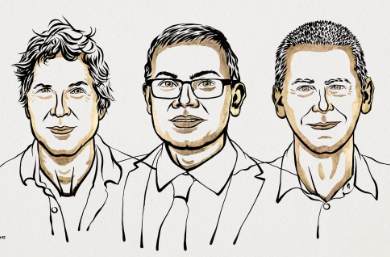
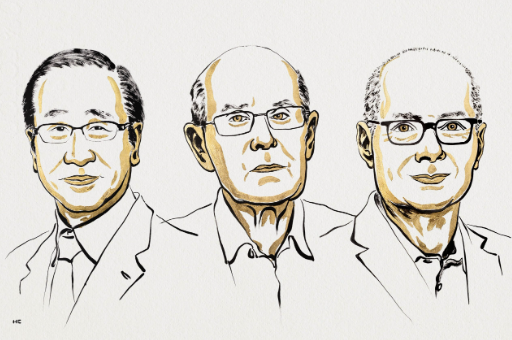
Nobel Prize in Chemistry awarded to Susumu Kitagawa, Richard Robson, and Omar M. Yaghi for creating porous materials with blocks of molecules that capture substances and drive reactions
The Royal Swedish Academy of Sciences has awarded the 2025 Nobel Prize in Chemistry to Susumu Kitagawa, Richard Robson, and Omar M. Yaghi for the development of molecular structures with large spaces through which gases and other chemicals can flow. These structures, called metal-organic frameworks, can be used to extract water from desert air, capture carbon dioxide, store toxic gases, or catalyze chemical reactions.
Catalina - Nobel Química 2025
Catalina Biglione
Senior Researcher at the Advanced Porous Materials Unit at IMDEA Energy
The recent Nobel Prize in Chemistry awarded to Professors Kitagawa, Robson, and Yaghi for the development of metal-organic frameworks, known as MOFs, is a well-deserved recognition. These materials have a unique structure that can be ‘custom designed’ to perform specific functions in various applications. In my more than four years of work in this field, I have seen their extraordinary versatility: from capturing pollutants to their use in energy applications for fuel cells and even in innovative treatments in nanomedicine. This award not only celebrates a scientific breakthrough, but also highlights a technological platform with transformative potential.
Susana García - Nobel Química 2025
Susana García López
Professor of Chemical and Process Engineering, Director of the Carbon Dioxide Capture and Storage Group at the Research Center for Carbon Solutions (RCCS) at Heriot-Watt University, Edinburgh (United Kingdom)
The discovery of metal-organic frameworks (MOFs) opened the door to an extraordinary variety of applications, from gas storage and separation to catalysis, detection, and controlled drug release. The beauty of MOFs lies in their modular design: by modifying the metal nodes and/or organic linkers, it is possible to design tailor-made materials with perfectly controlled pore size, shape, and chemical functionality. This unprecedented structural and chemical diversity makes MOFs particularly promising for carbon dioxide capture, where balancing selectivity, capacity, and stability is essential to meet the demanding requirements of industrial-scale implementation.
Daniel Maspoch - Nobel Química 2025
Daniel Maspoch
Principal investigator of the Supramolecular NanoChemistry and Materials group at the Catalan Institute of Nanoscience and Nanotechnology
I am deeply happy that the Nobel Prize in Chemistry has been awarded to Professors Susumu Kitagawa, Richard Robson, and Omar M. Yaghi for the development of metal-organic frameworks (MOFs). These extraordinary materials combine enormous chemical and structural tunability with high porosity, giving them unprecedented potential to address some of the great challenges facing our society. Their applications range from CO₂ capture and controlled drug release to atmospheric water harvesting in arid regions, among many others.
This recognition highlights years of visionary research and consolidates MOFs as one of the most versatile and promising materials in modern chemistry.
david fairén - Nobel Química 2025
David Fairén-Jiménez
Professor of Molecular Engineering, University of Cambridge, President and Chief Scientific Officer of Immaterial and Vector Bioscience Cambridge
This Nobel Prize celebrates a true revolution in materials science. Metal-organic frameworks (MOFs; or porous coordination polymers, PCPs) have transformed our understanding and construction of matter. They represent the beauty of materials that form themselves, combining chemistry and design with unique elegance. Thanks to the visionary work of Kitagawa, Robson, and Yaghi, we can now create materials with atomic precision to capture CO₂, store hydrogen, or deliver drugs, even RNA, directly to a tumor. Their discovery opened up a new universe of possibilities in energy, the environment, and health, and will continue to inspire generations of scientists for decades to come.
Elena García Rojas - Nobel Química 2025
Elena García Rojas
PhD in Industrial Technologies, researcher in Metal-Organic Frameworks (MOF), Department of Chemical, Energy, and Mechanical Technology, Rey Juan Carlos University
I just found out and am celebrating with my colleagues, as this is a major breakthrough and a very important recognition for our field of research. The Nobel Prize in Chemistry awarded to Susumu Kitagawa, Richard Robson, and Omar M. Yaghi recognizes the development of metal-organic frameworks (MOFs), porous materials formed by metal ions and organic ligands that, since their discovery around 1995, have opened new frontiers in fields such as catalysis, CO₂ capture and utilization, gas storage, controlled drug release, and applications in magnetism and luminescence. This award highlights their enormous potential and consolidates the growing scientific interest in these materials, driving research towards more sustainable and multifunctional chemistry.
Javier y Eduardo - Nobel Química 2025
Javier Pérez Carvajal
Researcher at the Madrid Institute of Materials Science, CSIC, and member of the Nanostructured Hybrid, Biohybrid and Porous Materials group
Eduardo Ruiz-Hitzky
Researcher at the Madrid Institute of Materials Science, CSIC, and member of the Nanostructured Hybrid, Biohybrid and Porous Materials group
Fundamental contributions by French researchers, particularly Gérard Férey and Christian Serre, are missing. Many in the scientific community consider them pioneers, and they could easily have been recognised alongside Kitagawa, Robson and Yaghi. Their group in Versailles developed the famous MIL (Materials of Institut Lavoisier) family, such as MIL-100 with record specific surface area and high stability. These structures paved the way for practical applications in gas storage (H₂, CH₄, CO₂), catalysis and selective separation.
Jorge Albalad - Nobel Química 2025
Jorge Albalad Alcalá
Senior postdoctoral researcher and member of the Supramolecular NanoChemistry and Materials group at the Catalan Institute of Nanoscience and Nanotechnology (ICN2)
The work of Yaghi, Kitagawa, and Robson has opened the door to a new universe of materials. They have shown that by combining metals and small molecules as if they were Lego pieces, it is possible to design structures with virtually unlimited geometries, each optimized to perform a very specific function.
With a dose of geometry, chemistry, and a little ‘magic,’ today we can imagine, design, and build the perfect material for every challenge: from capturing CO₂ from the atmosphere, storing energy cleanly, or even extracting water from the air in the middle of the desert. What began as a quiet revolution in materials chemistry has ended up forever transforming the way scientists understand and create matter.
Arnau Carné - Nobel Química 2025
Arnau Carné
Visiting postdoctoral researcher in the Supramolecular NanoChemistry and Materials group at the Catalan Institute of Nanoscience and Nanotechnology (ICN2)
The Nobel Prize in Chemistry awarded to Professors Susumu Kitagawa, Omar M. Yaghi, and Makoto Fujita recognizes one of the great revolutions in modern chemistry: the creation of porous materials whose cavities can be controlled at the molecular level. This development is achieved through the controlled bonding of small molecules that, when assembled, give rise to porous architectures.
Thanks to their work, it is now possible to manufacture structures with “holes” specifically designed to trap certain molecules and allow others to pass through. This ability to select and store substances with such precision opens the door to a wide range of applications, such as capturing pollutants such as CO₂, obtaining water from the air, developing new catalysts, and separating complex mixtures.
Fernando Gomollón - Nobel Química 2025
Fernando Gomollón Bel
Doctor of Organic Chemistry, science communicator, co-founder of Agata Communications
The simple explanation: they are very porous materials, like sponges, with many channels inside, a large internal surface area, where many reactions can take place. They can be used with catalysts to absorb gases such as CO₂ and capture it for reuse or to remove it from the atmosphere. Omar M. Yaghi, for example, has created highly hydrophilic materials of this type to obtain water in liquid form in the desert, capturing the small amount of water in the air thanks to their extensive surface area.
They are literally like molecular sponges, like microscopic sponges, made of metals and organic substances, which is why they are called Metal Organic Frameworks (MOFs). They have metal nodes and organic substances. The beauty of this is that both parts, the metals and the organic substances, can be customized to some extent.
If you change the metal or the organic substances, the properties change. For example, if you use a basic substance as the organic substance, you can make MOFs that react with CO₂, which is acidic, and trap it.
These Metal Organic Frameworks can be used to capture CO₂ from fermentation, for example, in the manufacture of beer or wine, and then that CO₂ is packaged and used for food applications, to pressurize beer, to preserve wine... The beauty of these materials is that, in a very small space, you have a large surface area for whatever you want: reactions, catalysis, gas absorption... and this is being applied industrially.
Isabel Abánades - Nobel Química 2025 EN
Isabel Abánades Lázaro
Ramón y Cajal researcher, leader of the DREAM research group on Defect Engineering in Advanced Responsive Materials, Institute of Molecular Science (ICMol), University of Valencia
I am absolutely thrilled about the Nobel Prize for MOFs! Seeing these porous, flexible, almost magical materials—capable of capturing gases, cleaning the air, or even extracting water from dry air—receive this recognition fills me with pride, hope, and excitement. I have worked with them, seen them “breathe” and felt their potential. This award not only celebrates a scientific breakthrough, but also a vision of the future: chemistry that is not content with understanding the world, but improves it. I am moved to think that behind each crystalline structure there are years of curiosity, passion and perseverance. What immense joy to see how science is changing the course of the planet!
Felipe Gándara - Nobel Química 2025 EN
Felipe Gándara
Staff scientist at the Institute of Materials Science of Madrid – CSIC and member of the Supramolecular, Polymeric and Reticular Materials group
This year's Nobel Prize in Chemistry recognises the work of Robson, Kitagawa and Yaghi in the development of metal-organic frameworks (MOFs). MOFs are a class of materials formed by the bonding of metal centres and organic molecules. One of the main characteristics of these materials is that they have structures with pores inside them, at the molecular and nanometric scale, which can be used to encapsulate other molecules, such as different gases. These materials can have immense specific surface areas, up to thousands of square metres per gram.
The Nobel Prize recognises Robson's pioneering work in the preparation of these materials, describing how they can be designed by selecting the appropriate chemical components to give them the desired geometric and topological characteristics. The work of Kitagawa and Yaghi demonstrated that the porosity of these materials can be effectively used to incorporate other molecules inside them, either to capture gases or to carry out chemical reactions with them, while maintaining the integrity of their structures, or even adapting to the presence of these guest molecules. Yaghi's pioneering work has also served to establish what is now known as reticular chemistry, which allows us to design materials based on their own structures, once the molecules that compose them join and link together to form networks.
MOFs are currently being researched in numerous fields, with applications such as carbon dioxide capture and gas storage, but above all, they have given chemists the tools to design and create materials, modulating and adjusting their composition and properties with atomic precision.
Víctor Rubio - Nobel Química 2025
Víctor Rubio Giménez
GenT Researcher of the Functional Inorganic Materials Team (FuniMAT) at the Institute of Molecular Science (ICMol), University of Valencia
This Nobel Prize awarded to Kitagawa, Yaghi, and Robson has been very exciting news for scientists working on metal-organic frameworks (MOFs). It also rightly recognizes the contribution of these three pioneers in the field.
The potential of these porous materials is immense, with applications ranging from gas separation and catalysis to electronics. Their great versatility in terms of composition allows structures with customized properties to be designed and produced by combining metal ions with organic ligands. But there is still much to be developed. Spain is a powerhouse in MOF research, although we could achieve significantly greater progress if funding for public centers were up to par.
Carlos Martí - Nobel Química 2025 EN
Carlos Martí-Gastaldo
Group Leader of the Functional Inorganic Materials Team (FuniMAT) at the Institute of Molecular Science (ICMol) and senior lecturer in the Department of Inorganic Chemistry at the University of Valencia.
The possibility of creating materials atom by atom, bond by bond, is the dream of any synthetic chemist. As a researcher in this field, it was precisely that dream that captured my attention from the beginning of my career and drove me to devote myself to it. That same passion is shared today by all the members of my laboratory, regardless of their age or previous training, united by the same enthusiasm for building matter from its foundations. The idea of using simple and accessible construction concepts, giving them a general and universal design language, and seeing them transform into materials with cavities capable of addressing multiple challenges, from harvesting water or capturing CO2 to catalysing reactions, removing contaminants or separating molecules, remains deeply inspiring. If you can imagine it, you can do it!
My sincere congratulations to Professors Omar Yaghi, Susumu Kitagawa and Richard Robson, not only for creating a completely new field in chemistry, but also for keeping alive the purest spirit of science: the ability to create and discover materials that help solve the great challenges of our society.