A new version of CRISPR, base editing, reveals a key factor in human embryo development
An article published in Nature describes how the first use of precision editing has shed light on a gene essential for embryonic development. The authors caution that the clinical application of genome editing in human embryos requires rigorous ethical analysis and oversight, as well as broad public debate and support.
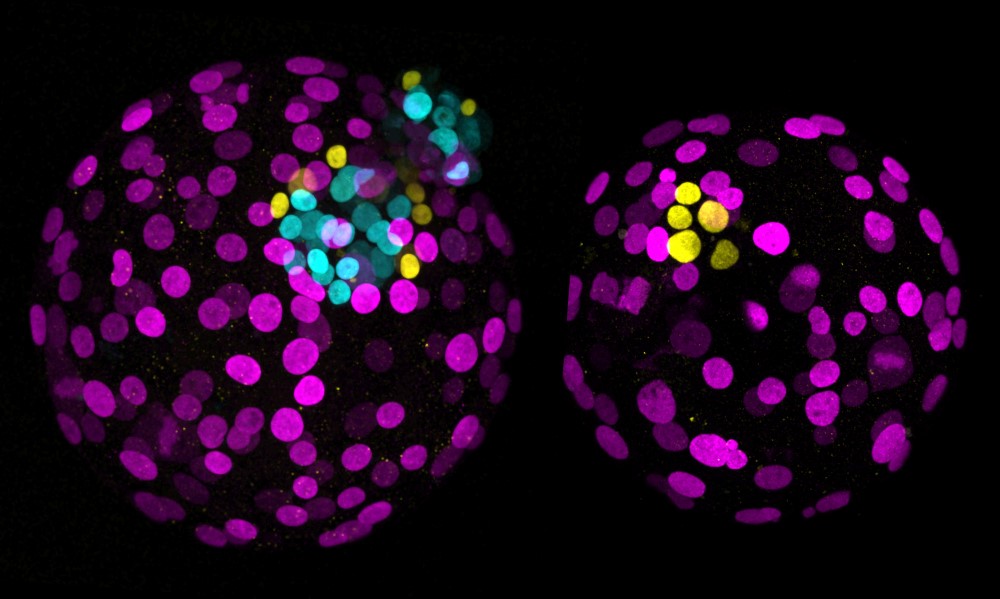
Day 6 human embryos showing the effect of NANOG presence versus absence. Credit: Katarina Harasimov, Oliver Bower and Kathy Niakan, Loke Centre for Trophoblast Research, University of Cambridge.
Lluis Montoliu - NANOG
Lluís Montoliu
Research professor at the National Biotechnology Centre (CNB-CSIC) and at the CIBERER-ISCIII
In 2015, just two years after the world learned of the enormous potential of CRISPR-Cas9 gene-editing tools, a team of Chinese researchers published the first paper demonstrating that it was possible to edit human embryos using these tools, just as we had been doing with mouse embryos. That first paper drew a great deal of criticism, especially from those who believed that a single-celled human embryo—a zygote—is already a person and possesses the identity of a person. The researchers anticipated this criticism by using triplonuclear embryos (with three nuclei), which result from the abnormal fertilization of an egg by two sperm. This is something that commonly occurs when applying in vitro fertilization techniques.
These three-nucleated embryos cannot continue developing beyond a few cell divisions; they eventually degenerate and die, and are therefore routinely discarded. These were the embryos used by the researchers. In doing so, they were conveying the idea that they had no interest in implanting the edited human embryos (if they had done so, no child would ever have been born from them) and could explain that they were only interested in determining whether CRISPR-Cas9 tools could be successfully used on preimplantation human embryos—which they did confirm.
In Europe, it took researchers two years to conduct a similar experiment. It was carried out by a researcher named Kathy Niakan, then at the Francis Crick Institute in London, who went a step further and decided to use CRISPR to investigate the possible differences between human and mouse embryos in the preimplantation stage—that is, before implantation in the uterus.
Much of what we know about early human embryology comes from studies conducted on mouse embryos. Naturally, these experiments were based on the assumption that these two mammalian species would have similar, equivalent genetic and cellular development. But Kathy Niakan suspected that this was not entirely true. She decided to apply to the UK’s Human Fertilization and Embryology Authority (HFEA) for permission to use surplus human embryos from in vitro fertilization procedures to inactivate, using CRISPR, the same gene (POU5F1, which encodes the OCT4 transcription factor) in both mouse and human embryos simultaneously, to analyze whether the consequences were comparable. And they were not. In 2017, when he published the study’s results in the journal Nature, he demonstrated that inactivating OCT4 in human embryos blocked embryonic development, preventing them from reaching the blastocyst stage. In contrast, inactivation of the same gene (Pou5f1) in mice did not appear to affect the early development of mouse embryos, which successfully reached the blastocyst stage without any problems, apparently without needing Oct4.
Niakan’s work demonstrated to us, beyond a shadow of a doubt, that we could not use mouse embryos to understand the early stages of human embryonic development prior to implantation, because they were significantly different.
From that work, it could be inferred that we had to continue researching human embryos—not mouse embryos—if we wanted to understand the embryology of the initial stages in humans.
Nine years after that milestone, Kathy Niakan’s own laboratory—now leading the Loke Centre for Trophoblast Research at the University of Cambridge—in collaboration with other researchers and institutions, has used second-generation CRISPR tools, base editors (designed by David R. Liu of the BROAD Institute in 2016, which are more specific and carry a lower risk of unexpected modifications elsewhere in the genome), to inactivate another early-expressed gene: NANOG.
The research results are published in the journal Nature this week. Once again, the study was conducted on surplus human embryos derived from in vitro fertilization and on mouse embryos. And, once again, the results were surprising. Inactivation of the NANOG gene in human embryos directly affects the epiblast (the inner cell mass)—the cluster of pluripotent cells from which all cell types and tissues of the developing fetus will derive— but apparently leaves intact the tissues that will form the placenta and the yolk sac, derived from the trophoblasts (the cells surrounding the blastocyst). In contrast, inactivation of the homologous Nanog gene in mouse embryos disrupts both the epiblast and the trophoblasts that will give rise to the placenta and the yolk sac. This provides new evidence from the same researcher, Kathy Niakan, that the early stages of human and mouse embryo development are not equivalent. It also confirms that the NANOG gene is essential for the development and differentiation of the embryo’s pluripotent cells.
It is also further confirmation that we must continue researching human embryos—surplus to in vitro fertilization processes—with the necessary permits from the authorities, precisely to understand the early stages of human embryo development. This could provide new insights to improve the implantation rate of human embryos and increase the likelihood of a successful pregnancy—one of the most delicate stages of assisted reproductive technologies, where many human embryos still fail to implant and, unfortunately, do not reach full term, forcing women or couples to begin a new cycle of in vitro fertilization. This is the potential impact of this new research by researcher Kathy Niakan.
This is the second paper to use base editors in human embryos, following the one deposited on the bioRxiv preprint server—which has not yet been published but was nonetheless discussed in the journal Nature a few weeks ago. In that study, American researchers, led by Dieter Egli, demonstrated how these base editors could be used to mutate various genes for therapeutic purposes with high efficiency and with virtually no associated problems in other parts of the genome.
Both papers demonstrate that it is now possible to genetically edit human embryos safely and effectively using base editors, unlike first-generation CRISPR-Cas9 tools, whose use in human embryos (as well as in mice or any other species) is associated with multiple unpredictable alterations in the genome. This is something we unfortunately witnessed following He Jiankui’s ill-fated experiment in 2018, which resulted in the birth of the first three girls with edited genomes but with unforeseen genetic modifications—compelling the Chinese government to medically monitor these girls in anticipation of potential pathologies that might arise.
260625_Robin Lovell-Badge_NANOG
Robin Lovell-Badge
FRS FMedSci, Group Leader, Francis Crick Institute
We sometimes like there to be a sense of mystery, but little can be done to solve problems without knowledge; moreover, knowing how something works does not detract from wonderment, it adds to it. Given all the things that can go wrong between having a fertilised egg and a healthy baby (and happy parents), such that this path fails in about 70% of cases, the more understanding we have of the early steps of human embryo development, the better chance we have of reducing distress, disappointment and sometimes debilitating disorders.
The work from Oliver Bower and others associated with Kathy Niakan’s lab is an important example of both how the research should be done as well as uncovering new knowledge about the first week or so of our beginnings. They focussed on a gene called NANOG, known from studies carried out in mice to play an important role in both the early epiblast, a group of cells that will go on to form the embryo proper, and the yolk sac, which is one of the extraembryonic tissues that, along with the placenta, supports the former. The most direct way to study the role of a specific gene is to inactivate it, and methods based on the use of CRISPR/Cas9 provide a direct and efficient way to do this. However, standard CRISPR methods that create double strand breaks in DNA rely on cellular mechanisms of DNA repair that all too frequently lead to chromosome damage, as shown previously by the Niakan lab and others. This can make it both challenging to draw firm conclusions and wasteful of valuable human embryos. The authors therefore chose to use base editing, a precise method to alter single nucleotides (‘letters’ in the code). [N.B. this is not the first attempt, but it was carried out with a high degree of rigour and with statistically valid results.] Bower et al show that the methods are both precise and efficient in the context of human embryos.
Furthermore, by introducing the base editing components along with the sperm during IVF (by intracytoplasmic sperm injection), they also largely avoid mosaicism, where the editing occurs after the first cell division such that only a proportion of cells carry the edit, which can also complicate interpretation of results. With respect to NANOG function, they find that it is required for the epiblast, and it is therefore also essential for human embryo development at an early stage, but that it is dispensable for the development of the extraembryonic endoderm that gives rise to the yolk sac. This adds to the evidence that the genes and mechanisms operating during early mouse and human embryo development can be substantially distinct, making it inappropriate to rely too much on results obtained with the former to understand the latter.
Although focussed on the role of NANOG in the early embryo, the work does relate to the notion of heritable genome editing, specifically by showing that base editing is very efficient, precise (with rigorous choice of guide RNAs), and can be used in a way that reduces concerns about mosaicism. These are all parameters that need to be close to perfect if the methods were to ever be used to create edited babies. They are not there yet, and even if they were, this should not be attempted without appropriately robust review, oversight, and knowledge of the extent of public acceptance and qualifications, and it would have to be legal, which it is not in most jurisdictions.
Conflict of interest: “Kathy Niakan and I are were colleagues at the Francis Crick Institute, where Oliver Bower began his PhD studies. I was a member of his PhD thesis committee and will have provided advice throughout at least the earlier stages of his project."
260625_Dusko Ilic_NANOG
Dusko Ilic
Professor of Stem Cell Science, King's College London (KCL)
This is an elegant and technically ambitious study that addresses a fundamental question in human developmental biology: how the cells that will ultimately form the foetus are established in the early embryo. The findings are important, but they should not be overinterpreted.
The work also shows the potential of base editing as a research tool, but it does not demonstrate that embryo editing is safe for clinical use. Likewise, any relevance to infertility, implantation failure or pregnancy loss remains prospective. The immediate value of the study is mechanistic, not clinical.
260625_Norah Fogarty_NANOG
Norah Fogarty
UKRI Future Leader Fellow and Lecturer, Centre for Gene Therapy & Regenerative Medicine, King's College London
This is a well-designed and thorough investigation into the use of base editing as a research tool in human embryos. Kathy Niakan and her team draw on their long-standing expertise in human embryonic stem cells and mouse embryology to robustly “quality control” the base editing machinery and assess its specificity and ability to knock out NANOG’s function. The team used a combination of the gold standard methods to get the most information out of each embryo used in the project in their assessment of the role of NANOG in embryo development. The edited embryos were compared with previously published datasets of unedited control embryos to increase the sample size, giving further confidence in the results. There have been a few studies already looking at the use of base editing in human embryos. However these studies were limited in that they largely used tripronuclear embryos which are developmentally and chromosomally abnormal. In contrast, this study uses embryos that are surplus to clinical requirements, or generated from donor gametes, but are otherwise developmentally normal.
In the near-term, this study elegantly demonstrates that base editing is a tool for human embryo research, allowing us to specifically investigate the role of genes involved in development. Human reproduction is highly inefficient: for reasons that remain incompletely understood: out of 100 fertilised eggs, around 50 fail to reach the blastocyst stage, and of those, a further proportion fail to implant. With advances in genomics technologies like single cell RNA- and genome-sequencing (as used in this paper), alongside emerging in vitro models of early development and implantation (within the legal limit of 14 days post-fertilisation) researchers have unprecedented opportunities to investigate the mechanisms governing early human development. Such discovery research has the potential to inform future clinical advances.
The authors are clear that more research is needed before base editing could be used in a clinical setting. They also emphasise that, even if clinical translation becomes feasible, there are important ethical and regulatory considerations, and that public engagement and support will be essential. In the future, genome editing may offer an option for patients to prevent passing on genetic disorders, especially in cases where it is not possible to produce healthy embryos for preimplantation genetic testing.
Overall, this paper reinforces the UK’s position as a global leader for technically and ethically rigorous discovery research using genome editing to understand the earliest stages of human embryo development.
Conflict of interest: Norah Fogarty was a postdoctoral fellow in the lab of Kathy Niakan and is the first author of the paper Fogarty, N., McCarthy, A., Snijders, K. et al. Genome editing reveals a role for OCT4 in human embryogenesis. Nature 550, 67–73 (2017). https://doi.org/10.1038/nature24033
Bower, O.J. et al.
- Research article
- Peer reviewed