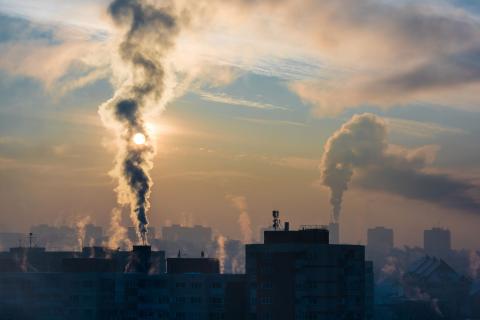
Global temperatures are close to exceeding a 1.5 °C rise, but this is still reversible, according to a UN report
Various models estimate that global temperatures will rise by more than 1.5 °C above pre-industrial levels in the coming years, which will increase the vulnerability of societies and economies to climate change. A new report by the United Nations Environment Programme (UNEP) states that it is still possible to reduce temperatures and meet the targets of the Paris Agreement. The report identifies a trajectory of overshoot, peak and decline as the best option. The key would be to minimise the magnitude and duration of this overshoot and to try to return to below 1.5 °C as soon as possible.
Ernesto Rodríguez - reacción 1,5 C
Ernesto Rodríguez Camino
Senior State Meteorologist and president of Spanish Meteorological Association
We are approaching an observed increase in the global average temperature of 1.5 °C compared with the pre-industrial period, as set out in the Paris Agreement as a policy objective — not to exceed that 1.5 °C rise in temperature — in order to avoid the undesirable consequences of current climate change. According to estimates by the World Meteorological Organisation (WMO), this 1.5 °C rise in temperature could be reached as early as this decade. Once this limit has been exceeded (overshooting), in order to continue to meet the 1.5 °C warming target, a strategy would need to be devised that asymptotically converges towards this limit above the trajectory curve, rather than below it as was initially envisaged. This strategy must be based on rapid, collective and global action to reverse the trend in global temperature and achieve the 1.5 °C target by the end of the 21st century.
The current report, based on the IPCC’s findings, paints a picture that remains possible and hopeful, provided that the overshoot of the 1.5 °C limit does not exceed a few tenths of a degree (0.2–0.3 °C) and is limited in duration. To reverse the temperature trend, the ultimate goal of net-zero greenhouse gas (GHG) emissions would need to be revised and regarded as an intermediate target on the path to net-negative emissions, leading to the removal of GHGs from the atmosphere. This will only be achieved through the large-scale implementation of methods for removing or eliminating atmospheric CO2, whether based on reforestation, afforestation (planting trees in areas where there has historically been a forest), ecosystem restoration, or on unconventional techniques such as, for example, bioenergy production combined with carbon capture and storage. Of course, the large-scale removal of atmospheric CO2 is in addition to urgent mitigation – which involves phasing out the use of fossil fuels and replacing them with renewable energy sources – and to adaptation, which is particularly necessary in regions and communities where the negative effects of climate change are already being felt.
In short, it is not so much a question of changing the long-term target of 1.5 °C warming compared with pre-industrial levels, but rather of approaching it asymptotically from above the global temperature trend curve through ambitious policies for urgent mitigation and the large-scale deployment of a mix of techniques for removing atmospheric CO2. The use of techniques to remove atmospheric CO2 must never be seen as a substitute for the urgent reduction of GHG emissions, but rather as supplementary to this reduction; otherwise, it would amount to passing the problem on to future generations.
260902_Raffaele Bernardello_informe ONU temperatura
Raffaele Bernardello
Established Researcher, Climate Variability and Change Group, Barcelona Supercomputing Center
This report explicitly acknowledges the inevitability of crossing the 1.5 C warming limit, set by the Paris agreement, within the next few years. At the same time, the report stresses how the duration and intensity of a so-called overshoot period must be limited to reduce risks of harm to humans, ecosystems, infrastructure and economies. Every fraction of a degree and every year above 1.5 C matters and both should be minimized. The report delineates three interconnected phases that should drive an overshoot peak and decline pathway. These are immediate response, coping and containment, and long-term resilience and they would coexist across regions and timescales. The report stresses the urgency of planning mitigation and adaptation as interconnected dimensions of the same problem rather than sequential stages.
The report sounds once again the alarm about the urgency of rapid action to reduce the most severe impacts of climate change and it provides a detailed account of what is required and what are the potential consequences of further delaying global coordinated action.
UN Environmental Programme